Description
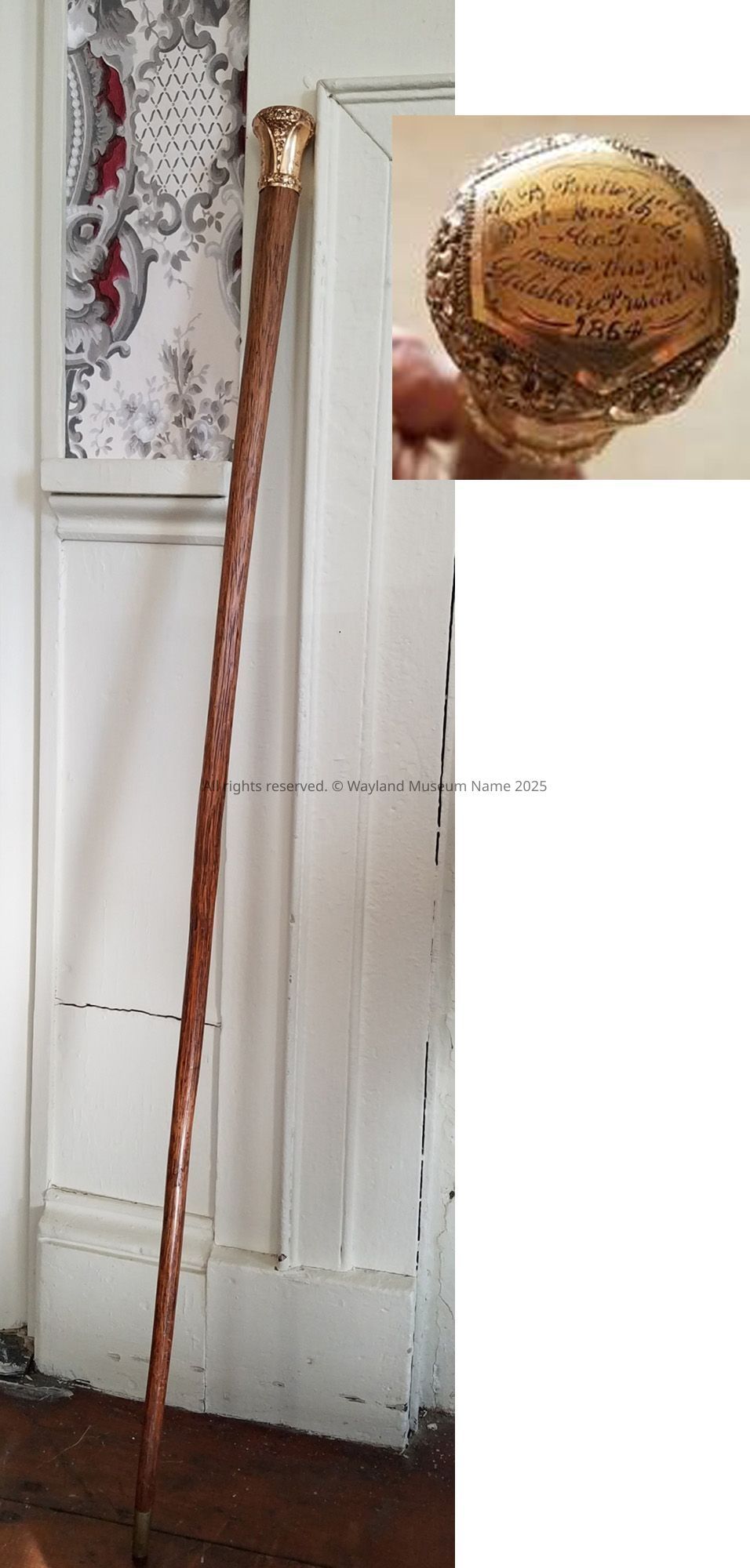
Charles Butterfield cane; made by him with a caseknife while a prisoner for 9 months in the Salisbury, NC, Prison in 1864. Gold handle made by jeweler, Washington Street, Boston (No charge).
Size: 36 1/4" tall; cane head 1 5/8" diam. x 2" tall
Material: oak, gold head cap (real gold?)
Inscription: "C.B Butterfield 39th Mass. Vols. Co.G.- made this in Salisbury Prison1864"Context
Charles Butterfield of Cochituate created this object during his nine-month imprisonment in 1864.
Military Service: Butterfield enlisted in the Union Army alongside his father and older brother, leaving nine younger siblings at home. He fought in 23 battles including Mine Run, Spottsylvania, Bethesda Church, Petersburg, Marshall House, and Weldon Station, Virginia, where he was captured by Confederate forces.
Imprisonment: Butterfield endured brutal conditions in three Confederate prisons: Libby, Belle Isle, and Salisbury. At Libby Prison, he had no shelter and received barely any rations—on several occasions, a single animal's eye was all he was given to eat. At Salisbury Prison, he was among 4,000 prisoners, 3,000 of whom had no shelter. Men dug holes in the frozen ground with their bare hands for protection from the cold. Daily rations consisted of half a pound of bread per person, with a small piece of meat or rice soup only every three to four weeks. These starvation conditions caused daily deaths among the prisoners.
Post-War Life: After the war, Butterfield returned to Cochituate where he operated a boarding house and worked as a shoemaker. He enjoyed racing horses on the ice at Dudley Pond. His family's house at 14 Pemberton Road still stands today.Collection
Charles Butterfield CollectionCataloged By
Goeselt, Jo