Martha, Ernestine, Edgar, Charles, and Cecil: records of a family enslaved in New Orleans, 1843–1850
Overview
Description
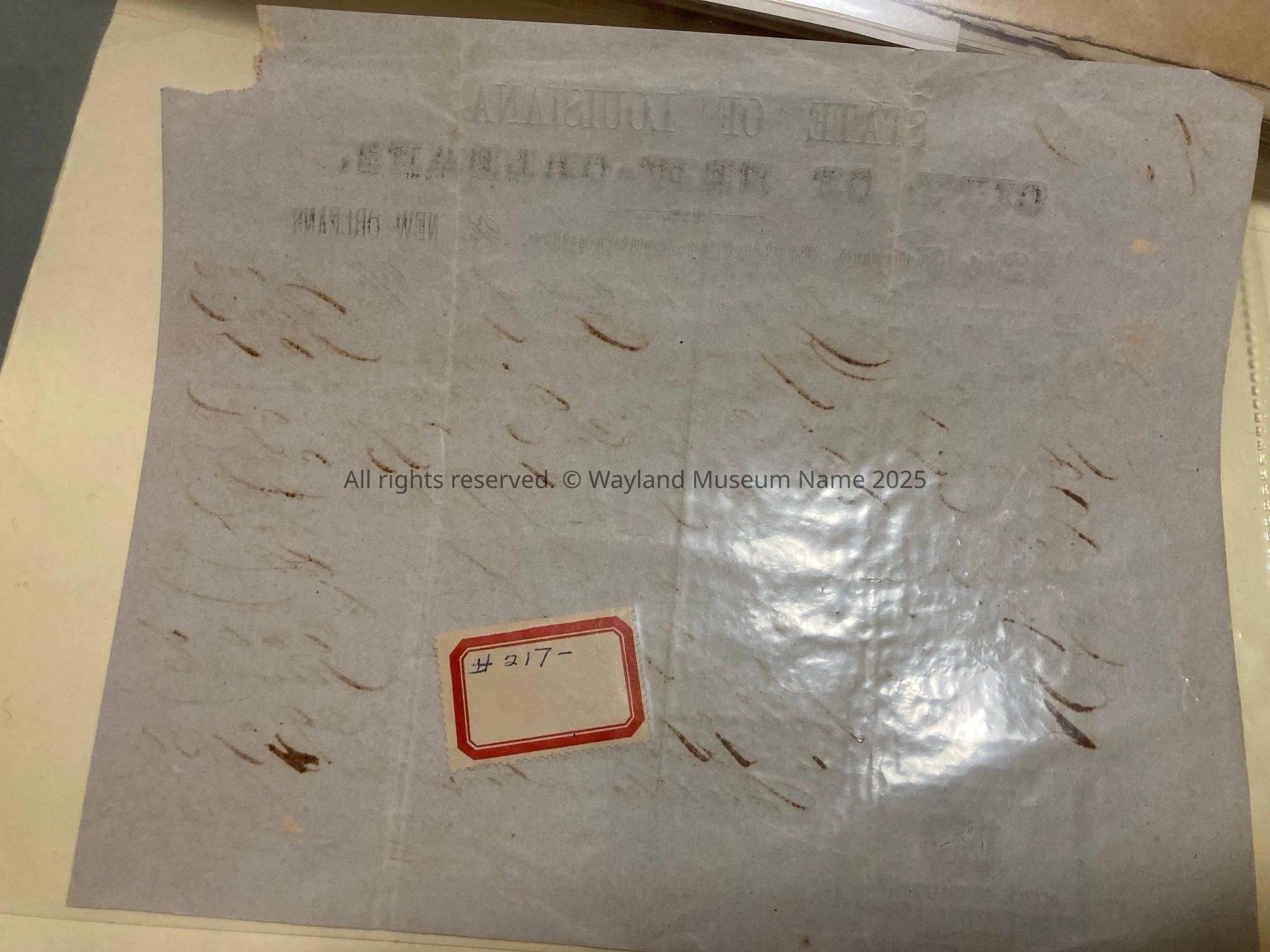
These papers record a mother and her four children: Martha, about 26 years old in 1850, and her children Ernestine, age 8; Edgar, 6; Charles, 4; and Cecil, 2. They lived in New Orleans, where the law treated them as property. Their names and ages survive because they were written into legal documents used to buy, sell, and borrow against them. The papers trace at least seven years of Martha’s life. In February 1843 she was sold by William Guesnard to Benjamin Franklin Lewis. Lewis then mortgaged her at least four times, in 1843, 1845, 1846, and 1850. Ernestine, Edgar, Charles, and Cecil were born during those years. On December 5, 1850, Lewis used Martha and all four children to secure a $900 loan from Bertrand Saloy. If he did not repay it within six months, the family would become Saloy’s permanently. The papers do not say what happened when that deadline came in June 1851. The records do not tell us who the children’s father was, where the family lived or worked, or how Martha and her children understood their own lives. Those silences are part of what these documents show. Research to recover more of the family’s story is ongoing. The group contains four items: Notarial act, December 5, 1850. Act no. 312 before Antoine Doriocourt, notary, New Orleans. It records Martha and her four children by name and age, and lists the earlier mortgages on Martha. The Register of Conveyances recorded it in Book 53, folio 364 [confirm]. Several folded sheets, brown ink. Certificate of the Register of Conveyances, December 4, 1850. A printed form filled in by hand. It confirms that Martha and her children had not been transferred to anyone else, and was prepared for the 1850 act. One sheet of blue-gray paper with loss at the upper right corner. The verso bears a red-bordered label, “#217.” Handwritten note. On tan paper, reading “1850 Slave Sale.” It lists Martha and her four children by name and age, with $900. It is a later summary by an unknown hand. Envelope, 1929. Mailed from Memphis to Frank K. Hahn in Cambridge, Mass. (see Collection).Context
Before 1843, Martha was enslaved in the household of Dr. William Guesnard and his wife, Jeanne-Louise Emma De Larsille. Mary, a young woman enslaved by the same couple, later sued for her freedom after being taken to France (Couvent v. Guesnard, 1848; La. Supreme Court 1850). Martha and Mary may have known each other, but no record confirms it. Source: Alexandra Havrylyshyn, “Free for a Moment in France” (Ph.D. diss., UC Berkeley, 2018). The original acts are held by the New Orleans Notarial Archives. Later records may show what happened to Martha and her children after June 1851. Sources include the 1870 census and Freedmen’s Bureau records, which could show the family by name after emancipation. The documents call Martha a “mulatress slave.” This record uses “enslaved” to recognize Martha and her children as people, not property. The documents’ own wording is quoted for accuracy.Use
Every document here was created to treat Martha and her children as property: to prove title, to secure debt, or to summarize a sale. Martha’s record of transactions, as listed in the 1850 act:
February 25, 1843: sold by William Guesnard to B. F. Lewis, with a mortgage of $800 (Jules Mossy, notary, act no. 26)
July 3, 1845: mortgaged for $175 (Adolphe Mazureau, act no. 95)
October 18, 1845: mortgaged for $175 (Mazureau, act no. 119)
February 10, 1846: mortgaged (Mazureau, act no. 21)
September 28, 1850: mortgaged for $410 (Antoine Doriocourt)
December 5, 1850: Martha and her four children pledged for $900 (Doriocourt, act no. 312)