Note
Notes: Sarah married John Heard in Boston in 1851 and upon the death of his parents appears to have brought their two girls, Grace & Blanche, to live in Wayland. When the new Town Hall was constructed on this site in 1878 she had to move the house to Old Sudbury Road. John was a daguerreotypist and photographer who traveled a great deal, to Europe, the South, & to Argentina, for several years at a time. He died in 1878. Sarah became librarian in 1885 for sixteen years. She died in 1902.
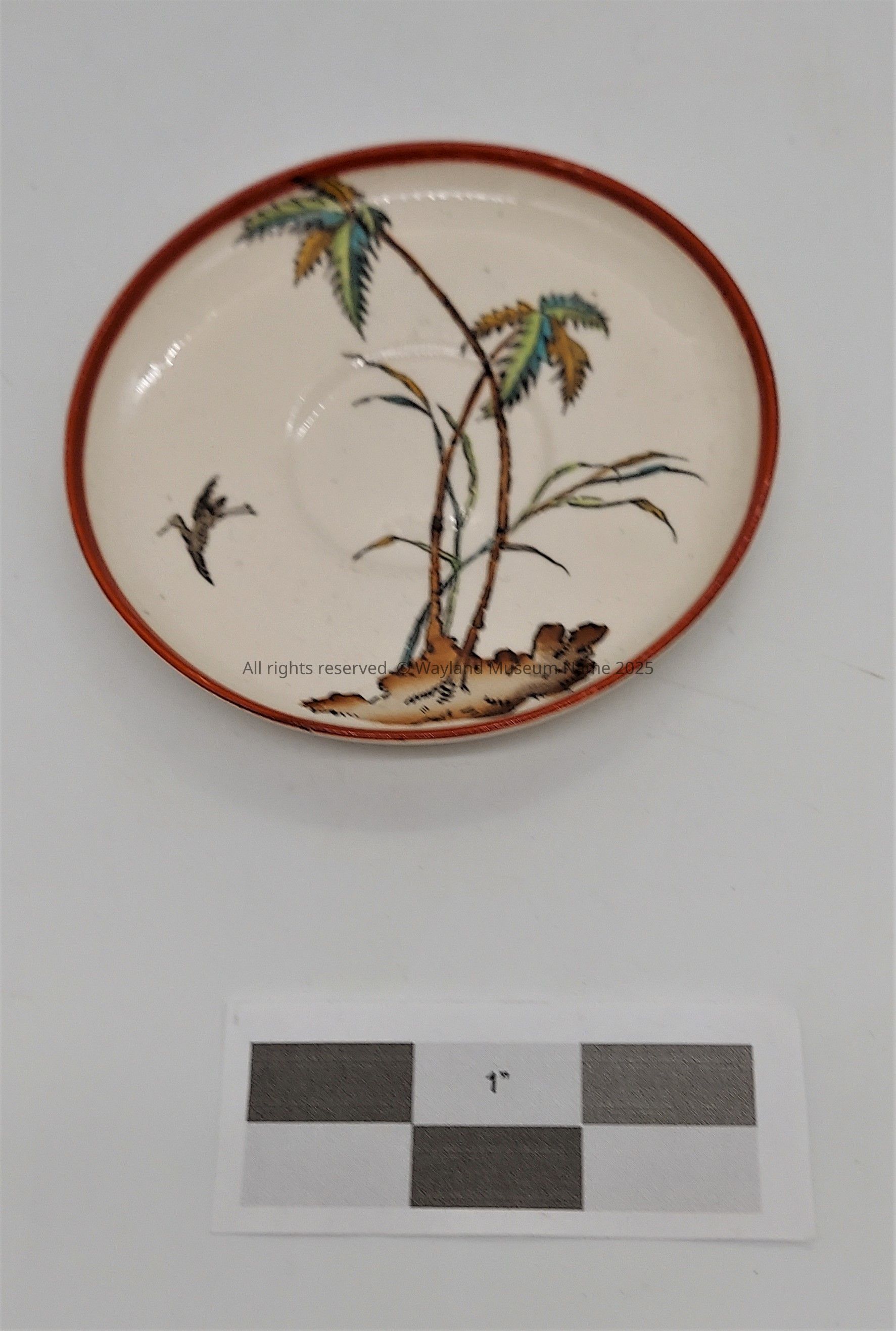
Polychrome is created by layering multiple materials - paint, gesso, varish, or even metallic guilding - atop a foundation for an attractive laminated effect.
Josiah Spode apprenticed as a potter in the mid 1700's. In 1754 he started work for William Banks in Stoke-on-Trent in Staffordshire, England. Later he began his own firm making cream colored earthenware and whiteware with blueprints. Spode blue & white transfer printed wares were generally considered to be among the finest ever made. Porcelain was introduced about 1800 in the factory of Josiah Spode and Josiah II. Their "hybrid porcelain" combined ingredients of hard-paste (china clay & china stone) porcelain and bone ash. (Cow bone ash creates unique shades of colour and hues.) This became the standard for English "bone china". By 1842, S pode, along with Coalport, Wedgewood, Worcester, and others were making this special product. Till 1833 the company was managed by a son and other managers. At that time the company was acquired by William Taylor Copeland & Thomas Garrett but continued to use the name Spode in their marks or Copeland & Garrett till 1847. In 1867 Copeland became sole owner. Copeland has appeared on pieces from 1847 til 1970. The Spode China Company official trade name was changed to WTCopeland and Sons, reverting back to Spode in 1970. In 1976, a merger created Royal Worcester Spode. Made since 1772, Spode was rescued in 2008, and now is part of Portmeurion pottery group as of 2009.
Status: OK
Status By: Wolfson, Evelyn
Status Date: 2016-12-01