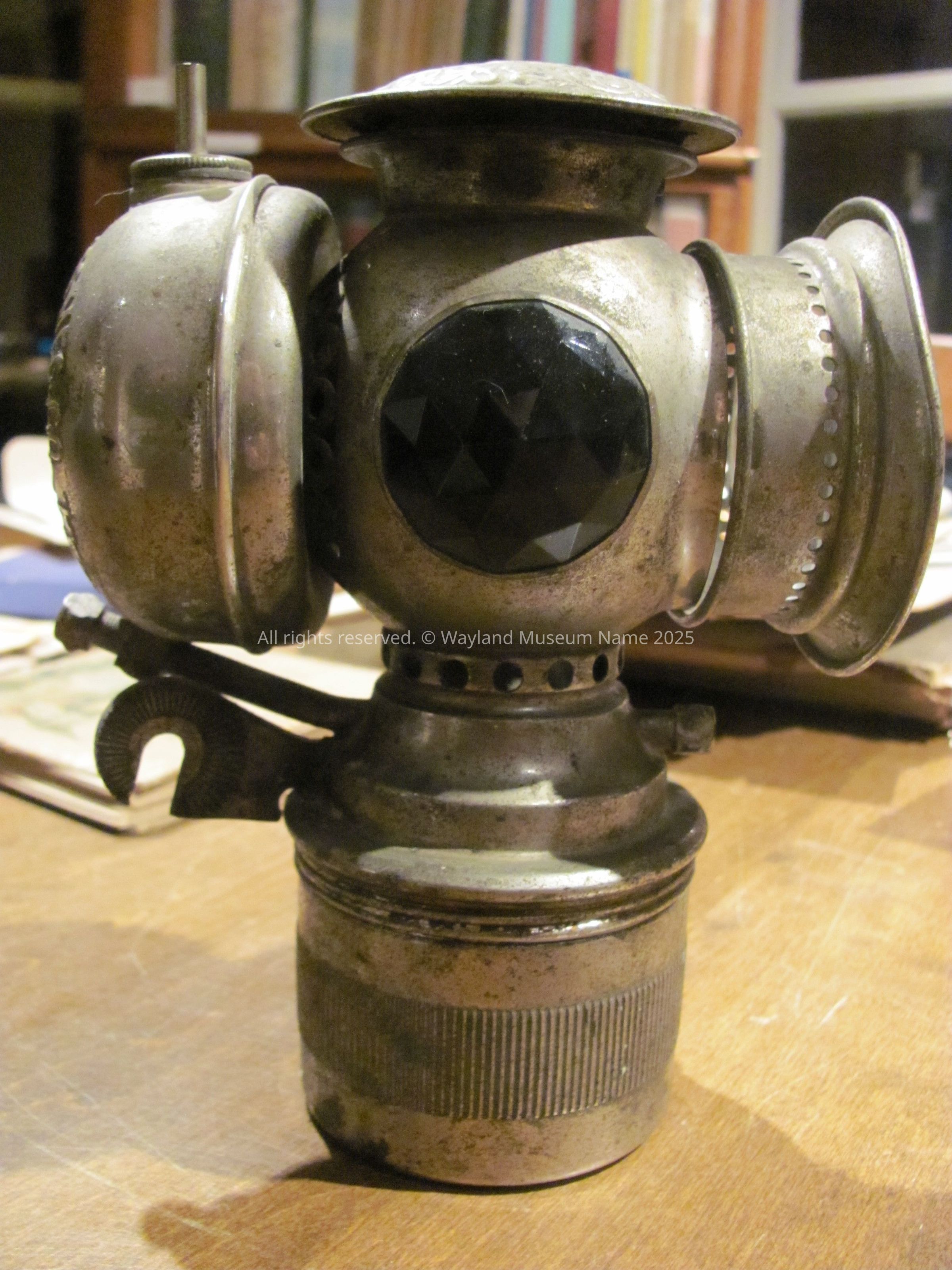
Lamp, Bicycle

Object/Artifact

Object ID: 2021.3.2

Wayland Museum

Lamp, Bicycle

Overview

Description

Badger Solar Carbide Bike Lamp: A cylindrical metal base narrows then widens to spherical center with a raised circular lid. Lid has embossed pattern and text reading, "Solar". Canister base screws into circular light mechanism. Side has glass lens with metal cone frame. Opposite side has flat circular container that has a rounded opening with a screw top. Below container is a circular metal ring to attach to bicycle. Spherical center has a green gem-like piece on one side and red gem-like piece on the other. Manufactured by the Badger Brass Manufacturing Company, Kenosha, Wisconsin.

Cataloged By

Gardner-Westcott, Kay

Acquisition

Accession

2021.3

Source or Donor

Russell, John W.

Acquisition Method

Gift

Made/Created

Manufacturer

Badger Brass Manufacturing Company, Kenosha, WI

Date made

1900 - 1930

Place

Location

Kenosha Wisconsin

Lexicon

Nomenclature 4.0

Nomenclature Tertiary Object Term

Lamp, Bicycle

Nomenclature Secondary Object Term

Lamp, Vehicle

Nomenclature Primary Object Term

Component, Vehicle

Nomenclature Sub-Class

Land Transportation Accessories

Nomenclature Class

Land Transportation T&E

Nomenclature Category

Category 07: Distribution & Transportation Objects

LOC Thesaurus for Graphic Materials

Transportation

Search Terms

Bicycle, Bike, Lamp, Bicycle lamp

Dimensions

Height

7-1/4 in

Width

5-1/4 in

Length

3-3/4 in

Materials

Brass

Condition

Overall Condition

Fair

Date Examined

Aug 31, 2021

Examined By

Gardner-Westcott, Kay

Notes

It is tarnisihing (its original sheen starts to haze up) a dull, misty appearance that will eventually thicken up until removing it to reveal the shiny surface underneath becomes almost impossible

Maintenance

Maintenance History

Date

Aug 31, 2021

Relationships

Related Person or Organization

Person or Organization

Russell, Samuel L.

Provenance

Notes

Found: 101 Pelham Island Road, Wayland, MA; Russell barn, property of Samuel L. Ru Last Owner: Samuel L. Russell or previous owner of the barn Owned by Samuel L. Russell or previous owner of the barn where it was found.

Exhibitions

The Home Team: Out Until Dark

General Notes

Note

Notes: "SOLAR" (Embossed on top lid); "THE BADGER BRASS MFG. CO. / KENOSHA, WIS. U.S.A." (Embossed on back container); "PAT IN US. FEB.4.1896. / JAN.31.1899. / FEB.7.1899. / " " ENGLAND / FEB.4.1896. / MAY12.1898. / " " CANADA / JUN.15.1899." "FRANCE/Feb.4, 1896/ Jan. 12, 1898" " BELGIUM Jan. 12, 1898" "AUSTRIA May 5, 1898" (Engraved on bottom). In 1897, the American Badger Brass Company, of Kenosha, WI, advertised the first practical acetylene gas bicycle lamp. Known as the "Solar", it was an invention of intricate design - to produce light, pieces of calcium carbide are spaced in the lower compartment of the lamp. The small tank at the back is filled with water and the flow is regulated by a key valve at the side of the lamp. When the water hits the carbide, acetylene gas is formed and is forced into the upper chamber burner producing a bright white flammable light. A reflector in the back, and a lens in front further enhanced the light. By controlling the amount of water dripping onto the calcium carbide, the brilliance of the flame could be adjusted. Faceted colored lenses on the sides of the lamp provided a warning to approaching vehicles from the right or left. To prevent the flame from going out when the cyclist hit a bump or pothole, a piece of wire was wrapped around the ceramic jets, which caused it to glow red-hot. If the flame disappeared, the hot wire would re-ignite the gas. Bicyclers needed to use caution when lighting one of these lamps, as fires were not uncommon. If the acetylene gas escaped its chamber while the lamp was lit, or if excessive pressure built up inside, a serious explosion could result. By the time the company was sold in 1917 to C. M. Hall Lamp Company, they had 200 employees and sales of near $1 million and an annual capacity of about 100,000 bicycle lamps. These lamps went out of fashion in the late 1930's when battery operated bicycle lights became practical. However, during WWII, when batteries became scarce, these old lamps were dusted off and again pressed into service. Status: OK Status By: Gardner-Westcott, Kay Status Date: 2021-08-31