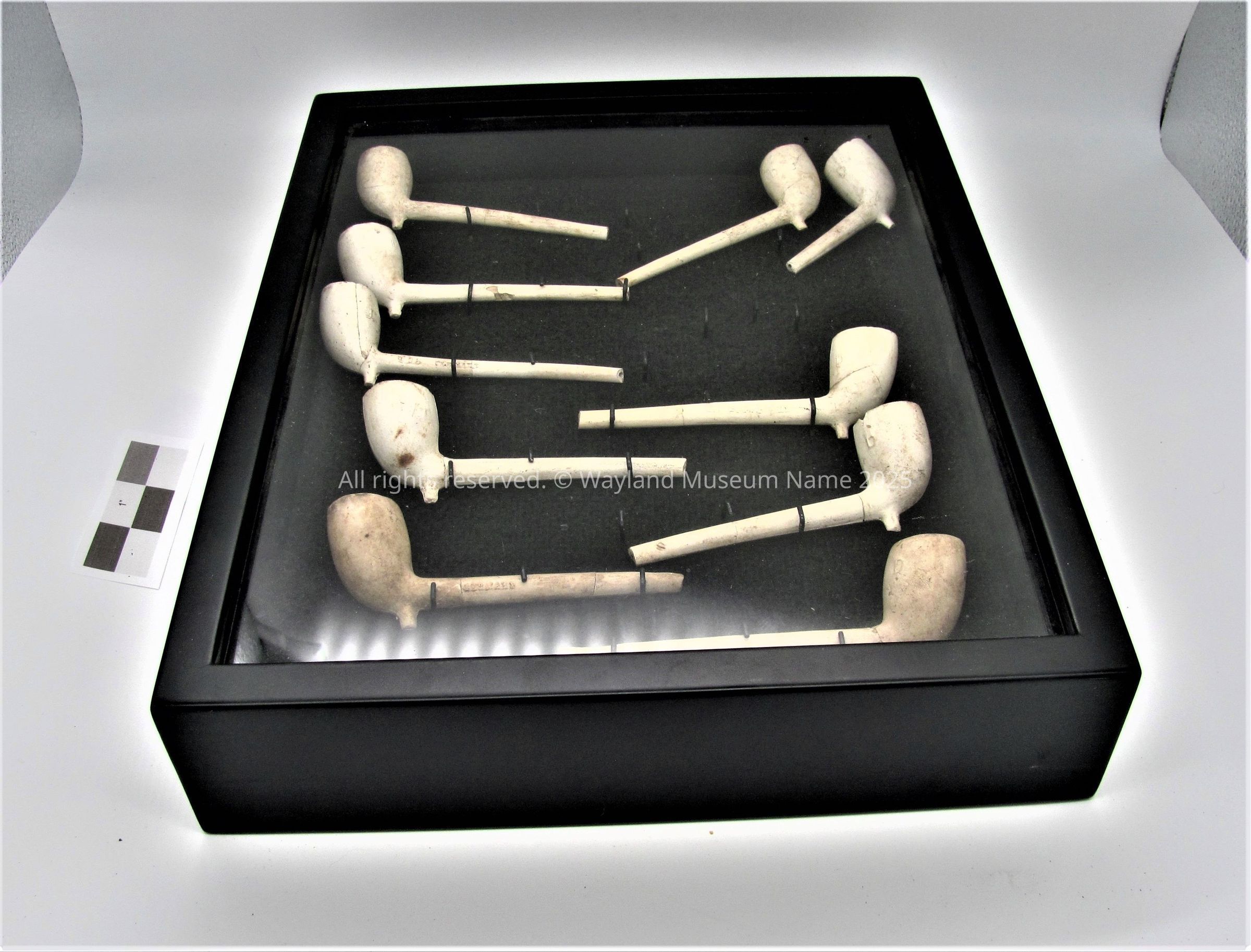
Description
Donor Judy St. Croix's explanation of how the pipes were discovered:
On Mother's Day 2001, my grandsons, Richard (10) and Stephen (7), were visiting, and like all other boys, love to play in the dirt and dig holes. They were exploring with a friend, Tommy (7), when they came across some white pieces of clay. They came running declaring that they had uncovered what they thought were "dinosaur bones." I placed all of the fragments into a bag and gave them to Paul Gardescu, Wayland Archaeology Group, for identification. To my surprise, they turned out to be pieces of English clay pipes. Thus began a four month archaeological "big dig" at my home, 164 W. Plain Road in Wayland (built in 1880), by Paul Gardescu and Royce Kahler. Extensive research has been done by Mr. Gardescu and Mr. Kahler into the history of the English tobacco clay pipe so that we could try to determine how old the pipes were, how long they may have been buried, and how they got to my home in the first place.
In order to find any clues that might exist in the soil around the find spot, the area was laid out in a grid and the soil removed by trowels and then screened to recover all fragments. Plans and sections were drawn of the soil to record the context of material. Along with the pipe fragments, there was a grand mixture of broken glass, a rusted nail, coal, ashes, candy wrappers, asbestos, an asphalt shingle fragment, chicken bones, gnawed hickory nuts, and a 14 carat gold woman's bracelet. Also, a buried concrete footing for a yard light was identified as having been from the early 1980's. The light tied into the later field trash that was in the fill soil. It is probable that the trench dug to bury the footing ran into earlier trash in the hedge row. Why or how the pipes came to be in the soil remains a mystery. It is possible that they were at one time someone's collection and were tossed to "get rid of the nasty things."
Each piece excavated was carefully examined, identified and preserved. Pieces were matched, put together with pipe cleaners, and mounted, in an attempt to get a better image of each pipe.
ENGLISH TOBACCO CLAY PIPE
The Europeans, who adopted the custom of smoking from the Indians by the late 16th century, soon mass- produced tobacco pipes, using ball or pipe clay. In time, these became a favorite item of trade to the Indians as well. Examples marked T.D. (the initials of an otherwise unidentified maker) are among the trade pipes most commonly found at colonial sites.
Tobacco was introduced to England by explorers returning from the New World in the second half of the 15th century. A North American Indian concept, "Tobacco Drinking" as it was then known, quickly became popular, as did the demand for clay tobacco pipes. The first clay pipes were described as being more of a spoon shape. The early clay pipes have small bowls because the tobacco was very strong and very expensive. As years passed, the shape and size of the clay pipe changed so that it had more of a bowl-like shape to hold more tobacco and provide a longer "drinking" time. It was a pastime of not only men, but women and children, too. The size of the pipe bowl provided archaeologists with a good idea of the dates of their sites. By the time Jamestown was settled in 1607, smoking tobacco in clay pipes was a popular English pastime
The length of the stem had no bearing on the size of the bowl, but it did have a very considerable influence on the size of the hole that passed through it. This was made with a wire that was pushed down the solid stem while it was still supported in the mold. When the stem was short, a large hole could be made by using a thick wire. When the stems became longer and the wire had further to travel, a thick wire was more liable to stick through the side than a thin wire.
Many thanks to Paul Gardescu and Royce Kahler for all of their hard work. This has been a very interesting project and a great history lesson for my grandsons and their friend.
________
Clay smoking pipes (10): Group of clay smoking pipes found at 164 W. Plain St., Wayland MA.
NO. STEM HOLE DIA. BOWL MARKS STEM MARKS
1 4/64" - /D McDougall / Scotland
2 4/64" - /D McDougal / Scotland
3 4/64" T/D McDougal / ScoScotland
4 4/64" T/D McDo gal / lascota
5 5/64" [ /D T 78. White / Scotland
6 5/64" T/D - / Scotland
7 5/64" T/D - / -
8 6/64" T/D - / -
9 6/64" T/D Germany / -
10 6/64" (T)/D Germany / -Cataloged By
Gardner-Westcott, Kay