Village Green & Mellen Law Office
Name/Title
Village Green & Mellen Law OfficeEntry/Object ID
ph-50-428-nDescription
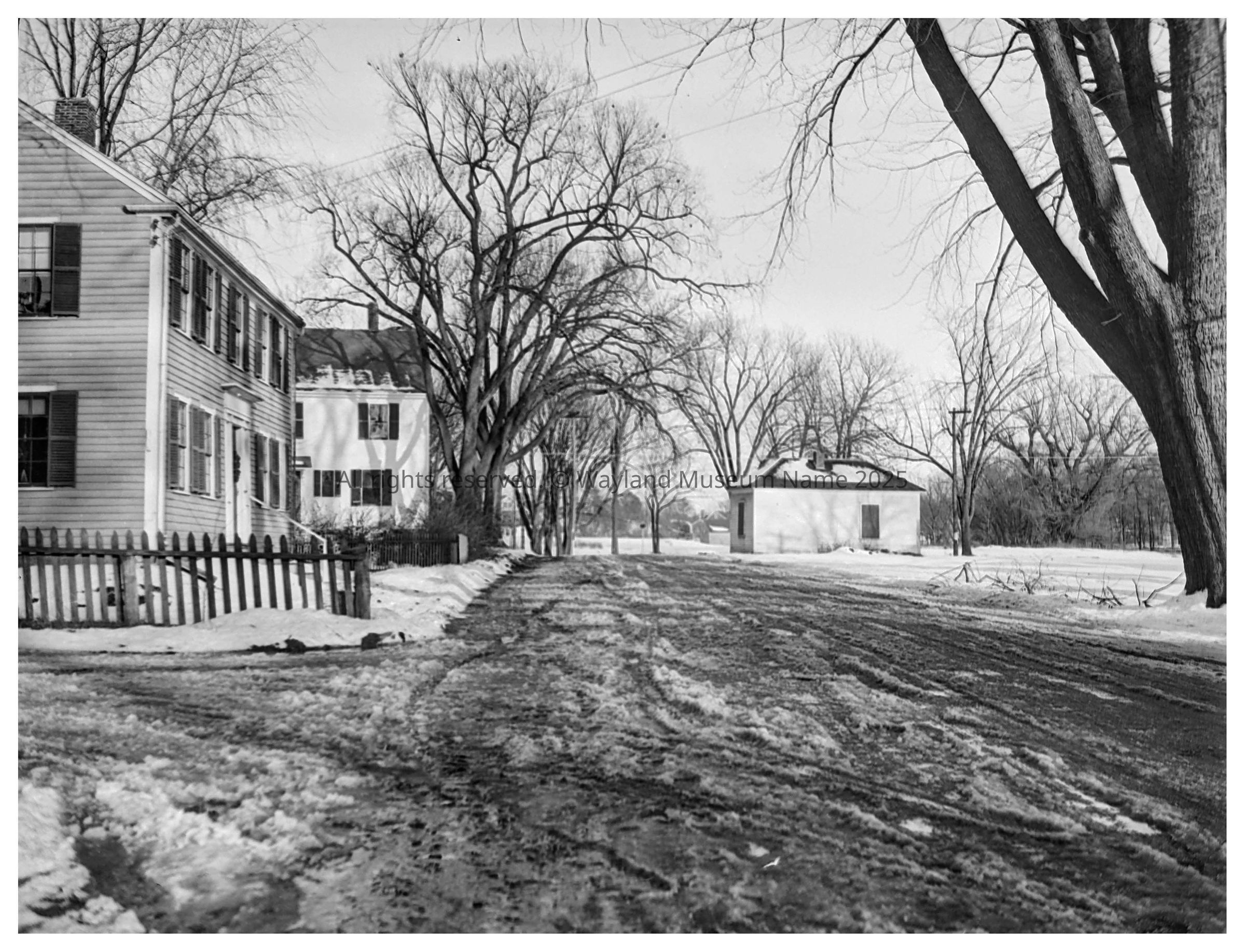
Village Green & Mellen Law Office Looking east along Pelham Island Road at the back side of the building. On the left is the Frost-Ward House and the back of the George Smith house. The so-called "Heater Place"--the grassy triangle where Routes 20, 126 and 27 nearly intersect--c. 1933. Folsom photographed the removal of some of the trees along the north side in 1933, and this view, with the Mellen Law Office now without apparent benefit of shade, seems to have been made shortly thereafter. Small triangles of land such as this one were referred to as "heater places." This is a typical early nineteenth century village law office, one of twenty-five still in New England and one of five of its type (with two rooms). Built in about 1829 by lawyer Samuel H. Mann Esq. The 1829 date was only a month before Mann’s marriage to Isabella Ross. It is believed that he built this small law office across the road from his house on this town green, now known as the Mellen Law Office Green. A year later in November 1830, Mann sold the house and this law office to Judge Edward Mellen (who moved to the house just after his marriage to Sophia Whitney in 1831) where he lived out the rest of his life. Mellen, who practiced law in Wayland in this law office, was appointed Chief Justice of the Massachusetts Court of Common Pleas in 1855. Mellen was a graduate of Brown University and a close friend of the Rev. Francis Wayland (1796-1865), who was president of Brown University from 1827 until 1855. Mellen’s widow Sophia Mellen retained ownership of the law office after her husband’s death in 1875. After Judge Mellen’s retirement, the office was used for a time by lawyer Somerby. When Sophia died in 1893, the law office passed to her daughter Anna Mellen Bennett. The Law Office was then passed to Anna Bennett’s daughter Sophie Bennett Sears wife of Edmund Sears. During World War II a newsletter to soldiers the Village Bugle was published here. A couple of businesses used the law office in the 1950s and 1960s. In 1971 Sears gave it to the town. It was the town that moved it only a few feet south in 1973 due to its proximity to an elm tree. The Historical Society used it for summer History Camp weeks. The Frost-Ward House, built by James Draper in 1838. First occupied by the Rev. Leonard P. Frost and who was active in Wayland as the headmaster of the Wayland Academy. The Ward family acquired it in 1843. It was occupied by the Ward family for about 100 years. It is currently an office building. To the far right, is the George Smith double house built in 1845. It was used as a store, dwelling, and sometimes as a post office for about fifty years.Collection
W. H. Folsom Shoebox CollectionCataloged By
Gardner-Westcott, KayCategory
Folsom Negatives