Letter pg 2 Jan 24, 1928 to Bartow Bull from Barton, Durstine & Osborn
Entry/Object ID
001222
Tags
Olaus Borneman Bull
Scope and Content
1/27/28
-1-
B&P
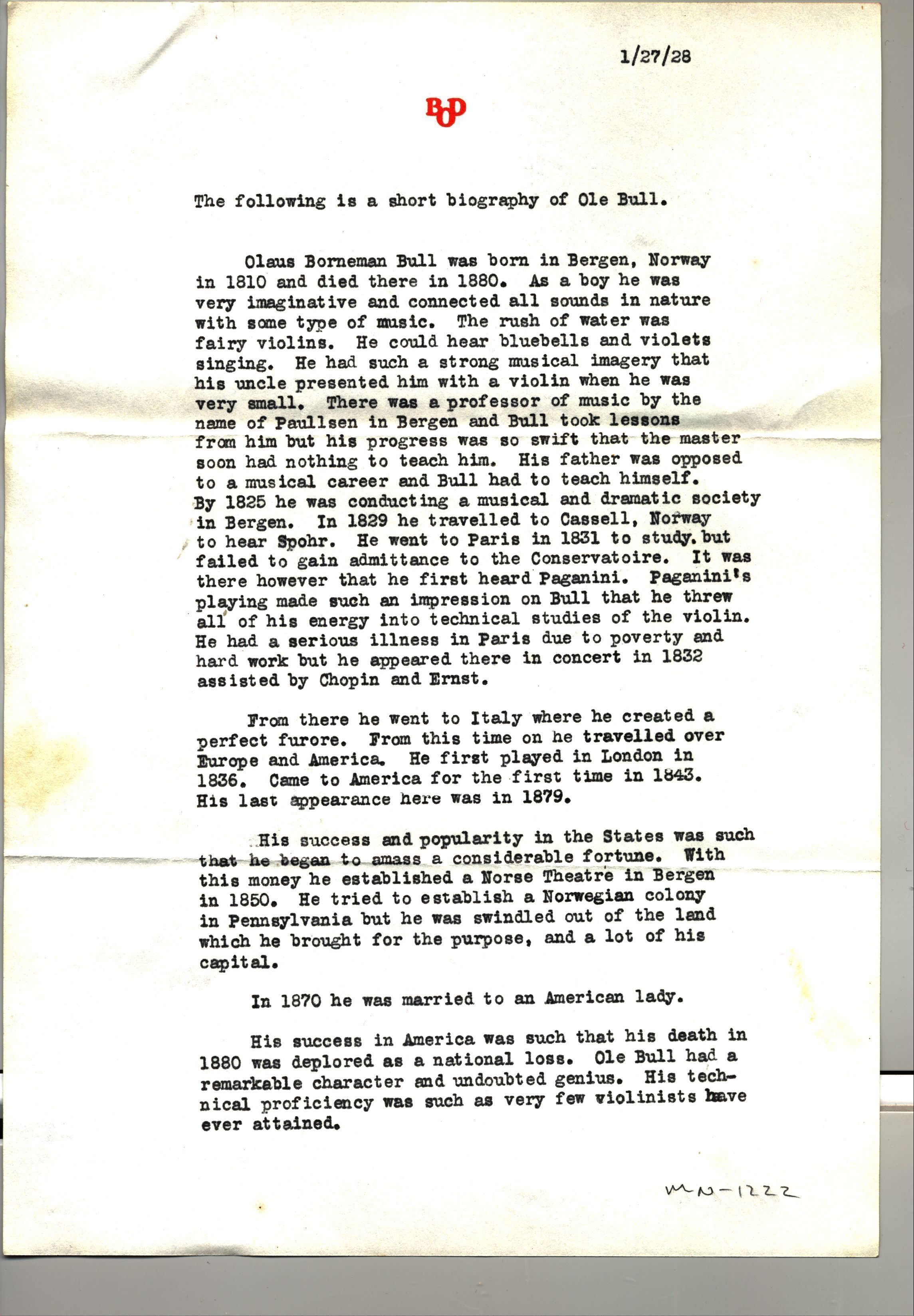
The following is a short biography of Ole Bull.
Olaus Borneman Bull was born in Bergen, Norway in 1810 and died there in 1880. As a boy he was very imaginative and connected all sounds in nature with some type of music. The rush of water was fairy violins. He could hear bluebells and violets singing. He had such a strong musical imagery that his uncle presented him with a violin when he was very small. There was a professor of music by the name of Paullsen in Bergen and Bull took lessons from him but his progress was so swift that the master soon had nothing to teach him. His father was opposed to a musical career and Bull had to teach himself. By 1825 he was conducting a musical and dramatic society in Bergen. In 1829 he travelled to Cassell, Norway to hear Spohr. He went to Paris in 1831 to study, but failed to gain admittance to the Conservatoire. It was there however that he first heard Paganini. Paganini's playing made such an impression on Bull that he threw all of his energy into technical studies of the violin. He had a serious illness in Paris due to poverty and hard work but he appeared there in concert in 1832 assisted by Chopin and Ernst.
From there he went to Italy where he created a perfect furore. From this time on he travelled over Europe and America. He first played in London in 1836. Came to America for the first time in 1843. His last appearance here was in 1879.
His success and popularity in the States was such that he began to amass a considerable fortune. With this money he established a Norse Theatre in Bergen in 1850. He tried to establish a Norwegian colony in Pennsylvania but he was swindled out of the land which he brought for the purpose, and a lot of his capital.
In 1870 he was married to an American lady.
His success in America was such that his death in 1880 was deplored as a national loss. Ole Bull had a remarkable character and undoubted genius. His technical proficiency was such as very few violinists have ever attained.
- 2 -
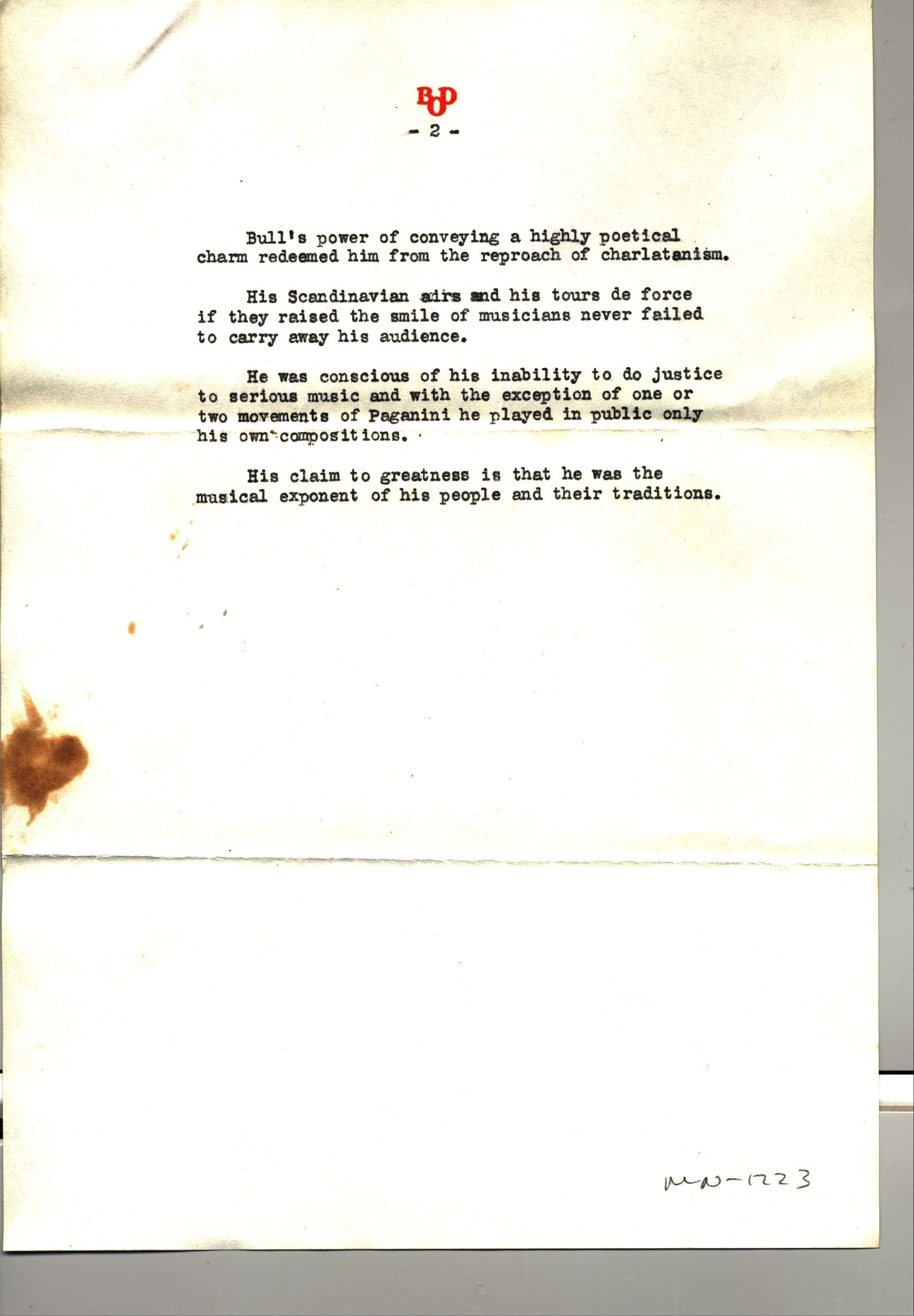
Bull's power of conveying a highly poetical charm redeemed him from the reproach of charlatanism.
His Scandinavian airs and his tours de force if they raised the smile of musicians never failed to carry away his audience.
He was conscious of his inability to do justice to serious music and with the exception of one or two movements of Paganini he played in public only his own compositions.
His claim to greatness is that he was the musical exponent of his people and their traditions.