Name/Title
Keturah Bull obituary May 1871Entry/Object ID
001377Tags
Keturah Bull, William BullScope and Content
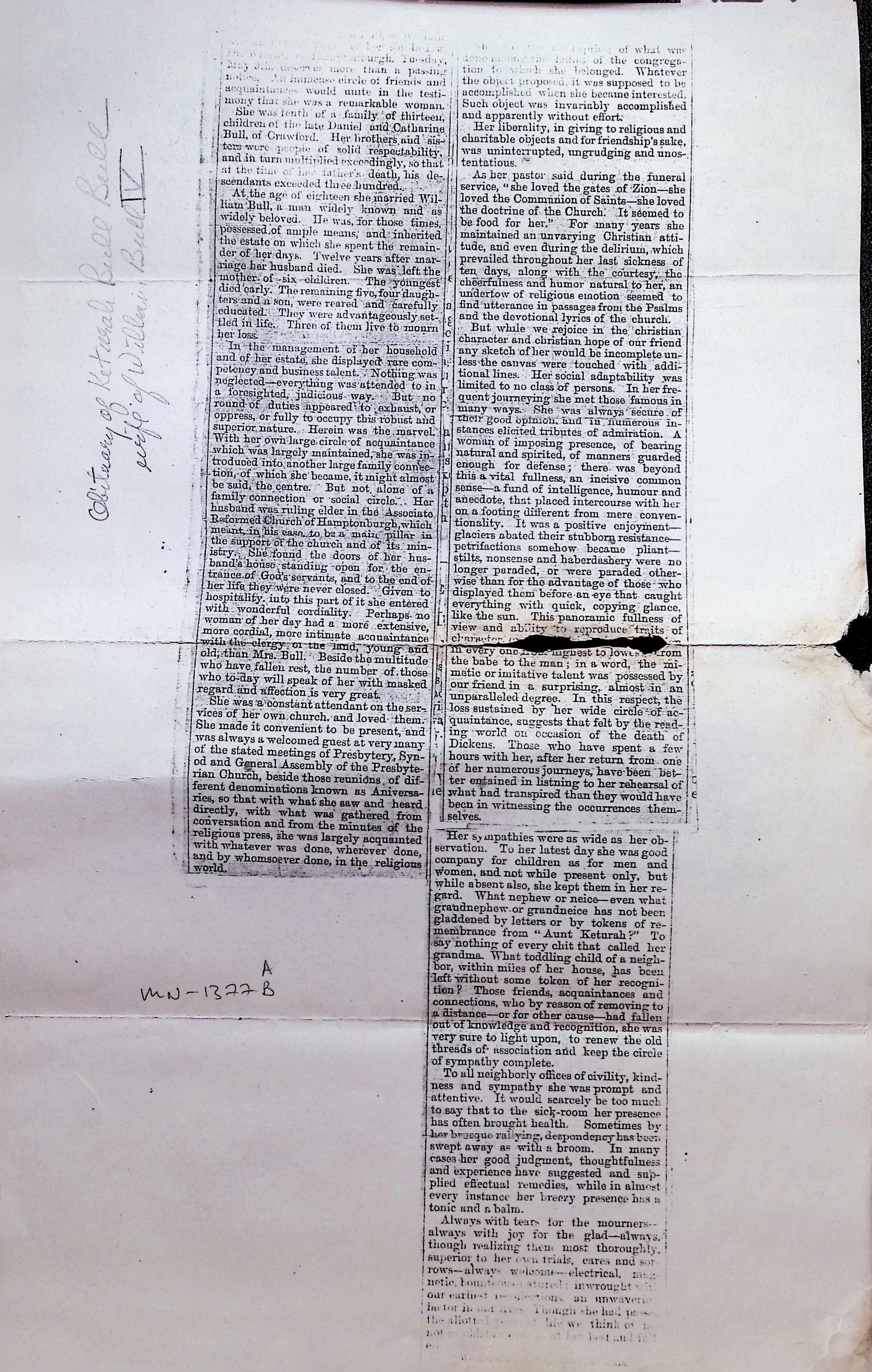
Obituary of Keturah Bull Beattie wife of William Bull IV
...of Hamptonburgh, Tuesday, May 9th, deserves more than a passing notice. An immense circle of friends and acquaintances would unite in the testimony that she was a remarkable woman. She was tenth of a family of thirteen, children of the late Daniel and Catharine Bull, of Crawford. Her brothers and sisters were people of solid respectability, and in turn multiplied exceedingly, so that at the time of her father’s death, his descendants exceeded three hundred. At the age of eighteen she married William Bull, a man widely known and as widely beloved. He was, for those times, possessed of ample means, and inherited the estate on which she spent the remainder of her days. Twelve years after marriage her husband died. She was left the mother of six children. The youngest died early. The remaining five, four daughters and a son, were reared and carefully educated. They were advantageously settled in life. Three of them live to mourn her loss. In the management of her household and of her estate, she displayed rare competency and business talent. Nothing was neglected-everything was attended to in a foresighted, judicious way. But no round of duties appeared to exhaust, or oppress, or fully to occupy this robust and superior nature. Herein was the marvel. With her own large circle of acquaintance which was largely maintained, she was introduced into another large family connection, of which she became, it might almost be said, the centre. But not alone of a family connection or social circle. Her husband was ruling elder in the Associate Reformed Church of Hamptonburgh, which meant in his case to be a main pillar in the support of the church and of its ministry. She found the doors of her husband’s house standing open for the en- trance of God’s servants, and to the end of her life they were never closed. Given to hospitality, into this part of it she entered with wonderful cordiality. Perhaps no woman of her day had a more extensive, more cordial, more intimate acquaintance with the clergy of the land, young and old, than Mrs. Bull. Beside the multitude who have fallen rest, the number of those who to-day will speak of her with masked regard and affection is very great. She was a constant attendant on the services of her own church, and loved them. She made it convenient to be present, and was always a welcomed guest at very many of the stated meetings of Presbytery, Synod and General Assembly of the Presbyterian Church, beside those reunions of different denominations known as Anniversaries, so that with what she saw and heard directly, with what was gathered from conversation and from the minutes of the religious press, she was largely acquainted with whatever was done, wherever done, and by whomsoever done, in the religious world.She was the mainspring of what was done among the ladies of the congregation to which she belonged. Whatever the object proposed, it was supposed to be accomplished when she became interested. Such object was invariably accomplished and apparently without effort. Her liberality, in giving to religious and charitable objects and for friendship’s sake, was uninterrupted, ungrudging and unostentatious. As her pastor said during the funeral service, “she loved the gates of Zion-she loved the Communion of Saints-she loved the doctrine of the Church.” It seemed to be food for her. For many years she maintained an unvarying Christian attitude, and even during the delirium, which prevailed throughout her last sickness of ten days, along with the courtesy, the cheerfulness and humor natural to her, an undertow of religious emotion seemed to find utterance in passages from the Psalms and the devotional lyrics of the church. But while we rejoice in the christian character and christian hope of our friend any sketch of her would be incomplete unless the canvas were touched with additional lines. Her social adaptability was limited to no class of persons. In her frequent journeying she met those famous in many ways. She was always secure of their good opinion, and in numerous in- stances elicited tributes of admiration. A woman of imposing presence, of bearing natural and spirited, of manners guarded enough for defense; there was beyond this a vital fullness, an incisive common sense-a fund of intelligence, humour and anecdote, that placed intercourse with her on a footing different from mere conventionality. It was a positive enjoyment- glaciers abated their stubborn resistance- petrifactions somehow became pliantstilts, nonsense and haberdashery were no longer paraded, or were paraded otherwise than for the advantage of those who displayed them before an eye that caught everything with quick, copying glance, like the sun. This panoramic fullness of view and ability to reproduce traits of character, or [hole in doc] in every one from the highest to [hole in doc] from the babe to the man; in a word, the mimetic or imitative talent was possessed by our friend in a surprising, almost in an unparalleled degree. In this respect, the loss sustained by her wide circle of acquaintance, suggests that felt by the reading world on occasion of the death of Dickens. Those who have spent a few hours with her, after her return from one of her numerous journeys, have been better entertained in listening to her rehearsal of what had transpired than they would have been in witnessing the occurrences themselves. Her sympathies were as wide as her observation. To her latest day she was good company for children as for men and women, and not while present only, but while absent also, she kept them in her regard. What nephew or niece even what grandnephew or grand niece has not been gladdened by letters or by tokens of remembrance from “Aunt Keturah?” To say nothing of every chit that called her grandma. What toddling child of a neighbor, within miles of her house, has been left without some token of her recognition? Those friends, acquaintances and connections, who by reason of removing to a distance-or for other cause-had fallen out of knowledge and recognition, she was very sure to light upon, to renew the old threads of association and keep the circle of sympathy complete. To all neighborly offices of civility, kind- ness and sympathy she was prompt and attentive. It would scarcely be too much to say that to the sick-room her presence has often brought health. Sometimes by her brusque rallying, despondency has been swept away as with a broom. In many cases her good judgment, thoughtfulness and experience have suggested and supplied effectual remedies, while in almost every instance her breezy presence has a tonic and a balm. Always with tears for the mourners- always with joy for the glad-always, though realizing them most thoroughly, superior to her own trials, cares and sorrows-always welcome-electrical, magnetic, bounteous-natured; inwrought with our earliest recollections, an unwavering factor in our lives. Though she had passed the allotted years of life we think of her not as old, but ever as at her best and fullest.