Name/Title
1st Presby Ch Hamptonburgh Pg 656, 657 copied from History of Orange County NYEntry/Object ID
000040Tags
Orange County HistoryScope and Content
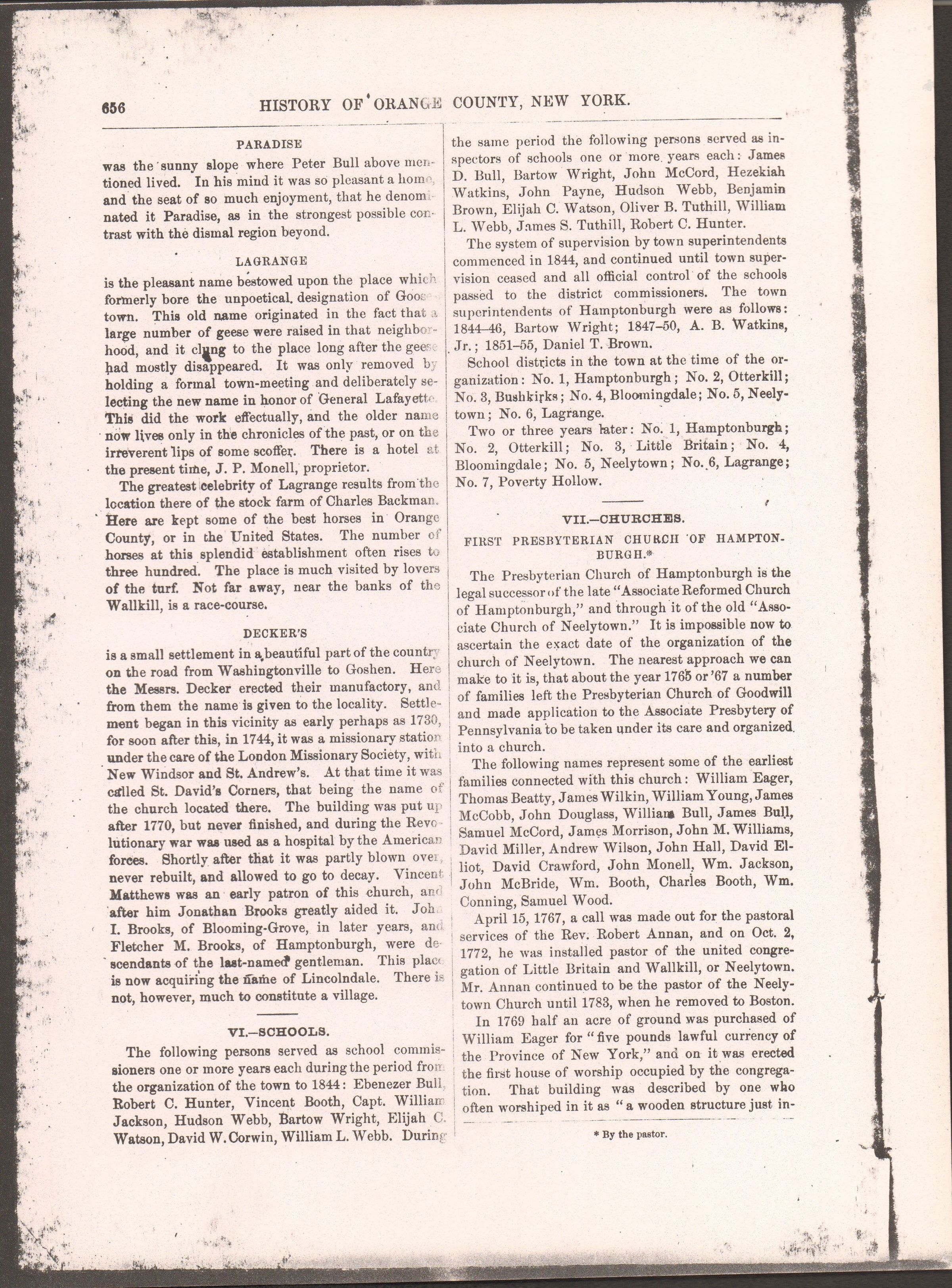
Page 656
PARADISE
was the sunny slope where Peter Bull above mentioned lived. In his mind it was so pleasant a home and the seat of so much enjoyment, that he denominated it Paradise, as in the strongest possible contrast with the dismal region beyond.
LAGRANGE
is the pleasant name bestowed upon the place which formerly bore the unpoetical designation of Goose town. This old name originated in the fact that a large number of geese were raised in that neighborhood, and it clung to the place long after the geese had mostly disappeared. It was only removed by holding a formal town-meeting and deliberately selecting the new name in honor of General Lafayette. This did the work effectually, and the older name now lives only in the chronicles of the past, or on the irreverent lips of the some scoffer. There is a hotel at the present time, J.P. Monell, proprietor.
The greatest celebrity of Lagrange results from the location there of the stock farm of Charles Backman. Here are kept some of the best horses in Orange County, or in the United States. The number of horses at his splendid establishment often rises to three hundred. The place is much visited by lovers of the turf. Not far away, near the banks of the Wallkill, is a race-course.
DECKERS
is a small settlement in a beautiful part of the country on the road from Washingtonville to Goshen. Here the Mears, Decker erected their manufactory, and from them the name is given to the locality. Settlement began in this vicinity as early perhaps as 1730, for soon after this, in 1744, it was a missionary station under the care of the London Missionary Society, with New Windsor and St. Andrew’s. At that time it was called St. David’s Corners, that being the name of the church located there. The building was put up after 1770, but never finished, and during the Revolutionary war was used as a hospital by the American forces. Shortly after that it was partly blown over, never rebuilt, and allowed to go to decay. Vincent Matthews was an early patron of this church, and after him Jonathan Brooks greatly aided it. John T. Brooks, of Blooming-Grove, in later years, and Fletcher M. Brooks, of Hamptonburgh, were descendants of the last-named gentleman. This place is now acquiring the fame of Lincolndale. There is not, however, much to constitute a village.
---
VI.—SCHOOLS.
The following persons served as school commissioners one or more years each during the period from the organization of the town to 1844: Ebenezer Bull, Robert C. Hunter, Vincent Booth, Capt. William Jackson, Hudson Webb, Bartow Wright, Elijah C. Watson, David W. Corwin, William L. Webb. During the same period the following persons served as inspectors of schools one or more years each: James D. Bull, Bartow Wright, John McCord, Hezekiah Watkins, John Payne, Hudson Webb, Benjamin Brown, Elijah C. Watson, Oliver B. Tuthill, William L. Webb, James S. Tuthill, Robert C. Hunter.
The system of supervision by town superintendents commenced in 1844, and continued until town supervision ceased and all official control of the schools passed to the district commissioners. The town superintendents of Hamptonburgh were as follows: 1844–46, Bartow Wright; 1847–50, A. B. Watkins, Jr.; 1851–55, Daniel T. Brown.
School districts in the town at the time of the organization: No. 1, Hamptonburgh; No. 2, Otterkill; No. 3, Bushkirk’s; No. 4, Bloomingdale; No. 5, Neelytown; No. 6, Lagrange.
Two or three years later: No. 1, Hamptonburgh; No. 2, Otterkill; No. 3, Little Britain; No. 4, Bloomingdale; No. 5, Neelytown; No. 6, Lagrange; No. 7, Poverty Hollow.
---
VII.—CHURCHES.
FIRST PRESBYTERIAN CHURCH OF HAMPTONBURGH.
The Presbyterian Church of Hamptonburgh is the legal successor of the “Associate Reformed Church of Hamptonburgh,” and through it of the old “Associate Church of Neelytown.” It is impossible to ascertain the exact date of the organization of the church of Neelytown. The nearest approach we can make to it is, that about the year 1765 or ’67 a number of families left the Presbyterian Church of Goodwill and made application to the Associate Presbytery of Pennsylvania to be taken under its care and organized into a church.
The following names represent some of the earliest families connected with this church: William Eager, Thomas Beatty, James Wilkin, William Young, James McCob, John Douglass, William Bull, James Bull, Samuel McCord, James Morrison, John M. Williams, David Miller, Andrew Wilson, John Hall, David Elliott, David Crawford, John Monell, Wm. Jackson, John McBride, Wm. Booth, Charles Booth, Wm. Conning, Samuel Wood.
April 16, 1767, a call was made out for the pastoral services of the Rev. Robert Annan, and on Oct. 2, 1772, he was installed pastor of the united congregation of Little Britain and Neelytown, at Neelytown. Mr. Annan continued to be the pastor of the Neelytown Church until 1783, when he removed to Boston.
In 1765 half an acre of ground was purchased of William Eager for “five pounds lawful currency of the Province of New York,” and on it was erected the first house of worship occupied by the congregation. That building was described by one who often worshiped in it as “a wooden structure just in—”
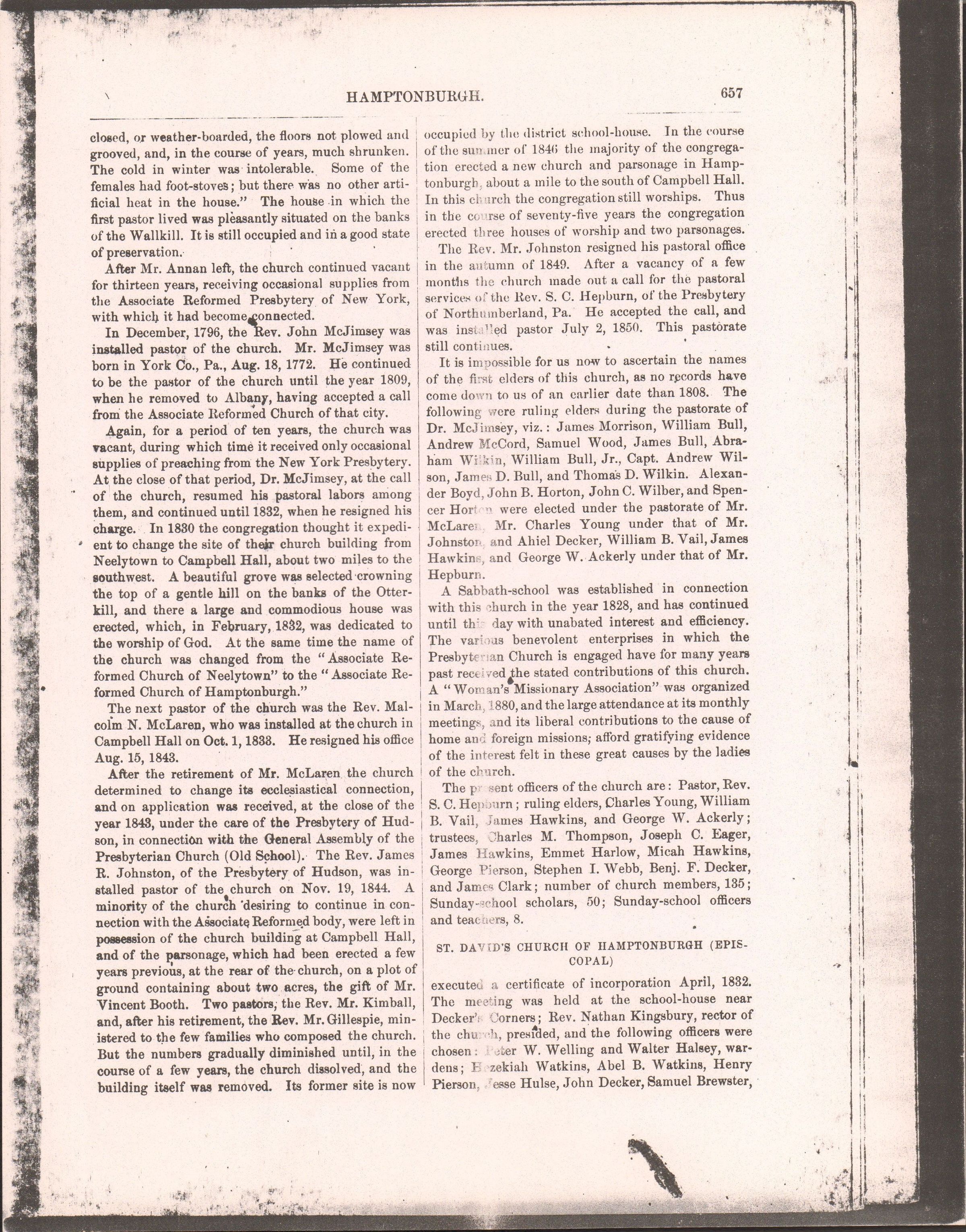
Page 657
HAMPTONBURGH.
Closed, or weather-boarded, the floors not plowed and grooved, and, in the course of years, much shrunken. The cold in winter was intolerable. Some of the females had foot-stoves; but there was no other artificial heat in the house. The house in which the first pastor lived was pleasantly situated on the banks of the Wallkill. It is still occupied and in a good state of preservation.
After Mr. Aitman left, the church continued vacant for thirteen years, receiving occasional supplies from the Associate Reformed Presbytery of New York, with which it had become connected.
In December, 1796, the Rev. John McJimsay was installed pastor of the church. Mr. McJimsay was born in York Co., Pa., Aug. 18, 1772. He continued to be the pastor of the church until the year 1804, when he removed to Albany, having accepted a call from the Associate Reformed Church of that city.
Again, for a period of ten years, the church was vacant, during which time it received only occasional supplies of preaching from the New York Presbytery. At the close of this period Dr. McJimsay, at the call of the church, resumed his pastoral labors among them, and continued until 1828. He resigned his charge. In 1830 the congregation thought it expedient to change the seat of their church building from Newtown to Campbell Hall, about two miles from the southwest. A beautiful grove was selected on the top of a gentle hill on the banks of the Otterkill, and there a large and commodious house was erected, which, in February, 1833, was dedicated to the worship of God. At the same time the name of the church was changed from the “Associate Reformed Church of Newtown” to the “Associate Reformed Church of Hamptonburgh.”
The next pastor of the church was the Rev. Malcolm M. McLaren, who was installed at the church in Campbell Hall on Oct. 1, 1838. He resigned his office Aug. 15, 1843.
After the retirement of Mr. McLaren, the church determined to change its ecclesiastical connection, and an application was received, at the close of the year 1843, under the care of the Presbytery of Hudson, in connection with the General Assembly of the Presbyterian Church (Old School). The Rev. James R. Johnston, of the Presbytery of Hudson, was installed pastor of the church on Nov. 19, 1844. A minority of the church desiring to continue in connection with the Associate Reformed body, were left in possession of the church building at Campbell Hall, and the previous pastor, which had been erected a few years previous, at the rear of the church, on a plot of ground containing about one acre, the gift of Mr. Vincent Booth. Two pastors; Rev. Mr. Kimball, and, after his retirement, the Rev. Mr. Gillespie, ministered to the few families who composed the church. But the numbers gradually diminished until, in the course of a few years, the church dissolved, and the building itself was removed. Its former site is now occupied by the district school-house. In the course of the summer of 1844 the majority of the congregation erected a new church and parsonage in Hamptonburgh, about a mile to the south of Campbell Hall. In this church the congregation still worships. During the course of seventy-five years the congregation erected three houses of worship and two parsonages.
The Rev. Mr. Johnston resigned his pastoral office in the autumn of 1849. After a vacancy of a few months the church made out a call for the pastoral services of the Rev. S. C. Hepburn, of the Presbytery of Northumberland, Pa. He accepted the call, and was installed pastor July 2, 1850. This pastorate still continues.
It is impossible for us now to ascertain the names of the first elders of this church, as no records have come down to us of an earlier date than 1808. The following were ruling elders during the pastorate of Mr. McJimsay, viz.: James Morrison, William Ball, Andrew McCord, Samuel Wood, James Ball, Hiram Wilkin, William Bull, Jr., Capt. Andrew Wilson, James D. Ball, and Thomas D. Wilkin. Alexander Boyd, John B. Horton, John C. Willier, and Spencer Hort were elected under the pastorate of Mr. McLaren. Mr. Charles Young under that of Mr. Johnston; and Ahiel Decker, William B. Vail, James Hawkins, and George W. Ackerly under that of Mr. Hepburn.
A Sabbath-school was established in connection with this church in the year 1828, and has continued to this day with unabated interest and efficiency. The various benevolent enterprises in which the Presbyterian Church is engaged have for many years past received the stated contributions of this church. A “Woman’s Missionary Association” was organized in March, 1880, and the large attendance at its monthly meetings, and its liberal contributions to the cause of home and foreign missions, afford gratifying evidence of the interest felt in these great causes by the church.
The present officers of the church are: Pastor, Rev. S. C. Hepburn; ruling elders, Charles Young, William B. Vail, James Hawkins, and George W. Ackerly; trustees, Charles M. Thompson, Joseph C. Eager, James Hawkins, Emmet Harlow, Micah Hawkins, George Persons, Stephen I. Webb, Benj. F. Decker, and James Clark; number of church members, 135; Sunday-school scholars, 50; Sunday-school officers and teachers, 8.
ST. DAVID’S CHURCH OF HAMPTONBURGH (EPISCOPAL)
Executed a certificate of incorporation April, 1832. The meeting was held at the school-house near Decker’s Corners; Rev. Nathan Kingsbury, rector of the church, presided, and the following officers were chosen: Peter W. Welling and Walter Halsey, wardens; Zedekiah Watkins, Abel B. Watkins, Henry Pierson, Jesse Hulse, John Decker, Samuel Brewster—Relationships
Related Person or Organization
Person or Organization
Orange County History