Name/Title
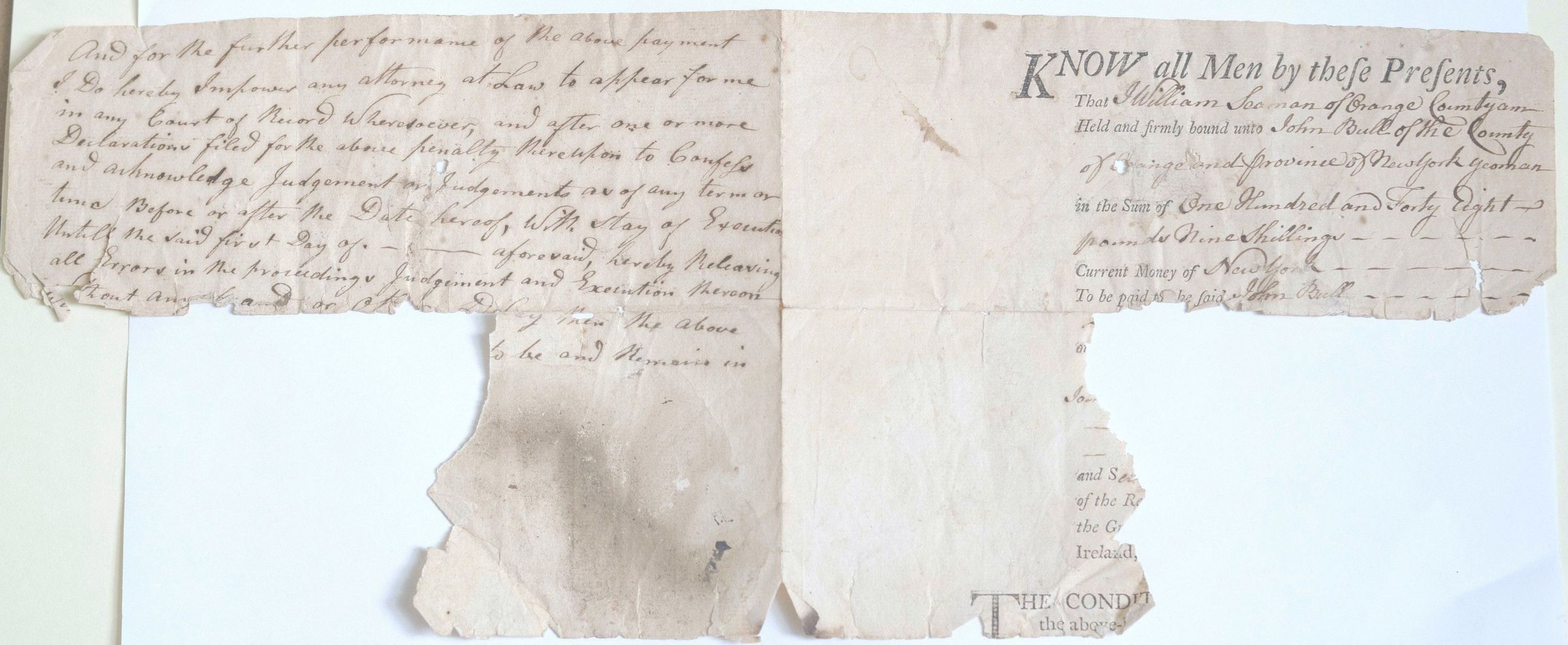
William Seaman paid to John Bull 148 pounds 9 shillingsEntry/Object ID
002528Tags
John Bull, William SeamanScope and Content
Based on the image provided, this is an 18th-century legal document—specifically a penal bond—recorded in the Province of New York. It follows a standard legal formula where one party binds themselves to pay a debt to another.
The document is damaged, particularly at the bottom, but here is a transcription of the legible portions:
Transcription
Right Side (The Bond)
KNOW all Men by these Presents,
That I William Seaman of Orange County am
Held and firmly bound unto John Bull of the County
of Orange and Province of New York Yeoman in the Sum of One Hundred and Forty Eight
pounds Nine Shillings ——————
Current Money of New York ——————
To be paid to the said John Bull ————
[...]
[Lower fragment]
...and Sec[eal]
...of the Re[ign]
...the Gr[eat]
...Ireland
Left Side (The Power of Attorney)
And for the further performance of the above payment
I Do hereby Impower any attorney at Law to appear for me
in any Court of Record whatsoever, and after one or more
Declarations filed for the above penalty Thereupon to Confess and acknowledge Judgement or Judgements as of any term or
time Before or after the Date hereof, with Stay of Execution
Until the said first day of [blank] aforesaid, hereby Releasing
all Errors in the proceedings Judgement and Execution thereon
[bottom fragment]
[...] then the above
[...] to be and Remains in
Contextual Notes
Parties Involved: William Seaman (the debtor) and John Bull (the creditor). Both are listed as residents of Orange County, New York.
The Debt: The amount is £148, 9s in "Current Money of New York." In colonial times, different colonies often had different valuations for their local currencies compared to British Sterling.
Legal Mechanism: The left side of the document is a Warrant of Attorney. It basically says that if William Seaman fails to pay, he authorizes any lawyer to go to court and "confess judgment" against him. This was a common way to fast-track debt collection without a full trial.
Date: While the specific year is missing due to the tear at the bottom right, the mention of the "Province of New York" and the handwriting style strongly suggest the mid-to-late 1700s (pre-Revolutionary War).