Name/Title
Bond 1786 to 1809Entry/Object ID
002554Tags
Hamlet S. RoeScope and Content
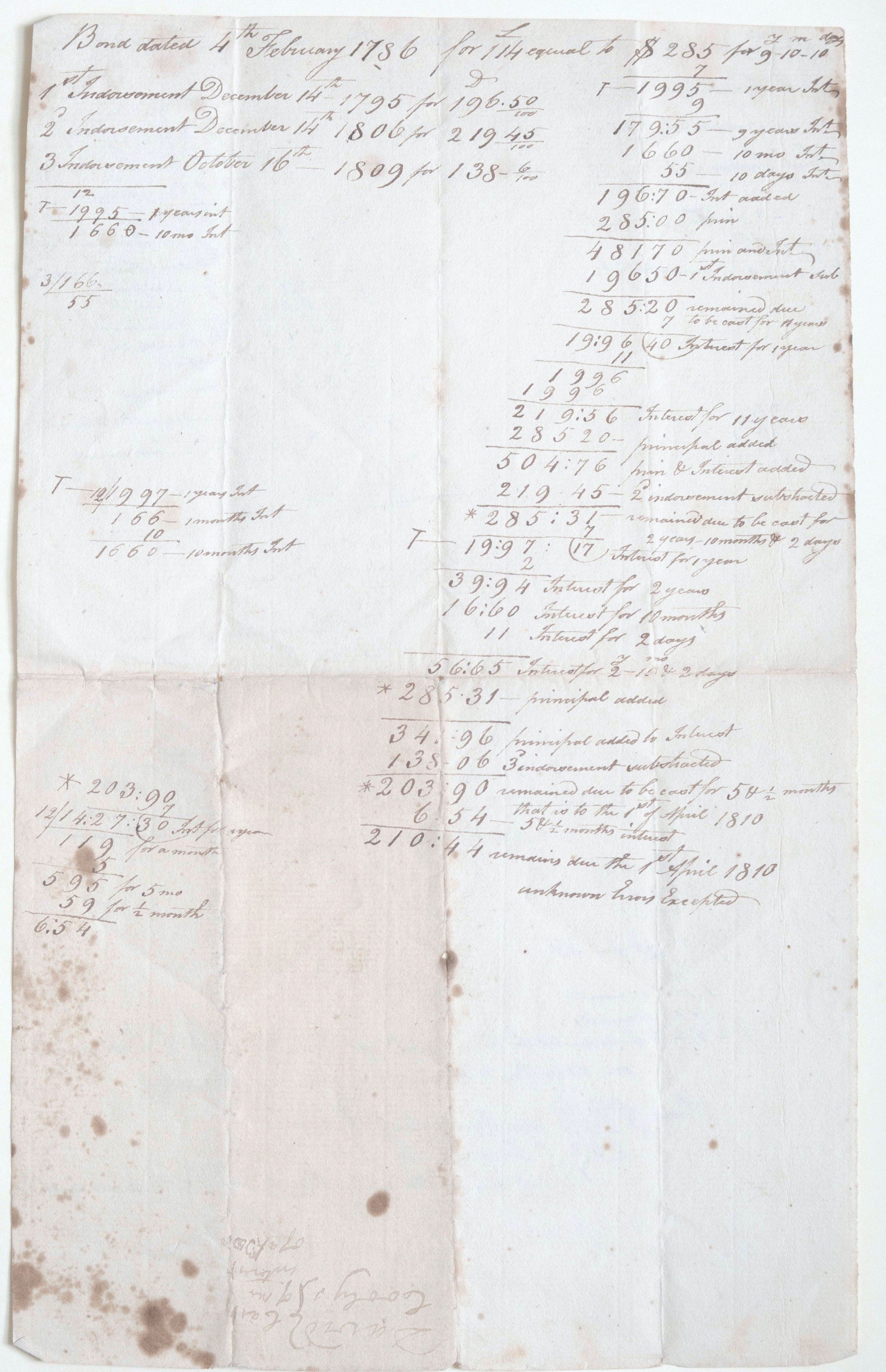
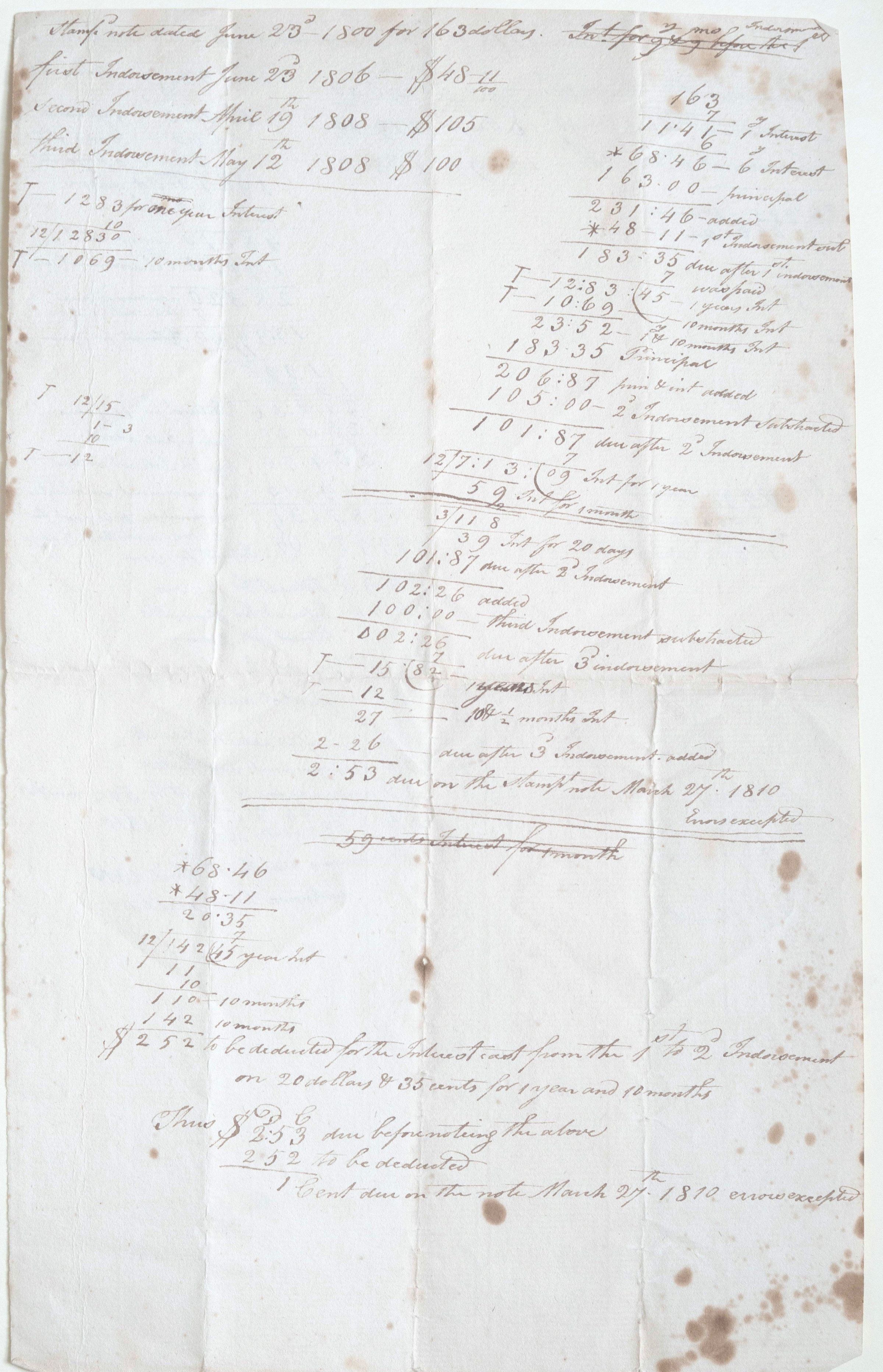
The images provided, these documents represent a fascinating piece of late 18th and early 19th-century American financial history. They are detailed interest and payment calculations (amortization schedules) for debts dating back to the post-Revolutionary War period.
Here is a breakdown of what each document contains:
1. Financial Accounting for a Bond
This is a ledger sheet tracking a significant debt. It illustrates how interest was manually calculated before the digital age, using the "United States Rule" (applying payments first to interest, then to principal).
The Original Debt: A "Bond dated 4th February 1786" for the amount of $285.00.
Timeline: The sheet tracks payments (called "indorsements") made in 1795, 1806, and 1809.
The Math: You can see the scribe calculating interest for specific periods (e.g., "9 years, 10 months, and 10 days").
Final Balance: After adding interest and subtracting payments over 24 years, the document concludes that $210.44 remained due as of April 1, 1810.
2. Promissory Note Accounting
This document follows a similar format but concerns a different debt, specifically a "stamped note."
The Original Debt: A note dated June 23, 1800, for $163.00.
Timeline: It tracks payments made in 1806 and 1808.
Outcome: Through meticulous subtraction and interest addition, the debt was almost entirely settled. The final line notes that only "1 Cent" remained due on March 27, 1810.
Legal Phrase: Note the recurring phrase "errors excepted," a common legal disclaimer of the time (equivalent to "E&OE" today).
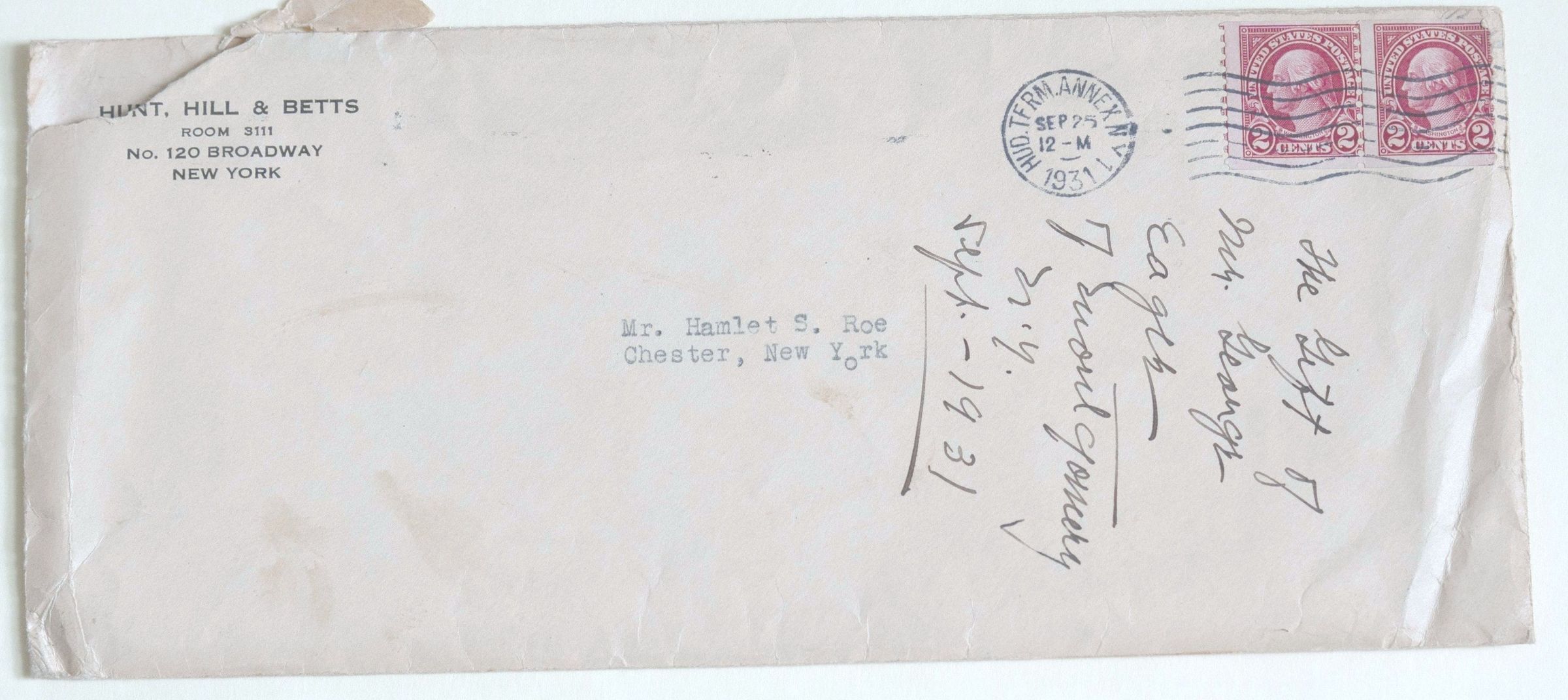
3. Provenance and Storage
This is the envelope that likely contained these papers for a long time, providing a "bridge" between the 1800s and the early 20th century.
The Firm: The return address is for Hunt, Hill & Betts, a prominent New York maritime law firm located at 120 Broadway (The Equitable Building).
The Recipient: Mr. Hamlet S. Roe of Chester, NY.
Postmark: September 25, 1931.
Notations: Someone (likely Mr. Roe) wrote on the envelope that these were "The gift of Mr. George Eagle" in September 1931.
Summary
These are legal-financial records used to settle estates or long-standing debts. They show how a debt of a few hundred dollars could persist for decades, meticulously tracked by hand through the early years of the United States. They were likely kept as historical curiosities or legal proof of payment by the Roe family after being gifted to them in 1931.