Name/Title
May 10, 1822 bill of sale for Timber Joshua Howell to Peter BullEntry/Object ID
002618Tags
Joshua Howell, Peter BullScope and Content
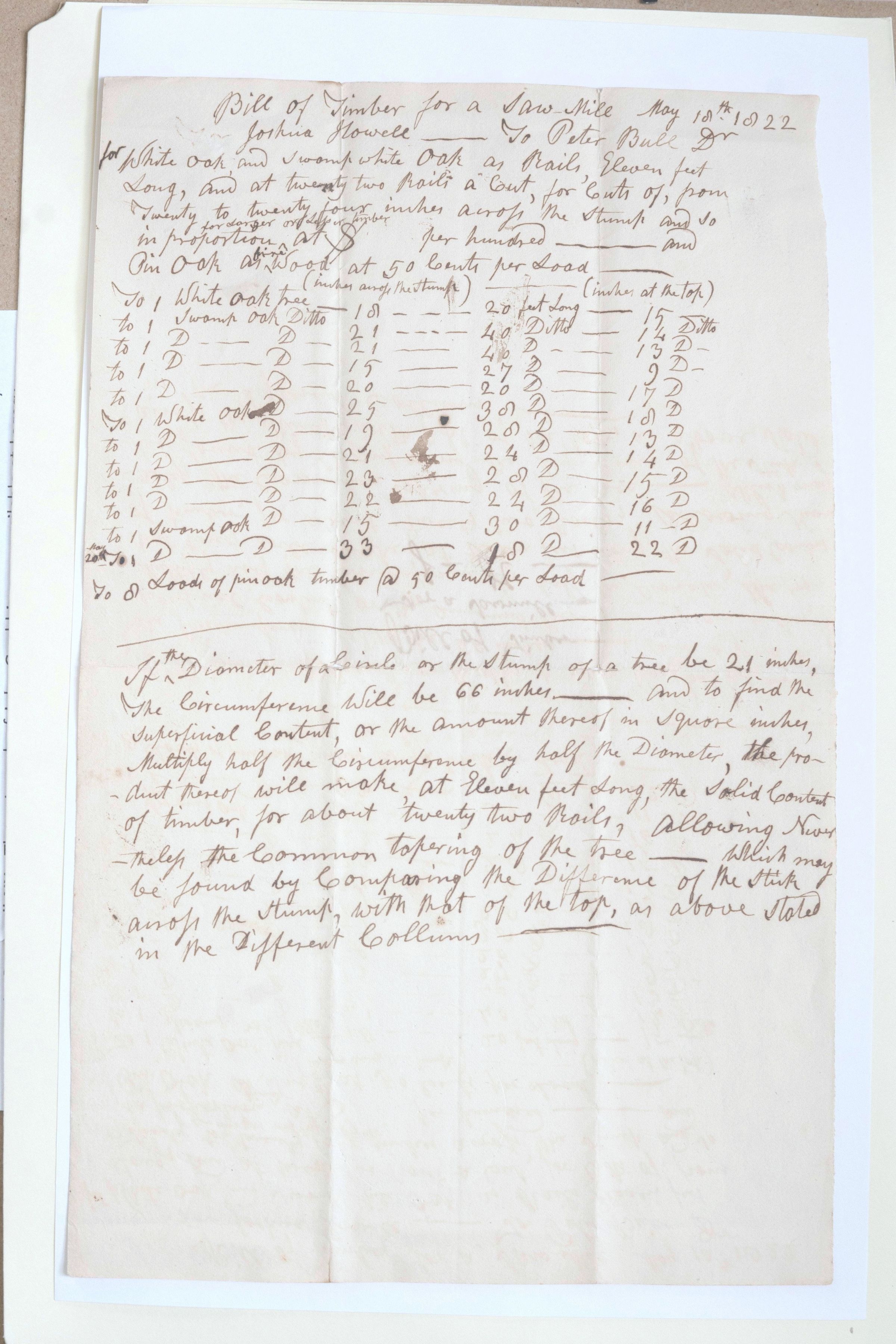
This document is a historical "Bill of Timber" dated May 10, 1822. It records an agreement between Joshua Howell and Peter Bull for various types of oak timber (White Oak, Swamp White Oak, and Pin Oak) intended for a sawmill.
Below is the transcription of the handwritten text:
Bill of Timber for a Saw-Mill May 10th 1822
Joshua Howell —— To Peter Bull Dr
for White oak, and Swamp White Oak as Rails, Eleven feet long, and at twenty two rails a Cut, for Cuts of, from twenty to twenty four inches across the stump and so in proportion at $—— per hundred —— and Pin Oak at Wood at 50 cents per Load ——
Qty Description Inches across the stump Length Inches at the top
To 1 White oak tree 18 20 feet long 15 Ditto
to 1 Swamp oak Ditto 21 40 Ditto 14 Ditto
to 1 D —— D 21 40 D 13 D
to 1 D —— D 15 27 D 9 D
to 1 D —— D 20 20 D 17 D
to 1 D —— D 25 30 D 18 D
to 1 White oak 19 20 D 13 D
to 1 D —— D 21 24 D 14 D
to 1 D —— D 23 20 D 15 D
to 1 D —— D 22 24 D 16 D
to 1 Swamp oak D 15 30 D 11 D
to 1 D —— D 33 18 D 22 D
To 8 Loads of pin oak timber @ 50 cents per Load
Geometric and Volume Calculations
The bottom section of the document explains the mathematical formula used to calculate the volume of the timber based on its diameter and circumference.
If the Diameter of a Circle or the stump of a tree be 21 inches, the Circumference will be 66 inches. —— and to find the superficial content, or the amount thereof in Square inches, Multiply half the Circumference by half the Diameter, the product thereof will make, at Eleven feet Long, the Solid Content of timber, for about twenty two Rails; allowing nevertheless the common tapering of the tree —— which may be found by Comparing the Difference of the Stick across the stump, with that of the top, as above stated in the Different Columns ——