Name/Title
Letter March 5, 1826 Regarding property lines - John B Horton & Samuel Brewster, Ebenezer & Peter BullEntry/Object ID
002623Tags
Peter Bull, Ebenezer Bull, Samuel BrewsterScope and Content
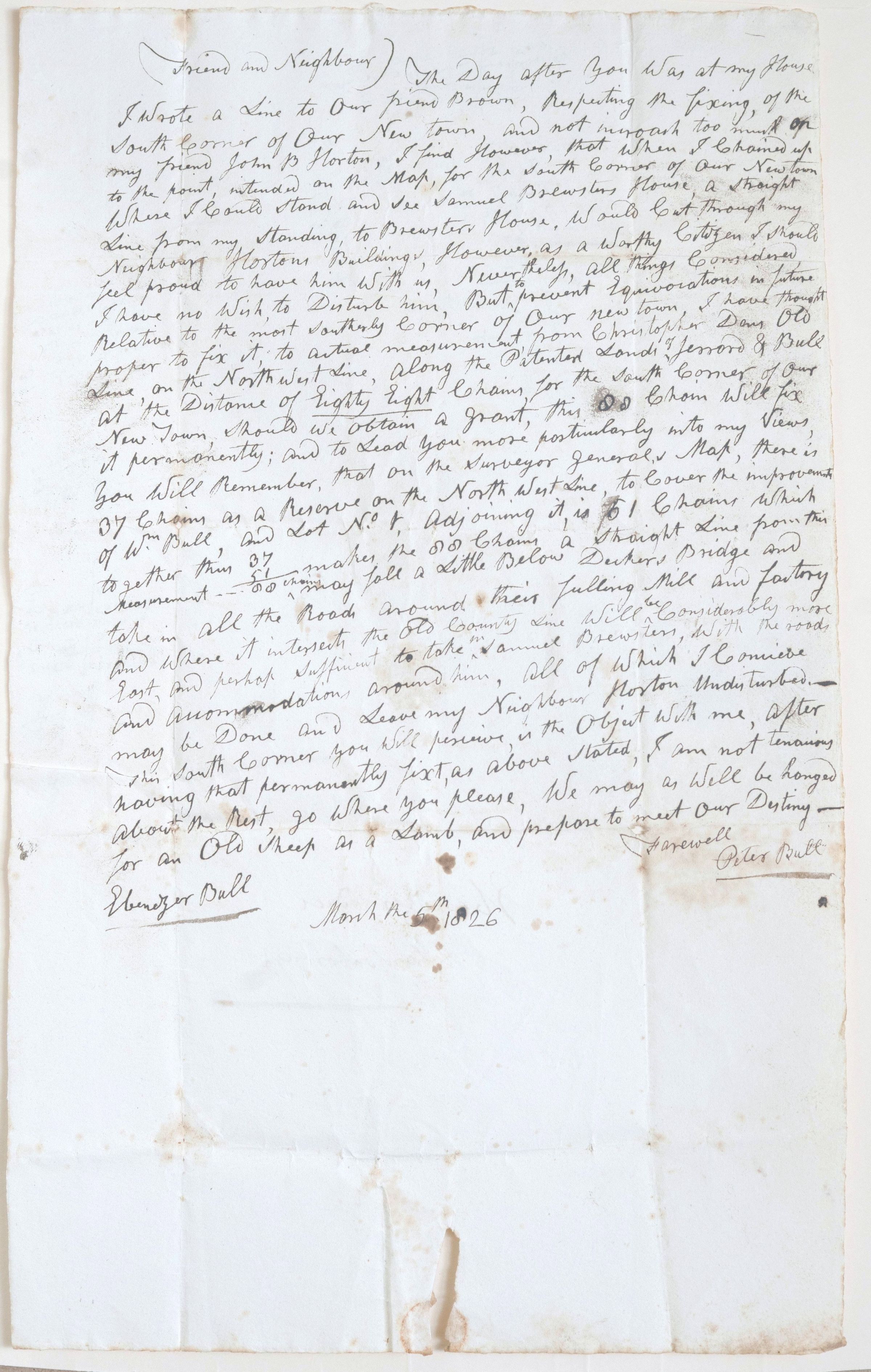
This historical document appears to be a letter written by Peter Bull regarding land surveying and the establishment of boundaries for a "New Town." It is dated March the 5th, 1826.
Below is a transcription of the text, preserving the original spelling, capitalization, and punctuation as closely as possible.
Letter Transcription
(Friend and Neighbour) The Day after You Was at my House I wrote a Line to Our friend Brown, Respecting the fixing, of the South Corner of Our New town, and not encroach too much on my friend John B Norton, I find however that when I chained up to the point, intended on the Map, for the south Corner of Our New town Where I could stand and see Samuel Brewsters House, a Straight Line from my Standing, to Brewsters House, would Cut through my Neighbour Hortons Buildings, However, as a worthy Citizen I should feel proud to have him with us, Nevertheless, all things considered I have no wish to Disturb him, But to prevent Equivocations in future Relative to the most Southerly Corner of Our new town, I have thought proper to fix it, to actual measurement from Christopher Dens Old Line on the North West Line, Along the Patented Land of Jessord & Bull at the Distance of Eighty Eight Chains for the south Corner of Our New Town, should we obtain a grant, this 88 Chains will fix it permanently; and to Lead You more particularly into my Views, You Will Remember, that on the Surveyor general's Map, there is 37 Chains as a Reserve on the North West Line, to Cover the improvements of Wm Bull, and Lot No 1. Adjoining it, is 51 Chains Which together thin 37 together with 51 makes the 88 Chains a Straight Line point in measurement—88 chains may fall a Little Below Darkers Bridge and take in all the Road around their fulling Mill and factory and Where it intersects the Old County Line will be Considerably more East, and perhaps Sufficient to take in Samuel Brewsters, with the roads and Accommodations around him, All of Which I conceive may be Done and Leave my Neighbour Norton Undisturbed. this South Corner you will perceive, is the Object with me, After having that permanently fixt, as above Stated, I am not tenacious About the rest, go Where you please, We may as Well be hanged for an Old Sheep as a Lamb, and prepare to meet Our Destiny.
Farewell
Peter Bull
Ebenezer Bull
Month the 5th 1826
Key Observations
The "Old Sheep" Idiom: The letter concludes with the phrase, "We may as Well be hanged for an Old Sheep as a Lamb," a common 19th-century idiom meaning that if the punishment is the same, one might as well commit the greater offense (or in this context, take the more ambitious action).
Technical Details: The author uses "Chains" as a unit of measurement. In traditional surveying, a Gunter’s chain is 66 feet long.
Names Mentioned: Peter Bull, Ebenezer Bull, John B. Norton, Christopher Dens, Samuel Brewster, and William Bull.
~~~~~~~~~~~~~~~~~~~~~~~~~~~~~~~~~~~
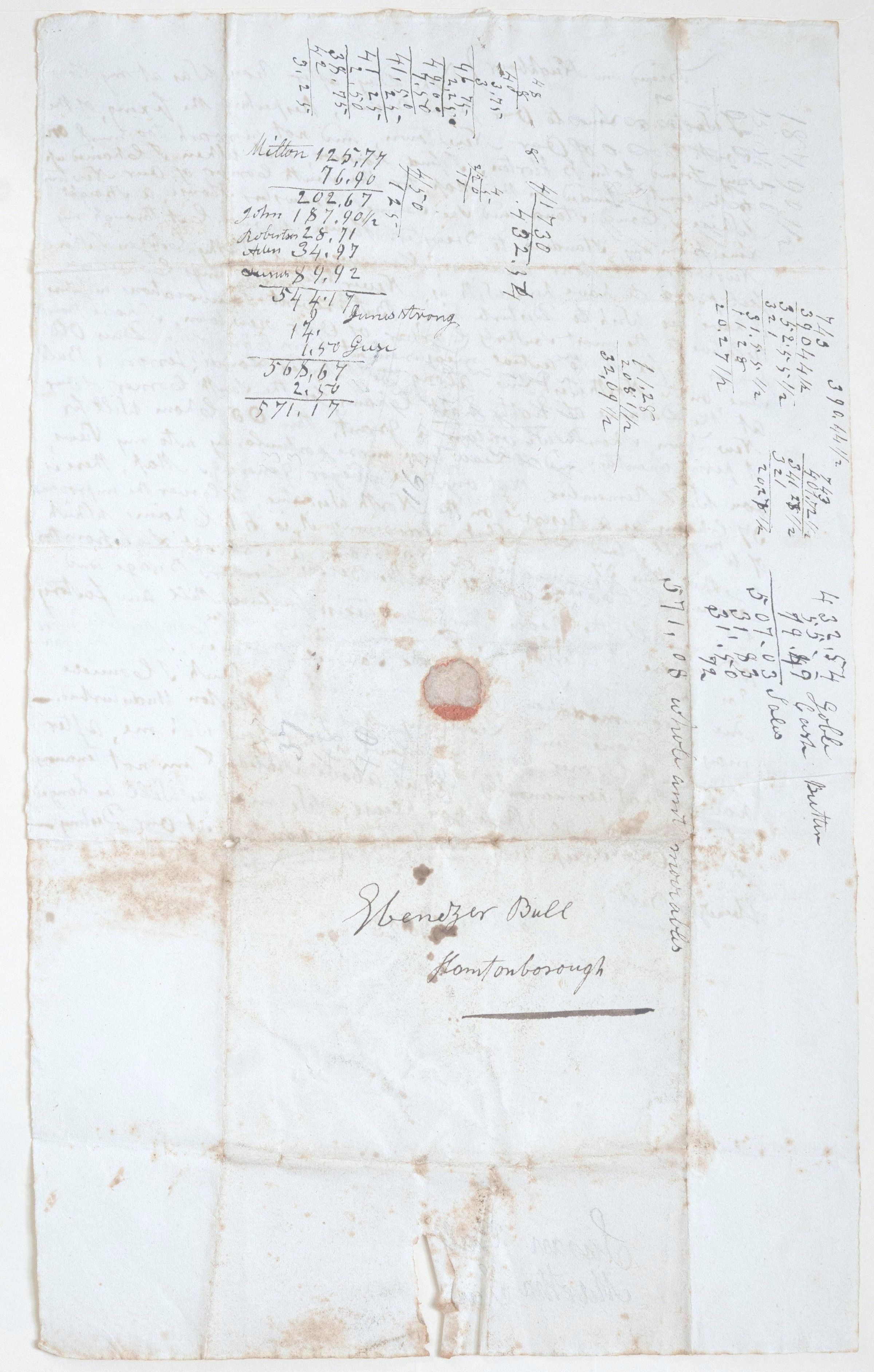
First page
This image shows the back of a folded 18th or 19th-century document, which appears to have been used as a "scrap sheet" for accounting and address information. The paper is aged, stained, and shows distinct fold lines where it would have been sealed for delivery.
Key Features of the Document
1. Primary Inscription (Address/Name)
In the lower-center section, there is a formal name and location written in a bold, cursive hand:
Name: Ebenezer Bull
Location: Hamptonborough (likely a historical spelling or specific locality)
2. Accounting and Calculations
The upper half and right margin are covered in dense numerical notations and tally marks. These appear to be financial records or "settlements." Notable details include:
Names and Amounts: References to names like "Milton," "John," "Armstrong," and "Gage" are listed alongside specific monetary figures (e.g., 125.77, 202.67).
Fractions: Many numbers include small fractions written as 1/2 or 1/4, which was common in currency calculations of the era.
Goods: On the right side, there are vertical notations that mention "Gold," "Cash," and "Butter," suggesting these calculations represent a trade ledger or an estate settlement.
3. Physical Condition
Staining: A prominent, circular reddish-brown stain is visible in the center, which may be a remnant of a wax seal used to keep the letter closed before it was opened.
Texture: The paper has the characteristic "laid" texture of antique handmade paper, with visible foxing (brown spots) and water damage along the edges and creases.