Name/Title
Newspaper Article Cornelius B Wood - Freight CaptainEntry/Object ID
002936Tags
Cornelius B Wood, ChesterScope and Content
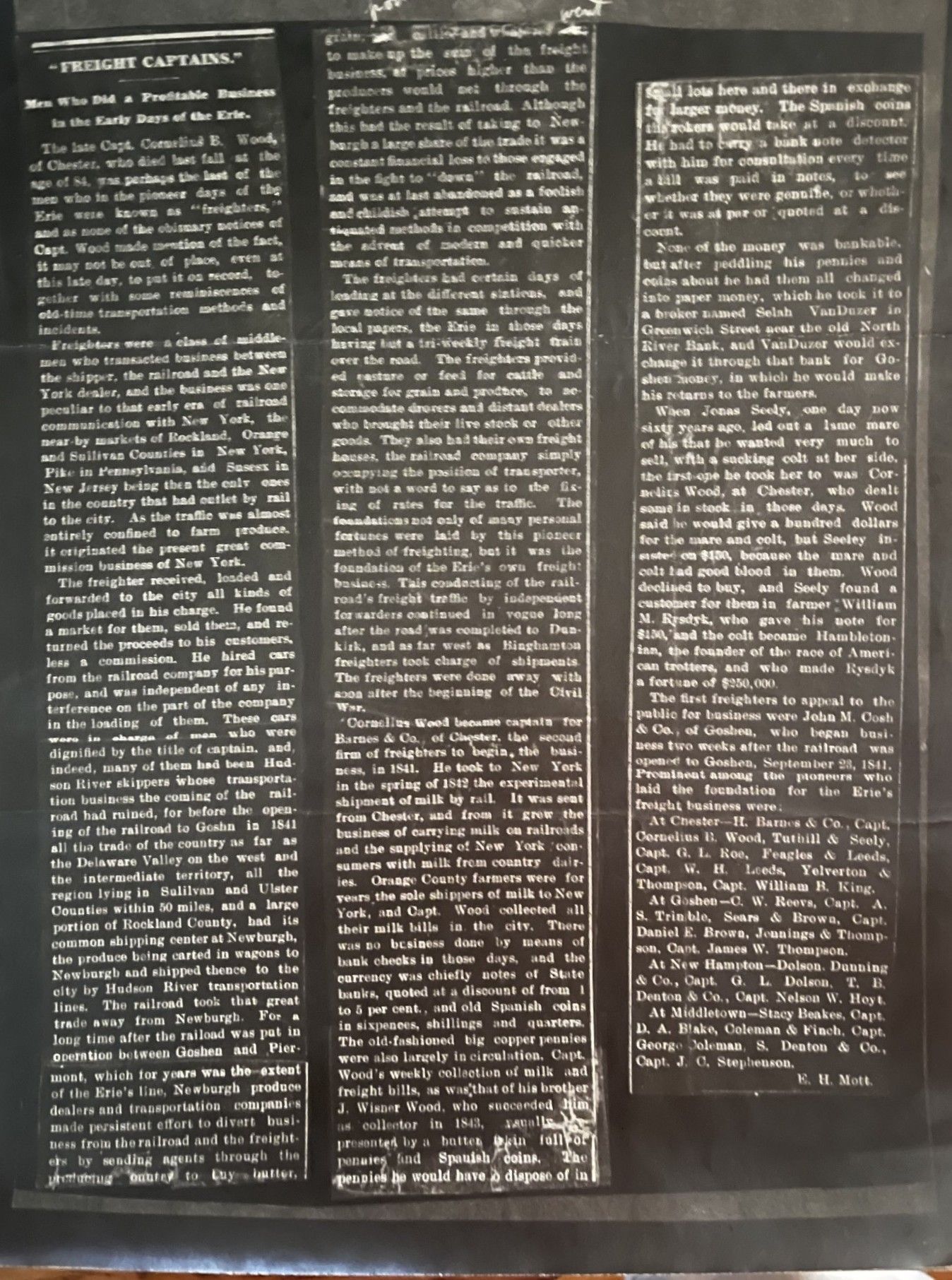
“FREIGHT CAPTAINS.” Men Who Did a Profitable Business in the Early Days of the Erie. The late Capt. Cornelius B. Wood, of Chester, who died last fall at the age of 84, was perhaps the last of the men who in the pioneer days of the Erie were known as “freighters,” and as none of the obituary notices of Capt. Wood made mention of the fact, it may not be out of place, even at this late day, to put it on record, together with some reminiscences of old-time transportation methods and incidents. Freighters were a class of middle-men who transacted business between the shipper, the railroad and the New York dealer, and the business was one peculiar to that early era of railroad communication with New York, the near-by markets of Rockland, Orange and Sullivan Counties in New York, Pike in Pennsylvania, and Sussex in New Jersey being then the only ones in the country that had outlet by rail to the city. As the traffic was almost entirely confined to farm produce, it originated the present great commission business of New York. The freighter received, loaded and forwarded to the city all kinds of goods placed in his charge. He found a market for them, sold them, and re-turned the proceeds to his customers, less a commission. He hired cars from the railroad company for his purpose, and was independent of any interference on the part of the company in the loading of them. These cars were in charge of men who were dignified by the title of captain, and, indeed, many of them had been Hudson River skippers whose transportation business the coming of the rail-road had ruined, for before the opening of the railroad to Goshn in 1841 all the trade of the country as far as the Delaware Valley on the west and the intermediate territory, all the region lying in Sullivan and Ulster Counties within 50 miles, and a large portion of Rockland County, had its common shipping center at Newburgh, the produce being carted in wagons to Newburgh and shipped thence to the city by Hudson River transportation lines. The railroad took that great trade away from Newburgh. For a long time after the railroad was put in operation between Goshen and Piermont, which for years was the extent of the Erie’s line, Newburgh produce dealers and transportation companies made persistent effort to divert business from the railroad and the freighters by sending agents through the producing country to buy butter, grain, etc., willfully and dangerously to make up the sum of the freight business, at prices higher than the producers would net through the freighters and the railroad. Although this had the result of taking to Newburgh a large share of the trade it was a constant financial loss to those engaged in the fight to “down” the railroad, and was at last abandoned as a foolish and childish attempt to sustain approximated methods in competition with the advent of modern and quicker means of transportation.
The freighters had certain days of loading at the different stations, and gave notice of the same through the local papers, the Erie in those days having but a tri-weekly freight train over the road. The freighters provided pasture or feed for cattle and storage for grain and produce, to accommodate drovers and distant dealers who brought their live stock or other goods. They also had their own freight houses, the railroad company simply occupying the position of transporter, with not a word to say as to the fixing of rates for the traffic. The foundations not only of many personal fortunes were laid by this pioneer method of freighting, but it was the foundation of the Erie’s own freight business. This conducting of the rail-road’s freight traffic by independent forwarders continued in vogue long after the road was completed to Dun-kirk, and as far west as Binghamton freighters took charge of shipments. The freighters were done away with soon after the beginning of the Civil War. Cornelius Wood became captain for Barnes & Co., of Chester, the second firm of freighters to begin the business, in 1841. He took to New York in the spring of 1842 the experimental shipment of milk by rail. It was sent from Chester, and from it grew the business of carrying milk on railroads and the supplying of New York consumers with milk from country dair-ies. Orange County farmers were for years the sole shippers of milk to New York, and Capt. Wood collected all their milk bills in the city. There was no business done by means of bank checks in those days, and the currency was chiefly notes of State banks, quoted at a discount of from 1 to 5 per cent., and old Spanish coins in sixpences, shillings and quarters. The old-fashioned big copper pennies were also largely in circulation. Capt. Wood’s weekly collection of milk and freight bills, as was that of his brother J. Wisner Wood, who succeeded him as collector in 1843, usually presented by a butter skin full of pennies and Spanish coins. The pennies he would have to dispose of in small lots here and there in exchange for larger money. The Spanish coins the brokers would take at a discount. He had to carry a bank note detector with him for consultation every time a bill was paid in notes, to see whether they were genuine, or whether it was at par or quoted at a discount.
None of the money was bankable, but after peddling his pennies and coins about he had them all changed into paper money, which he took it to a broker named Selah VanDuzer in Greenwich Street near the old North River Bank, and VanDuzer would ex-change it through that bank for Goshen money, in which he would make his returns to the farmers. When Jonas Seely, one day now sixty years ago, led out a lame mare of his that he wanted very much to sell, with a sucking colt at her side, the first one he took her to was Cornelius Wood, at Chester, who dealt some in stock in those days. Wood said he would give a hundred dollars for the mare and colt, but Seeley insisted on $150, because the mare and colt had good blood in them. Wood declined to buy, and Seely found a customer for them in farmer William M. Rysdyk, who gave his note for $150, and the colt became Hambletonian, the founder of the race of American trotters, and who made Rysdyk a fortune of $250,000. The first freighters to appeal to the public for business were John M. Cosh & Co., of Goshen, who began business two weeks after the railroad was opened to Goshen, September 23, 1841. Prominent among the pioneers who laid the foundation for the Erie’s freight business were: At Chester—H. Barnes & Co., Capt. Cornelius B. Wood, Tuthill & Seely, Capt. G. L. Roe, Feagles & Leeds, Capt. W. H. Leeds, Yelverton & Thompson, Capt. William R. King. At Goshen—C. W. Reeves, Capt. A. S. Trimble, Sears & Brown, Capt. Daniel E. Brown, Jennings & Thompson, Capt. James W. Thompson. At New Hampton—Dolson, Dunning & Co., Capt. G. L. Dolson, T. B. Denton & Co., Capt. Nelson W. Hoyt. At Middletown—Stacy Beakes, Capt. D. A. Blake, Coleman & Finch, Capt. George Coleman, S. Denton & Co., Capt. J. C. Stephenson. E. H. Mott.