Name/Title
"THE DAIRYMEN’S LEAGUE NEWS" 1925Entry/Object ID
002997Tags
Ebenezer BullScope and Content
THE DAIRYMEN’S LEAGUE NEWS 3
A Correction
In our issue of March 26, page 3 we printed an article headed "Milk
Men Discuss Production" in the sixth paragraph of which we quoted Mr.
Marcusson, Assistant Production Manager of the Borden Farm Products Company in his analysis of the present retail price of 15 cents a
quart for milk which the consumer pays in New York City. The figures
as given were confusing and we are herewith giving the correct ones:
The farmer receives $.06; cost of operating the country receiving station, $.008; freight 200 miles to city, $.011; trucking from terminal to city
pasteurizing plants, $.005; pasteurizing plant expense, $.015; trucking
from pasteurizing plant to retail sales branch, $.006; retail branch cost, including delivery to doorstep, $.042; company’s net profit, $.003; total $.15.
____________________________________
Dairymen Meet at Cortland
THE regular monthly meeting of the Dairymen’s League was held
at the Court House on Friday afternoon, March 19th, with County Presi-
dent D. E. Bennie presiding. At the opening of the meeting, a
discussion on prices was carried on and it was found that certain dealers
not buying pooled milk were paying farmers less than the League is paying in localities where there is no competition and that the same dealers are paying more than the League is paying where there is a League
plant and therefore sharp competition. The fact that the Dairymen’s
League has been building a valuable organization for the future protection
of the industry was stressed and also that it paid an average of $.43 more
per hundred pounds this year than was paid last year. The League also
has made it possible for non-poolers to get this increase as well as their
own members. In other words, the League, though having the support of
but a part of the producers, has through organization stabilized and
protected the industry for all, a fact that all have reason to be grateful for.
A. L. Milks of Cattaraugus county was the principal speaker and touched
on some of the high spots interesting all farmers and those dependent on
agriculture. Mr. Milks said that the biggest reason for agriculture’s lack
of prosperity is the tax situation. But 35% of our wealth is in the form of
real estate, yet real estate is paying 75% of the tax burden. This falls
too heavily on the farmers. At the same time, other property that is
yielding many more times income is escaping.
Another reason for agriculture’s plight is its lack of organization. All
other lines are organized to protect their interests, while big money is
directing efforts to destroy the farmers’ faith in such organizations as they
have.
Mr. Milks pointed out the fact that 30% of our people were engaged in
agriculture in 1920. By 1930 a gain of 16,000,000 population is expected
and the gain will be in the cities. This means that by that time only 20% of
the population will be farmers. With this general status of agriculture, farmers are now confronted by a new problem-that of western competition in milk, and this menace can best be met by organization on the
part of the eastern dairymen. The Utica meeting was referred to
as a step in the right direction. Only unity of dairymen will deal with the
situation efficiently. Mr. Milks urged the farmers to write to the representatives at Washington urging them to
raise the tariff on milk and cream. The price of milk in April will be
maintained on the March basis, if possible, it was announced by Mr.
Bennie.
____________________________________
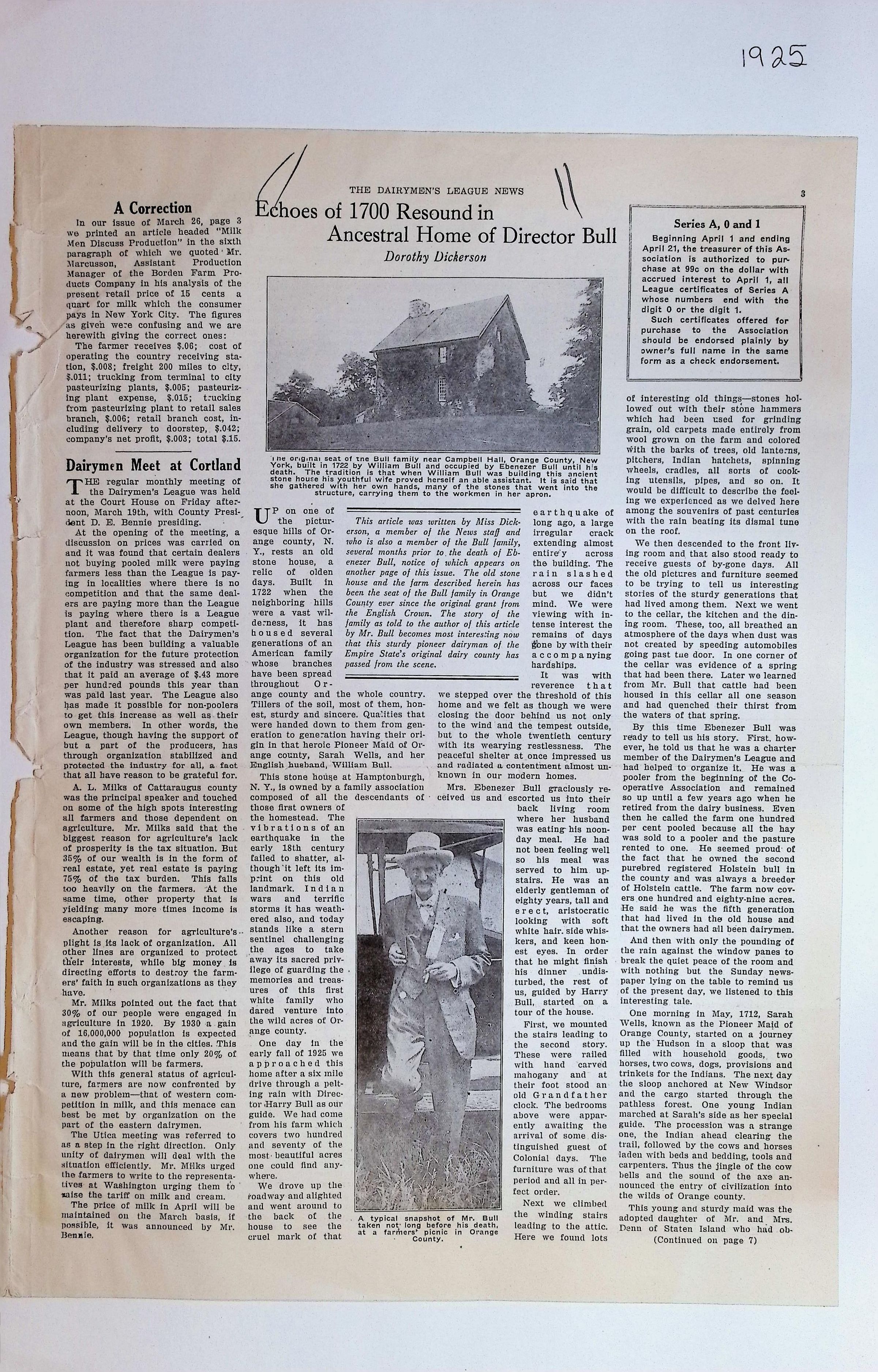
Echoes of 1700 Resound in
Ancestral Home of Director Bull
Dorothy Dickerson
[Image: A stone house surrounded by trees]
The original seat of the Bull family near Campbell Hall, Orange County, New
York, built in 1722 by William Bull and occupied by Ebenezer Bull until his
death. The tradition is that when William Bull was building this ancient
stone house his youthful wife proved herself an able assistant. It is said that
she gathered with her own hands, many of the stones that went into the
structure, carrying them to the workmen in her apron.
UP on one of
the picturesque hills of Orange county, N. Y., rests an old
stone house, a
relic of olden
days. Built in
1722 when the
neighboring hills
were a vast wilderness, it has
housed several
generations of an
American family
whose branches
have been spread
throughout Orange county and the whole country.
Tillers of the soil, most of them, hon-
est, sturdy and sincere. Qualities that
were handed down to them from generation to generation having their
origin in that heroic Pioneer Maid of Orange county, Sarah Wells, and her
English husband, William Bull.
This stone house at Hamptonburgh,
N. Y., is owned by a family association
composed of all the descendants of
those first owners of
the homestead. The
vibrations of an
earthquake in the
early 18th century
failed to shatter, al-
though it left its im-
print on this old
landmark. Indian
wars and terrific
storms it has weathered also, and today
stands like a stern
sentinel challenging
the ages to take
away its sacred privilege of guarding the
memories and treasures of this first
white family who
dared venture into
the wild acres of Orange county.
One day in the
early fall of 1925 we
approached this
home after a six mile
drive through a pelting rain with Director Harry Bull as our
guide. We had come
from his farm which
covers two hundred
and seventy of the
most beautiful acres
one could find any-
where.
We drove up the
roadway and alighted
and went around to
the back of the
house to see the
cruel mark of that
---------------------------------------
This article was written by Miss Dickerson, a member of the News staff and
who is also a member of the Bull family, several months prior to the death of Ebenezer Bull, notice of which appears on another page of this issue. The old stone house and the farm described herein has been the seat of the Bull family in Orange County ever since the original grant from the English Crown. The story of the family as told to the author of this article by Mr. Bull becomes most interesting now that this sturdy pioneer dairyman of the
Empire State’s original dairy county has passed from the scene.
---------------------------------------
earthquake of long ago, a large irregular crack extending almost
entirely across the building. The rain slashed across our faces
but we didn't mind. We were looking with intense interest the
remains of days gone by with their accompanying hardships.
It was with reverence that we stepped over the threshold of this
home and we felt as though we were closing the door behind us not only
to the wind and the tempest outside, but to the whole twentieth century
with its wearying restlessness. The peaceful shelter at once impressed us
and radiated a contentment almost unknown in our modern homes.
Mrs. Ebenezer Bull graciously received us and escorted us into their
back living room where her husband was eating his noonday meal. He had
not been feeling well so his meal was served to him upstairs. He was an
elderly gentleman of eighty years, tall and erect, aristocratic looking with soft
white hair, side whiskers, and keen honest eyes. In order that he might finish
his dinner undisturbed, the rest of us, guided by Harry Bull, started on a
tour of the house. First, we mounted the stairs leading to the second story.
These were railed with hand carved mahogany and at their foot stood an
old Grandfather clock. The bedrooms above were apparently awaiting the
arrival of some distinguished guest of Colonial days. The furniture was of that period and all in perfect order. Next we climbed the winding stairs
leading to the attic. Here we found lots
[Image: A man in a hat standing in a field]
A typical snapshot of Mr. Bull taken not long before his death,
at a farmers' picnic in Orange County. of interesting old things-stones hollowed out with their stone hammers which had been used for grinding
grain, old carpets made entirely from wool grown on the farm and colored
with the barks of trees, old lanterns, pitchers, Indian hatchets, spinning
wheels, cradles, all sorts of cooking utensils, pipes, and so on. It
would be difficult to describe the feeling we experienced as we delved here
among the souvenirs of past centuries with the rain beating its dismal tune
on the roof. We then descended to the front living room and that also stood ready to receive guests of by-gone days. All the old pictures and furniture seemed to be trying to tell us interesting stories of the sturdy generations that had lived among them. Next we went to the cellar, the kitchen and the dining room. These, too, all breathed an atmosphere of the days when dust was not created by speeding automobiles going past the door. In one corner of the cellar was evidence of a spring that had been there. Later we learned
from Mr. Bull that cattle had been housed in this cellar all one season
and had quenched their thirst from the waters of that spring.
By this time Ebenezer Bull was ready to tell us his story. First, however, he told us that he was a charter member of the Dairymen's League and
had helped to organize it. He was a pooler from the beginning of the
Co-operative Association and remained so up until a few years ago when he
retired from the dairy business. Even then he called the farm one hundred
per cent pooled because all the hay was sold to a pooler and the pasture
rented to one. He seemed proud of the fact that he owned the second
purebred registered Holstein bull in the county and was always a breeder
of Holstein cattle. The farm now covers one hundred and eighty-nine acres.
He said he was the fifth generation that had lived in the old house and
that the owners had all been dairymen. And then with only the pounding of
the rain against the window panes to break the quiet peace of the room and
with nothing but the Sunday newspaper lying on the table to remind us
of the present day, we listened to this interesting tale. One morning in May, 1712, Sarah Wells, known as the Pioneer Maid of Orange County, started on a journey up the Hudson in a sloop that was filled with household goods, two
horses, two cows, dogs, provisions and trinkets for the Indians. The next day
the sloop anchored at New Windsor and the cargo started through the
pathless forest. One young Indian marched at Sarah's side as her special
guide. The procession was a strange one, the Indian ahead clearing the
trail, followed by the cows and horses laden with beds and bedding, tools and carpenters. Thus the jingle of the cow bells and the sound of the axe
announced the entry of civilization into the wilds of Orange County.
This young and sturdy maid was the adopted daughter of Mr. and Mrs.
Denn of Staten Island who had ob-
(Continued on page 7)
____________________________________
Series A, 0 and 1
Beginning April 1 and ending April 21, the treasurer of this As-
sociation is authorized to purchase at 99c on the dollar with
accrued interest to April 1, all League certificates of Series A
whose numbers end with the digit 0 or the digit 1.
Such certificates offered for purchase to the Association
should be endorsed plainly by owner’s full name in the same
form as a check endorsement.