Name/Title
Copy 168th Marriage of Sarah Wells & William Bull Aug 29, 1886Entry/Object ID
000419Tags
Sarah WellsScope and Content
Sun and New York press Sun Aug. 29, 1886
THE BULL FAMILY PICNIC.
HONORING THE MEMORY OF SARAH WELLS AND WILLIAM BULL.
Their Romantic Story-Common Ancestors of 20,000 Persons-Origin of the Bull Family in America-A House 160 Years Old.
GOSHEN, N.Y., Aug. 25.-Over one thousand persons bearing the name of Bull, or who are descendants of and intermarried with descendants of persons by that name, assembled to-day in the woods at Campbell Hall, a few miles from this place, to celebrate the 180th anniversary of
the marriage of their common ancestors in this country, William Bull and Sarah Wells, and to listen to the romantic story and reminiscences of these two pioneers of the Orange county wilderness. This gathering is an annual one, and is known as the "Bull Family Picnic."
Sarah Wells was the first white settler in what is now the very flower of Orange county. At the time she came into the wilderness she was only 16 years of age. She was an orphan, and the adopted daughter of a Frenchman named Christopher Denn and his wife. Denn lived in New
York. He had at one time been wealthy. In 1705 he and others purchased of the Indians 150,000 acres of land in what is now the towns of Goshen, Wawayanda, Hamptonburgh, Monroe, Blooming Grove, and Wallkill. Denn opened an office in Whitehall street, New York, for the
purpose of disposing of this land to settlers. None had been sold up to 1712. By that time Denn had used up his means and was heavily in debt. He had pledged all except 2,000 acres of his land to raise money, and this 2,000 acres was held by him, subject to there being a bona fide
settlement made on it on or before May 31, 1712. In his strait Denn received word that on the tract, land speculators had staked out a spot on the banks of a stream, now the Otterkill Creek, five miles from Goshen, where he desired to have the necessary settlement, were surprised, and
after returning to New York only waiting for the expiration of the time that his title to the property would be good unless the settlement was made.
Between 1705 and 1712 settlements had been made at New Windsor, on the Hudson, and there was a small Dutch settlement now in Rockland county, and the first settlement of Orange county. But between the Hudson and the Delaware River there were not one hundred white people, all
told, and they were along the rivers. Flatboats and Indian canoes were the only craft written on the Hudson River. They did all the passenger and freight traffic between New York and Albany, touching at New Windsor and Esopus (Kingston). Denn tried to induce other landholders in the
Wawayanda patent, but failed. Assisted by Denn's placement, he was enabled to secure a sloop, the services of two carpenters, two horses, two cows, and all the necessary provisions. At the last moment, when all was in readiness for starting in time to reach the tract and occupy it, but at the
last moment Denn, on the plea that he had not succeeded in satisfactorily arranging his personal affairs, really showed the white feather. His adopted daughter, Sarah Wells, then volunteered to lead the party, go out and sleep with the carpenters, and become the actual settler. The girl
consented without a murmur.
The sloop sailed from the foot of Whitehall street at sunset on the 20th of May and at sundown on the 24th arrived at New Windsor, and the next morning Sarah Wells and her party-all strangers to her-in charge of three half-clad Indian guides, started along on the long trek of twenty miles through the wilderness. The goods and utensils were packed on the cows and horses. Whatever the girl's fears might have been on this strange, wild tramp, they were groundless. The party reached the spot on the evening of the 24th of May. The next day the carpenters made a clearing and put up a cabin, which was formally taken possession of by Sarah Wells, and the last remnant of Christopher Denn's property was saved to him.
After the orphan girl had departed from them on the perilous mission, Christopher Denn and his horseback, passing through New Jersey and the Ramapo Pass with the expectation of finding their adopted daughter in the wilderness, and they performed the long and tedious journey without dismantling, arriving at the cabin but a short time after Sarah Wells had taken possession of it.
Other settlers quickly followed the Denns into the country. In a few years Denn, by sales of land, regained much of his lost fortune. Within two years came into the region was a settler named John Aske. On his way out he resolved to erect a stone house on his piece, to be used as a tavern, travel having become considerable. He went to New York to engage workmen. He heard that a vessel had just arrived with Irish emigrants, and, being anxious to secure work, he boarded the vessel. He found there a young Irishman, who said his name was William Bull. He was a stone mason. He had lived at Wolverhampton, England, near Dublin, and had paid his last cent for passage to America. On reaching New York the Captain told him that he was in his debt for part of the passage, and that he must be sold, as the custom was then, until his time paid the captain's claim. Aske liked the young man. He paid the Captain's claim against Bull, and brought the stone mason to Orange county and gave him charge of the new building. While working for Cromline young Bull met Sarah Wells, who belonged to the nearest neighbors, living only five miles distant. The young people fell in love with one another, and, in spite of the opposition of the girl's foster parents, she married William Bull on the 25th of August, 1718. Denn gave the bride one hundred acres of land, William Bull put up a log cabin on it, and the young couple went to housekeeping.
"From the time that the Denn's raised a family of eight negroes," said one of Sarah Wells's descendants, "Sarah Wells had done all the carrying of grist to and from the mill, which was at the mouth of the Fishkill Creek on the east shore of the Hudson, opposite New Windsor. She used to go from home on horseback twenty miles through the woods to New Windsor, where she placed it in a boat and rowed it across the Hudson. Waiting until it was ground, she would return home with it in the same manner. This trip took five days. Once she was chased by wolves, which clashed with her horse, and she was obliged to take to a tree, the horse going off. She was kept in the tree all night, and the next morning walked to her log house home. After she was married her husband relieved her of this heavy and perilous duty. He had no horse, and carried the grain on his back, and made the trip on foot, consuming three days. On one occasion William Bull did not reach home with his grist at the time he was expected, and she set out through the woods to meet him, knowing that something had gone wrong. She found him ten miles from home, nearly exhausted, she shouldered the grist, and, helping her husband along, they reached their wilderness home. Twenty thousand members of the Bull family in America to-day trace their origin to Sarah Wells, and such was their mother!"
In 1722 William Bull had become a man of means, and he bought land on his own account. In that year he built a new stone house in Hamptonburgh, and there he died in 1755, a widower. Sarah Wells died there in 1796, aged 102 years, leaving 335 grand and great-grandchildren. The home, which is occupied by descendants, some of the sixth generation, is fifty years older than this city of Newburgh, and is estimated to number more than the largest town in the vicinity of he old homestead-which is still standing just as William Bull built it nearly 160 years ago, and which has never been occupied or owned by other than a lineal descendant of his-and flags a grand family reunion on the 25th of August, 1898, to which descendants are living present to-day from nearly every State in the Union.
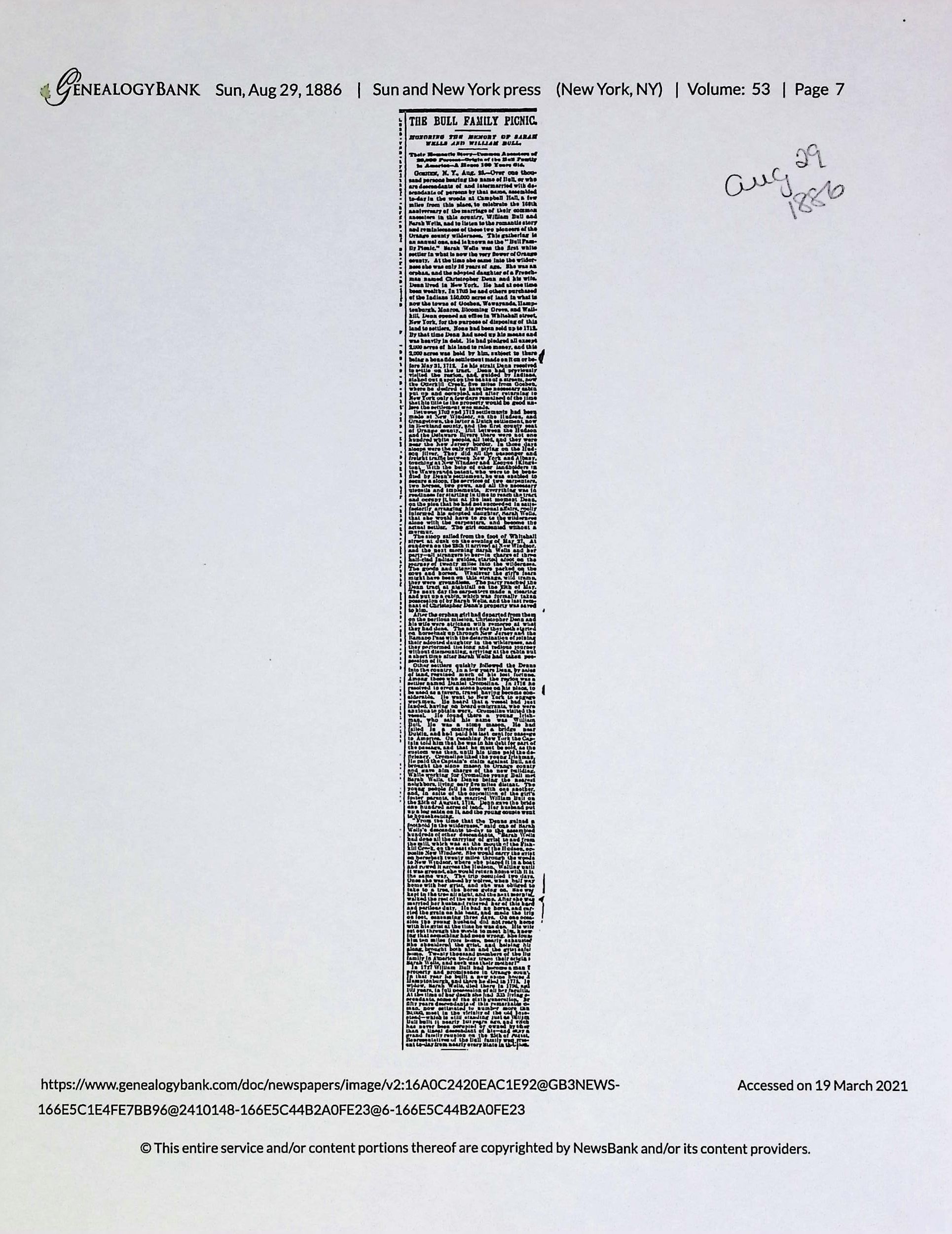
GENEALOGYBANK Sun, Aug 29, 1886 | Sun and New York press (New York, NY) | Volume: 53 | Page 7
Aug 29, 1886
THE BULL FAMILY PICNIC.
HONORING THE MEMORY OF SARAH
WELLS AND WILLIAM BULL.
Their Romantic Early History Reminded of
-A Brave Woman-Origin of the Bull Family
in America-A Home 160 Years Old.
---
GOSHEN, N. Y., Aug. 28.-Over one thousand persons bearing the name of Bull, or who are descendants of and intermarried with
descendants of persons by that name, assembled
today in the woods at Campbell Hall, a few
miles from this place, to celebrate the 168th
anniversary of the marriage of their common
ancestors in this country, William Bull and
Sarah Wells, and to listen to the romantic story
and reminiscences of these two pioneers of the
Orange county wilderness. This gathering is
an annual one, and is known as the "Bull Family Picnic."
Sarah Wells was the first white
settler in what is now the very flower of Orange
county. At the time she came into the wilder-
ness she was only 16 years of age. She was an
orphan, and the adopted daughter of a French-
man named Christopher Denn and his wife.
Denn lived in New York. He had at one time
been wealthy. In 1702 he had received a patent
of the Indians 150,000 acres of land in what is
now the towns of Goshen, Minisink, Hamptonburgh, Monroe, Blooming Grove, and Wallkill, in Orange county. Christopher Denn returned to
New York, for the purpose of disposing of this
land to settlers. None had been sold up to 1712.
By that time Denn had spent all his money and
was heavily in debt. He had pledged all except
2,000 acres of his land to his creditors, and this
2,000 acres was held by him, subject to there
being a bona-fide settlement made on it on or be-
fore May 31, 1712. In his strait Denn received
word from the other partners who had
visited the region, and, guided by Indians,
staked out a location for the 2,000 acres on
the Otterkill Creek, five miles from Goshen,
where he decided to have log buildings immediately
put up and occupied, and after returning to
New York sent a few men back, and at the time
specified by the agreement, standard was raised and
thus the settlement was made.
Previous to this, in 1710 settlements had been
made at New Windsor, on the Hudson, and
there were a few settlers living at Syracuse now
in Rockland county, and the first county seat
of Orange county. The entire population
of Orange county at that time was only a
hundred white people, all told, and they were
located along the river. A few small
sloops were the only craft plying on the Hud-
son, and there was no regular or
frequent traffic between New York and Albany,
much less to New Windsor and Goshen. To comply
with the terms of the agreement of
the Wawayanda patent, who were to be benefited by
Denn's settlement, he was enabled to
secure a sloop, the services of two carpenters,
two horses, two cows, and a few household
utensils and implements. Everything was in
readiness for starting to Orange county, when
the sailors inside the vessel refused to go,
on the plea that he had not succeeded in satisfying the
criteria of the agreement. Denn
informed his adopted daughter, Sarah Wells,
that she would have to go in the sloop
alone with the carpenters, and become the
first actual settler, and occupy the wilderness
log house.
The sloop sailed from the foot of Whitehall
street at dusk, on the evening of May 23. At
sundown on the 25th it arrived at New Windsor,
and the next morning Sarah Wells and her
companions, strangers, and under guidance of three
half-clad Indian guides, started, about 10 the
morning of the 26th, to run the Indian line.
The goods and utensils were packed on the
cows and horses. Historians can say little of what
must have been on this strange, wild tramp,
over hills, through valleys. The party reached the
Denn tract at nightfall on the 26th of May.
The next day the carpenters made a clearing
and put up a house, which was formally taken
possession of by Sarah Wells, and the last rem-
nant of the tangled beauty property was saved
to him.
After the orphan girl had departed from them
on the perilous journey, Christopher Denn and
his wife were stricken with remorse at what
they had done. The next day they both started
on horseback up through New Jersey, and the
Indians then provided escorts, anxious of joining
their adopted daughter in the wilderness, and
they expected nothing less than to find her dead; but they were happy to find her alive, a short time after Sarah Wells had taken pos-
session of it.
Other settlers quickly followed the Denns
into the country. In a few years Denn, by sales
of land, regained much of his lost fortune.
Among those who came into this country was a
mason named William Bull. In 1716 Denn
resolved to erect a stone house on his place, to
be used as a tavern, where he could entertain
siderable. He went to New York to engage
masons. He found that a vessel had just
arrived having on board emigrants, who were
anxious to obtain work. Christopher visited the
vessel, where he was shown a young English-
man, who said his name was William
Bull. He was a stone mason. He had
failed in a contract for a bridge near
Dublin, and had used his last penny to secure
a passage. On reaching New York the Cap-
tain told him that he was in his debt for part of
the passage, and that he must be sold, as the
custom was then, until his time paid the de-
ficiency. Denn at once paid the vessel Captain,
he paid the Captain's claim against Bull, and
brought the stone mason to Orange county
and set to work on his new house. Sarah
Wells, working for Christopher, young Bull met
Sarah Wells, the house hand they became
neighbors, living only five miles distant. The
young people fell in love with each other,
and, in spite of the opposition of the girl's
foster parents, who treated William Bull as
she would expect to be treated, Denn gave the girl
one hundred acres of land. Her husband put
up a log house on it, and the young couple went
to housekeeping.
"From the time that the Dynasty of white
settlers in the wilderness," said one of Sarah
Wells's descendants to-day, in reporting the
traditions of their ancestors, "Sarah Wells
had done all the carrying of grist to and from
the mill, which was at the mouth of the Murderer's
Kill Creek, on the east shore of the Hudson, occupying
three days. She would take the grain
on horseback, through the wilderness, the woods,
to New Windsor, where she placed it in a boat
and rowed it across the Hudson. When it
it was ground, she would return home with it in
the same way. The trip was not without its
perils. Once she was chased by wolves, when half way
home with her grist, and she was obliged to
climb up a tree, the horse took the path. She
kept in the tree all night, and the next morning
started the rest of the way home. The man she
married, her husband relieved her of this hard
and perilous duty. He now on standard occasions
tied the grain on his boat, and made the trip
to-day, managing three days. On one occ-
sion, the storm handled the old man's home
with his grist at the time he was due. His wife
for hours expected him to return, and, fear-
ing that something had gone wrong, she found
him down by the shore, having collapsed;
she shouldered the grist, and, helping him
along, brought him to their new home, their
home. Twenty thousand members of the Bull
family in America to-day trace their origin to
Sarah Wells, and such was their mother!"
In 1722 William Bull had become a man of
means, and he bought land on his own account.
In that year he built a new stone house in
Hamptonburgh, and there he died in 1755, a
widower. Sarah Wells died there in 1796, aged
102 years, in full possession of all her faculties.
At the time of her death she had 335 living de-
scendants, some of the sixth generation. Her
home, which is occupied by descendants, some of
them, is fifty years older than this city of New-
burgh, and is estimated to number more than the
largest town in the vicinity of the old home-
stead-which is still standing just as William
Bull built it nearly 160 years ago, and which
has never been occupied or owned by other than a
lineal descendant of his-and flags a grand
family reunion on the 25th of August, 1886,
to which descendants are living present to-
day from nearly every State in the Union.