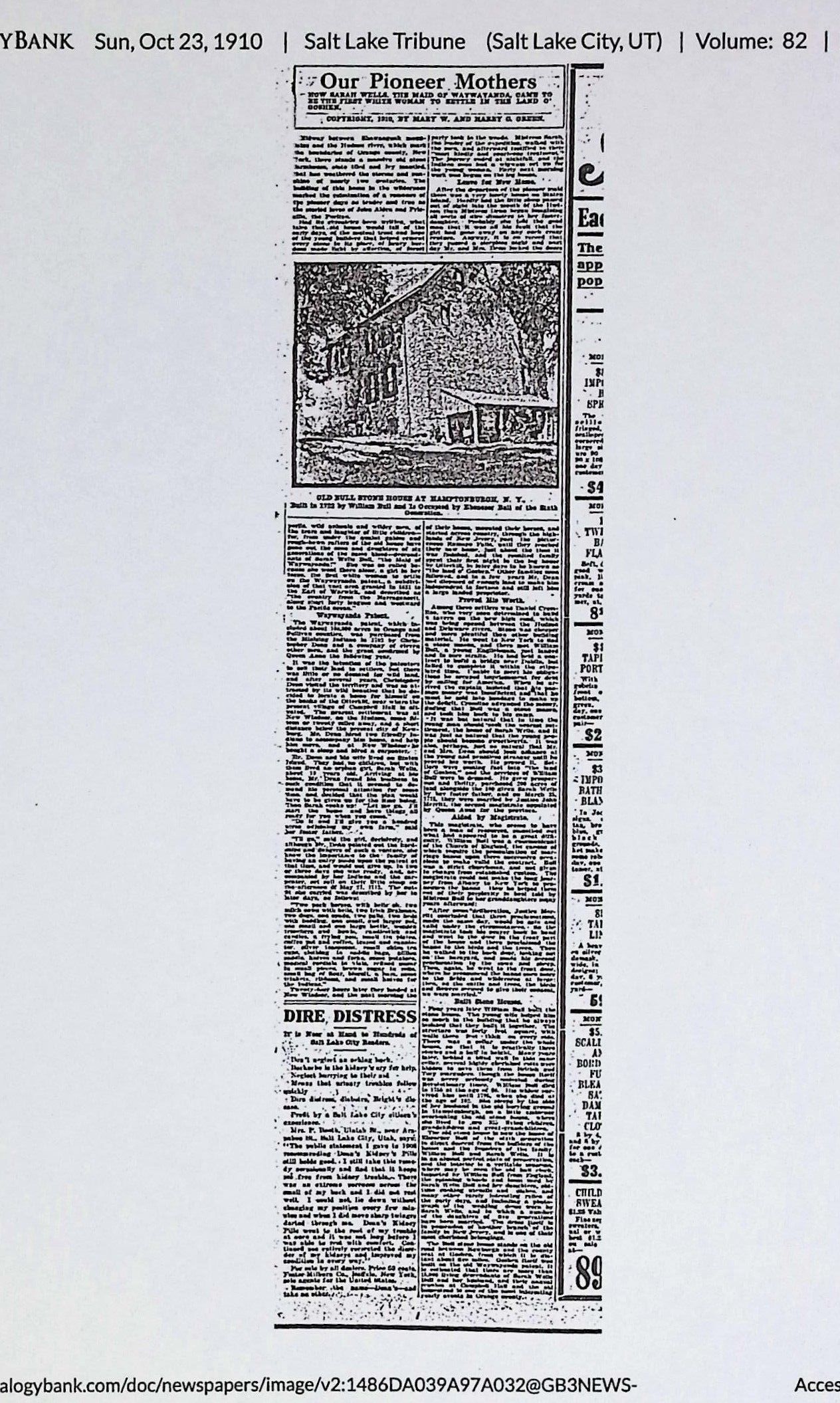
Name/Title
Copy Sarah Wells, First White Women to Settle in GoshenEntry/Object ID
000416Tags
William Bull and Sarah Wells Stone House AssociationScope and Content
Header
THE SALT LAKE TRIBUNE | Sun, Oct 23, 1910 | (Salt Lake City, UT) | Volume: 82 |
Main Article
Our Pioneer Mothers
— HOW SARAH WELLS, THE MAID OF WAYWAYANDA, CAME TO BE THE FIRST WHITE WOMAN TO SETTLE IN THE LAND OF GOSHEN. —
COPYRIGHT, 1910, BY MARY W. AND HARRY G. GREEN.
Midway between Shawangunk mountains and the Hudson river, which marks the boundaries of a certain portion of New York, there stands a massive old stone farmhouse, slate lined and ivy mantled, that has withstood the storms and sunshine of nearly two centuries. The building of this house in the wilderness marked the closing act of a romance of the pioneer days as tender and free as the storied loves of John Alden and Priscilla the Puritan.
Had the history been written, what deep chapters down, read today of the early days, of the mutual trust and honor of the young builders that bound safely every stone in the place, of hearty festival made light by affection, of scout party back in the woods. Mistress Sarah, the heroine of the narrative, safely reached the farm, and afterward recalled with early memories her first years in the wilderness. The journey rowed or canoed, and the arrival on the scene of the settlement by the young woman. Forty next morning she started on her way to—
Lover for New Home.
After the departure of the pioneer maid from the home of her childhood on Staten Island, cleanly text the little scrap leaves to tell how she came to be known among her New Jersey lovers as the laughing daughter. Probably she told the story herself to her children, when the little girl had grown away on some such evening when the wind howled through the forest, they standard by the open hearth, and the great logs crackled and flickered on the—
Image Caption
OLD BULL STONE HOUSE AT HAMPTONBURGH, N. Y.
Built in 1722 by William Bull and is Occupied by Ebenezer Bull of the Sixth Generation.
Wawayanda Patent.
The Wawayanda patent, which included about 150,000 acres, since divided into several townships, including Goshen, Warwick, Minisink and part of Sullivan counties, was purchased from the Indians by twelve men, among whom were John Bridges and a company of twelve other men. This deed was signed by the eleven chiefs the following year.
The owners of the patent, anxious to get their land to settlers, found them hard to find. They offered a hundred acres to the first settler who would go and stay several years. Christopher Denn, a carpenter from New York, was induced by the wild beauties that he decided to seek a location on the banks of the Otterkill, near where the village of Hamptonburgh now stands. The nearest settlement was at New Paltz, in Ulster county, a distance of twenty miles away, and a short distance further east was Newburgh, Mr. Denn hired two friendly Indians to lead the way through the trackless forest, and at New Whiteland he purchased three cows to take with him.
Mr. Denn and his wife lived on Staten Island, and in their family there lived with them an orphan girl, Sarah Wells, whom they had adopted. When the house, Mr. Denn found his business in New York required his personal attention for some months, and as the 100 acres was to be given to the first settler, he feared some one else would start the house and have things, all things, ahead of him.
"Go with the Indians and drive the cows, and I will give you a hundred acres," said Christopher Denn, teasing her foster father.
Sarah Wells, then a young girl of about sixteen, to the surprise of Mr. Denn, pointed out the parameters of the patent on the map, and said she knew the importance to the family of the land, and if he would trust her, that she would go, and would not give up. In the morning she started on her way, accompanied by her Indians and the three cows. This was on the afternoon of May 21, 1712. The historical event is celebrated by her in later days, as follows:
"Our provisions consisted of a bag of bread, a sack of flour, a small piece of pork, two kettles, a wooden bowl, a trench, and a wooden spoon. We had three cows, which I drove; a horse, with a pack saddle containing a bed, a bedding, and a small tent. We traveled through the woods, crossways and paths, sometimes on foot, sometimes on horseback, and through the bushes, briars, and swamps, without seeing any white person, or any human being except the Indians."
Three or four hours later they landed at New Windsor, and the next morning the party took to the woods. Mistress Sarah, started on her way, [recovered from] the corn, and afterward recalled to memory her first years in the wilderness. The journey rowed or canoed, and the arrival on the scene of the settlement by the young woman. Forty next morning she started on her way to—
Proved His Worth.
Among the early immigrants from England, who were determined to build homes in the New World, was William Bull. He was born at Wolverhampton, England, and after learning the trade of a stonemason, had flown to the western world to seek his fortune. He had a companion named John Bell, who had a trade like him. The two youths, it is said, came over from Liverpool for twenty guineas by calling for passage. William Bull, who had saved money and benefited from his trade, and had a contract to build a court house at Newburgh, but before the contract was signed, the official architect died, and the contract fell through. This was a great disappointment to him, and both him look to his craft.
Hearing of the new settlement on the Wawayanda patent, he went there to seek work. He found Denn building a house, and was glad to find the young pioneer maid there. The young woman, often, perhaps, felt so general that Mr. Denn should speak to the nearest neighbors, but before long she found the young mason was coming to see her. William Bull was twenty-six years old when they first met in the forest. He gave prosperity to the maiden, and on March 25, 1718, they were married by Silas Titus, a magistrate, this being the first white marriage recorded in the patent.
The Stone House.
Four years later William Bull built the stone house. The young wife helped him by carrying the stones, and together they built it together. The structure is one of the oldest in the state. There was a clock on every corner of the house, and so drastically were they shown and 3 feet in width that many an Indian arrow had spent its life manifesting a desire to get inside. It served to give them home from any attack from the red men, and there they lived out their lives in peace. William Bull died in 1755, and his wife lived until 1796, when she died at the age of 102. Surrounded by the family of her husband in the old homestead, and overseeing the old stone house, which has since been the home of her children, grandchildren, and great-grandchildren.