Name/Title
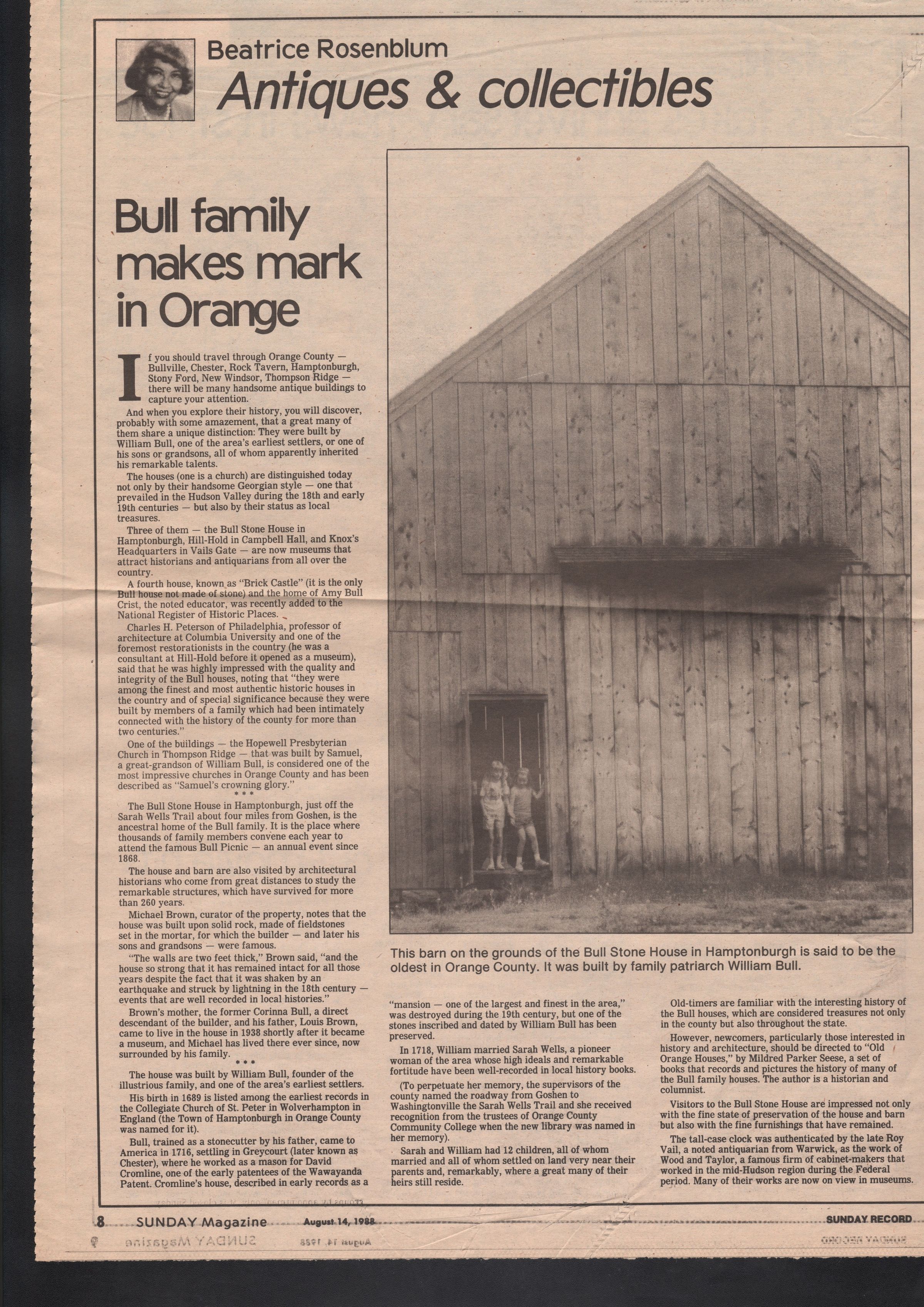
Newspaper "Sunday Record" August 14, 1988 Bull Stone House BarnEntry/Object ID
000376Tags
Bull Stone HouseScope and Content
Beatrice Rosenblum: Antiques & collectibles
Bull family makes mark in Orange
If you should travel through Orange County — Bullville, Chester, Rock Tavern, Hamptonburgh, Stony Ford, New Windsor, Thompson Ridge — there will be many handsome antique buildings to capture your attention.
And when you explore their history, you will discover, probably with some amazement, that a great many of them share a unique distinction: They were built by William Bull, one of the area's earliest settlers, or one of his sons or grandsons, all of whom apparently inherited his remarkable talents.
The houses (one is a church) are distinguished today not only by their handsome Georgian style — one that prevailed in the Hudson Valley during the 18th and early 19th centuries — but also by their status as local treasures.
Three of them — the Bull Stone House in Hamptonburgh, Hill-Hold in Campbell Hall, and Knox's Headquarters in Vails Gate — are now museums that attract historians and antiquarians from all over the country.
A fourth house, known as "Brick Castle" (it is the only Bull house not made of stone) and the home of Amy Bull Crist, the noted educator, was recently added to the National Register of Historic Places.
Charles H. Peterson of Philadelphia, professor of architecture at Columbia University and one of the foremost restorationists in the country (he was a consultant at Hill-Hold before it opened as a museum), said that he was highly impressed with the quality and integrity of the Bull houses, noting that "they were among the finest and most authentic historic houses in the country and of special significance because they were built by members of a family which had been intimately connected with the history of the county for more than two centuries."
One of the buildings — the Hopewell Presbyterian Church in Thompson Ridge — that was built by Samuel, a great-grandson of William Bull, is considered one of the most impressive churches in Orange County and has been described as "Samuel's crowning glory."
The Bull Stone House in Hamptonburgh, just off the Sarah Wells Trail about four miles from Goshen, is the ancestral home of the Bull family. It is the place where thousands of family members convene each year to attend the famous Bull Picnic — an annual event since 1868.
The house and barn are also visited by architectural historians who come from great distances to study the remarkable structures, which have survived for more than 260 years.
Michael Brown, curator of the property, notes that the house was built upon solid rock, made of fieldstones set in the mortar, for which the builder — and later his sons and grandsons — were famous.
"The walls are two feet thick," Brown said, "and the house so strong that it has remained intact for all those years despite the fact that it was shaken by an earthquake and struck by lightning in the 18th century — events that are well recorded in local histories."
Brown's mother, the former Corinna Bull, a direct descendant of the builder, and his father, Louis Brown, came to live in the house in 1938 shortly after it became a museum, and Michael has lived there ever since, now surrounded by his family.
The house was built by William Bull, founder of the illustrious family, and one of the area's earliest settlers.
His birth in 1689 is listed among the earliest records in the Collegiate Church of St. Peter in Wolverhampton in England (the Town of Hamptonburgh in Orange County was named for it).
Bull, trained as a stonecutter by his father, came to America in 1716, settling in Greycourt (later known as Chester), where he worked as a mason for David Cromline, one of the early patentees of the Wawayanda Patent. Cromline's house, described in early records as a "mansion — one of the largest and finest in the area," was destroyed during the 19th century, but one of the stones inscribed and dated by William Bull has been preserved.
In 1718, William married Sarah Wells, a pioneer woman of the area whose high ideals and remarkable fortitude have been well-recorded in local history books.
(To perpetuate her memory, the supervisors of the county named the roadway from Goshen to Washingtonville the Sarah Wells Trail and she received recognition from the trustees of Orange County Community College when the new library was named in her memory).
Sarah and William had 12 children, all of whom married and all of whom settled on land very near their parents and, remarkably, where a great many of their heirs still reside.
Old-timers are familiar with the interesting history of the Bull houses, which are considered treasures not only in the county but also throughout the state.
However, newcomers, particularly those interested in history and architecture, should be directed to "Old Orange Houses," by Mildred Parker Seese, a set of books that records and pictures the history of many of the Bull family houses. The author is a historian and columnist.
Visitors to the Bull Stone House are impressed not only with the fine state of preservation of the house and barn but also with the fine furnishings that have remained.
The tall-case clock was authenticated by the late Roy Vail, a noted antiquarian from Warwick, as the work of Wood and Taylor, a famous firm of cabinet-makers that worked in the mid-Hudson region during the Federal period. Many of their works are now on view in museums.
Photo Caption:
This barn on the grounds of the Bull Stone House in Hamptonburgh is said to be the oldest in Orange County. It was built by family patriarch William Bull.
Footer Information:
8 — SUNDAY Magazine — August 14, 1988 — SUNDAY RECORDRelationships
Related Person or Organization
Person or Organization
Bull Stone House