Newspaper Times Herald-Record Jan 27, 2004 Developer buys last egg farm - Tyler Etzel Sr
Newspaper "Times Herald-Record" Jan 27, 2004 Developer buys last egg farm - Tyler Etzel Sr

Newspaper "Times Herald-Record" Jan 27, 2004 Developer buys last egg farm - Tyler Etzel Sr

Name/Title

Newspaper "Times Herald-Record" Jan 27, 2004 Developer buys last egg farm - Tyler Etzel Sr

Entry/Object ID

000398

Tags

Tyler Etzel

Scope and Content

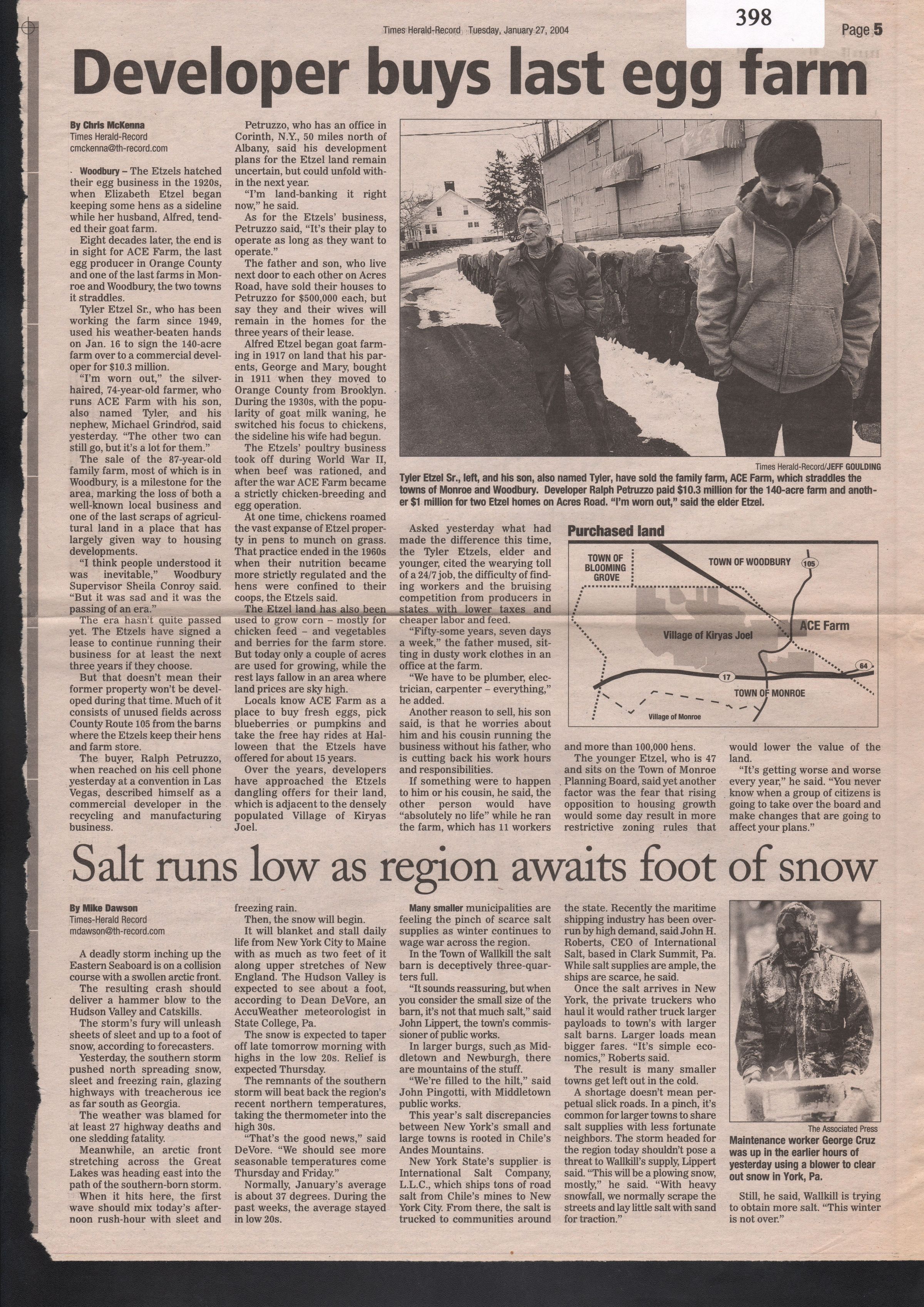
Times Herald-Record, Tuesday, January 27, 2004. Developer buys last egg farm By Chris McKenna Times Herald-Record [email protected] WOODBURY — The Etzels hatched their egg business in the 1920s, when Elizabeth Etzel began keeping some hens as a sideline while her husband, Alfred, tended their goat farm. Eight decades later, the end is in sight for ACE Farm, the last egg producer in Orange County and one of the last farms in Monroe and Woodbury, the two towns it straddles. Tyler Etzel Sr., who has been working the farm since 1949, used his weather-beaten hands on Jan. 16 to sign the 140-acre farm over to a commercial developer for $10.3 million. "I’m worn out," the silver-haired, 74-year-old farmer, who runs ACE Farm with his son, also named Tyler, and his nephew, Michael Grindrod, said yesterday. "The other two can still go, but it’s a lot for them." The sale of the 87-year-old family farm, most of which is in Woodbury, is a milestone for the area, marking the loss of both a well-known local business and one of the last scraps of agricultural land in a place that has largely given way to housing developments. "I think people understood it was inevitable," Woodbury Supervisor Sheila Conroy said. "But it was sad and it was the passing of an era." The era hasn’t quite passed yet. The Etzels have signed a lease to continue running their business for at least the next three years if they choose. But that doesn’t mean their former property won’t be developed during that time. Much of it consists of unused fields across County Route 105 from the barns where the Etzels keep their hens and farm store. The buyer, Ralph Petruzzo, when reached on his cell phone yesterday at a convention in Las Vegas, described himself as a commercial developer in the recycling and manufacturing business. Petruzzo, who has an office in Corinth, N.Y., 50 miles north of Albany, said his development plans for the Etzel land remain uncertain, but could unfold within the next year. "I’m land-banking it right now," he said. As for the Etzels’ business, Petruzzo said, "It’s their play to operate as long as they want to operate." The father and son, who live next door to each other on Acres Road, have sold their houses to Petruzzo for $500,000 each, but say they and their wives will remain in the homes for the three years of their lease. Alfred Etzel began goat farming in 1917 on land that his parents, George and Mary, bought in 1911 when they moved to Orange County from Brooklyn. During the 1930s, with the popularity of goat milk waning, he switched his focus to chickens, the sideline his wife had begun. The Etzels’ poultry business took off during World War II, when beef was rationed, and after the war ACE Farm became a strictly chicken-breeding and egg operation. At one time, chickens roamed the vast expanse of Etzel property in pens to munch on grass. That practice ended in the 1960s when their nutrition became more strictly regulated and the hens were confined to their coops, the Etzels said. The Etzel land has also been used to grow corn — mostly for chicken feed — and vegetables and berries for the farm store. But today only a couple of acres are used for growing, while the rest lays fallow in an area where land prices are sky high. Locals know ACE Farm as a place to buy fresh eggs, pick blueberries or pumpkins and take the free hay rides at Halloween that the Etzels have offered for about 15 years. Over the years, developers have approached the Etzels dangling offers for their land, which is adjacent to the densely populated Village of Kiryas Joel. Asked yesterday what had made the difference this time, the Tyler Etzels, elder and younger, cited the wearying toll of a 24/7 job, the difficulty of finding workers and the bruising competition from producers in states with lower taxes and cheaper labor and feed. "Fifty-some years, seven days a week," the father mused, sitting in dusty work clothes in an office at the farm. "We have to be plumber, electrician, carpenter — everything," he added. Another reason to sell, his son said, is that he worries about him and his cousin running the business without his father, who is cutting back his work hours and responsibilities. If something were to happen to him or his cousin, he said, the other person would "absolutely no life" while he ran the farm, which has 11 workers and more than 100,000 hens. The younger Etzel, who is 47 and sits on the Town of Monroe Planning Board, said yet another factor was the fear that rising opposition to housing growth would some day result in more restrictive zoning rules that would lower the value of the land. "It’s getting worse and worse every year," he said. "You never know when a group of citizens is going to take over the board and make changes that are going to affect your plans." Salt runs low as region awaits foot of snow By Mike Dawson Times Herald-Record [email protected] A deadly storm inching up the Eastern Seaboard is on a collision course with a swollen arctic front. The resulting crash should deliver a hammer blow to the Hudson Valley and Catskills. The storm’s fury will unleash sheets of sleet and up to a foot of snow, according to forecasters. Yesterday, the southern storm pushed north spreading snow, sleet and freezing rain, glazing highways with treacherous ice as far south as Georgia. The weather was blamed for at least 27 highway deaths and one sledding fatality. Meanwhile, an arctic front stretching across the Great Lakes was heading east into the path of the southern-born storm. When it hits here, the first wave should mix today’s afternoon rush-hour with sleet and freezing rain. Then, the snow will begin. It will blanket and stall daily life from New York City to Maine with as much as two feet of it along upper stretches of New England. The Hudson Valley is expected to see about a foot, according to Dean DeVore, an AccuWeather meteorologist in State College, Pa. The snow is expected to taper off late tomorrow morning with highs in the low 20s. Relief is expected Thursday. The remnants of the southern storm will beat back the region’s recent northern temperatures, taking the thermometer into the high 30s. "That’s the good news," said DeVore. "We should see more seasonable temperatures come Thursday and Friday." Normally, January’s average is about 37 degrees. During the past weeks, the average stayed in low 20s. Many smaller municipalities are feeling the pinch of scarce salt supplies as winter continues to wage war across the region. In the Town of Wallkill the salt barn is deceptively three-quarters full. "It sounds reassuring, but when you consider the small size of the barn, it’s not that much salt," said John Lippert, the town’s commissioner of public works. In larger burgs, such as Middletown and Newburgh, there are mountains of the stuff. "We’re filled to the hilt," said John Pingotti, with Middletown public works. This year’s salt discrepancies between New York’s small and large towns is rooted in Chile’s Andes Mountains. New York State’s supplier is International Salt Company, L.L.C., which ships tons of road salt from Chile’s mines to New York City. From there, the salt is trucked to communities around the state. Recently the maritime shipping industry has been overrun by high demand, said John H. Roberts, CEO of International Salt, based in Clark Summit, Pa. While salt supplies are ample, the ships are scarce, he said. Once the salt arrives in New York, the private truckers who haul it would rather truck larger payloads to town’s with larger salt barns. Larger loads mean bigger fares. "It’s simple economics," Roberts said. The result is many smaller towns get left out in the cold. A shortage doesn't mean perpetual slick roads. In a pinch, it’s common for larger towns to share salt supplies with less fortunate neighbors. The storm headed for the region today shouldn't pose a threat to Wallkill’s supply, Lippert said. "This will be a plowing snow, mostly," he said. "With heavy snowfall, we normally scrape the streets and lay little salt with sand for traction." Still, he said, Wallkill is trying to obtain more salt. "This winter is not over."

Relationships

Related Person or Organization

Person or Organization

Tyler Etzel