Name/Title
June 1, 1905 Bull Family History Newspaper ArticleEntry/Object ID
000425Tags
Bull FamilyScope and Content
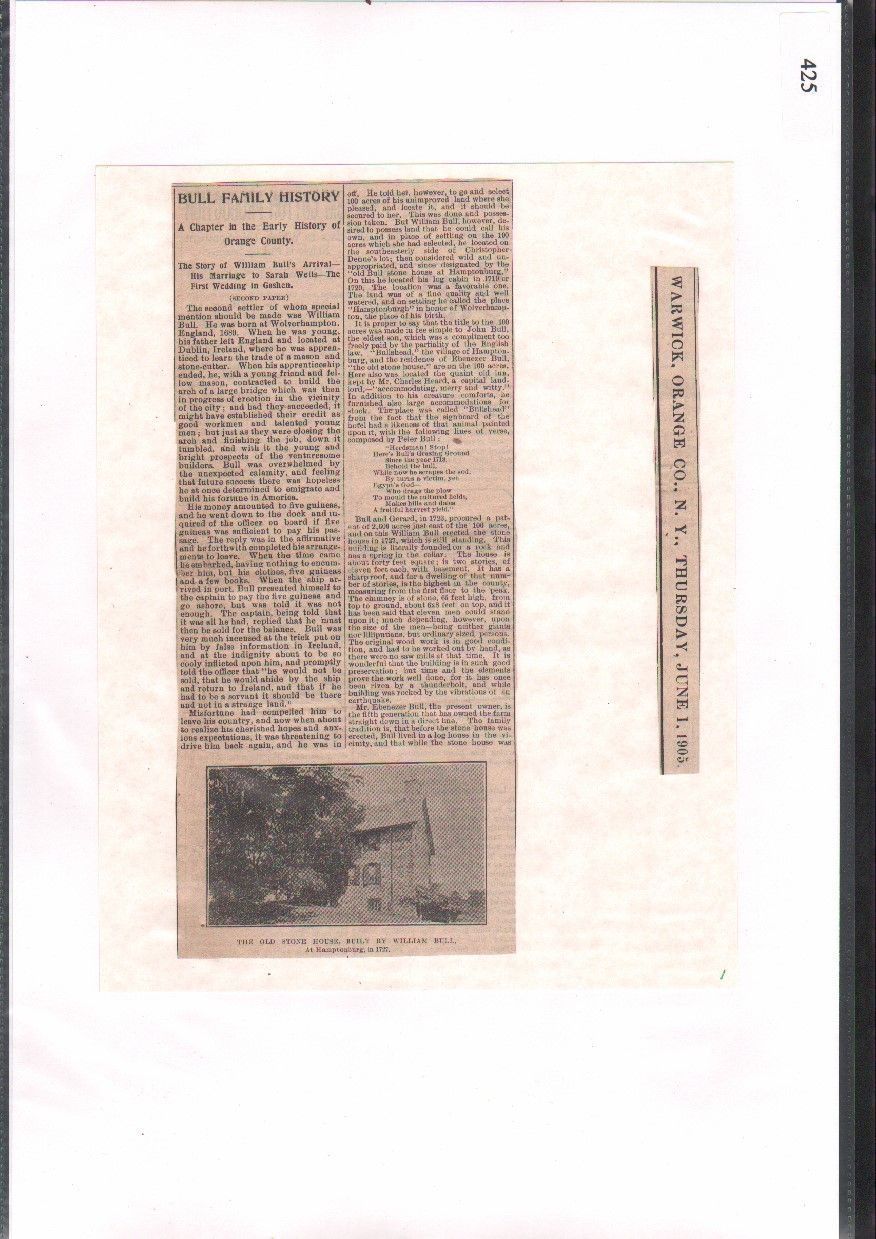
BULL FAMILY HISTORY
A Chapter in the Early History of Orange County.
(SECOND PAPER)
The Story of William Bull’s Arrival—His Marriage to Sarah Wells—The First Wedding in Goshen.
The second settler of whom special mention should be made was William Bull. He was born at Wolverhampton, England, 1689. When he was young, his father left England and located at Dublin, Ireland, where he was apprenticed to learn the trade of a mason and stone-cutter. When his apprenticeship ended, he, with a young friend and fellow mason, contracted to build the arch of a large bridge which was then in progress of erection in the vicinity of the city; and had they succeeded, it might have established their credit as good workmen and talented young men; but just as they were closing the arch and finishing the job, down it tumbled, and with it the young and bright prospects of the venturesome builders. Bull was overwhelmed by the unexpected calamity, and feeling that future success there was hopeless he at once determined to emigrate and build his fortune in America.
His money amounted to five guineas, and he went down to the dock and inquired of the officer on board if five guineas was sufficient to pay his passage. The reply was in the affirmative and he forthwith completed his arrangements to leave. When the time came he embarked, having nothing to encumber him, but his clothes, five guineas and a few books. When the ship arrived in port, Bull presented himself to the captain to pay the five guineas and go ashore, but was told it was not enough. The captain, being told that it was all he had, replied that he must then be sold for the balance. Bull was very much incensed at the trick put on him by false information in Ireland, and at the indignity about to be so coolly inflicted upon him, and promptly told the officer that "he would not be sold, that he would abide by the ship and return to Ireland, and that if he had to be a servant it should be there and not in a strange land."
Misfortune had compelled him to leave his country, and now when about to realize his cherished hopes and anxious expectations, it was threatening to drive him back again, and he was in [illegible] off. He told her, however, to go and select 100 acres of his unimproved land where she pleased, and locate it, and it should be secured to her. This was done and possession taken. But William Bull, however, desired to possess land that he could call his own, and in place of setting on the 100 acres which she had selected, he located on the southeasterly side of Christopher Denn’s lot; then considered wild and unappropriated, and the residence of Ebenezer Bull, the "old Bull stone house at Hamptonburgh." On this he located his log cabin in 1718 or 1720. The location was a favorable one. The land was of a fine quality and well watered, and on settling he called the place "Hamptonburgh" in honor of Wolverhampton, the place of his birth.
It is proper to say that the title to the 100 acres was made in fee simple to John Bull, the eldest son, which was a compliment too freely paid by the partiality of the English law, "Bullshead," the village of Hamptonburgh, and the residence of Ebenezer Bull, "the old stone house," are on the 100 acres. Here also was located the quaint old inn, kept by Mr. Charles Heard, a capital landlord, "accommodating, merry and witty." In addition to his creature comforts, he furnished also some accommodations for stock. The place was called "Bullshead" from the fact that the signboard of the hotel had a likeness of that animal painted upon it, with the following lines of verse, composed by Peter Bull:
"Herdsman! Stop!
Here's Bull's Grazing Ground
Since the year 1718.
Behold the bull,
While now he scrapes the sod.
By turns a victim, yet
Giving a God—
Who drags the plow
To mould the rutted fields,
Makes hills and dales
A fruitful harvest yield."
Bull and Gerard, in 1728, procured a patent of 2,020 acres just east of the 100 acres, and on this William Bull erected the stone house in 1727, which is still standing. This building is literally founded on a rock and has a spring in the cellar. The house is about forty feet square; is two stories, of eleven feet each, with basement. It has a sharp roof, and far a dwelling of that number of stories, is the highest in the county, measuring from the first floor to the peak. The chimney is of stone, 68 feet high, from top to ground, about 6x8 feet on top, and it has been said that eleven men could stand upon it; much depending, however, upon the size of the men—being rather giants nor Lilliputians, but ordinary sized persons. The original wood work is in good condition, and had to be worked out by hand, as there were no saw mills at that time. It is wonderful that the building is in such good preservation; but time and the elements prove the work well done, for it has once been riven by a thunderbolt, and while building was rocked by the vibrations of an earthquake.
Mr. Ebenezer Bull, the present owner, is the fifth generation that has owned the farm straight down in a direct line. The family tradition is, that before the stone house was erected, Bull lived in a log house in the vicinity, and that while the stone house was...