Name/Title
Nov 9, 1909 Story of Sarah Wells "Pioneer Maid of Wawayanda" Newspaper ArticleEntry/Object ID
000426Tags
Sarah WellsScope and Content
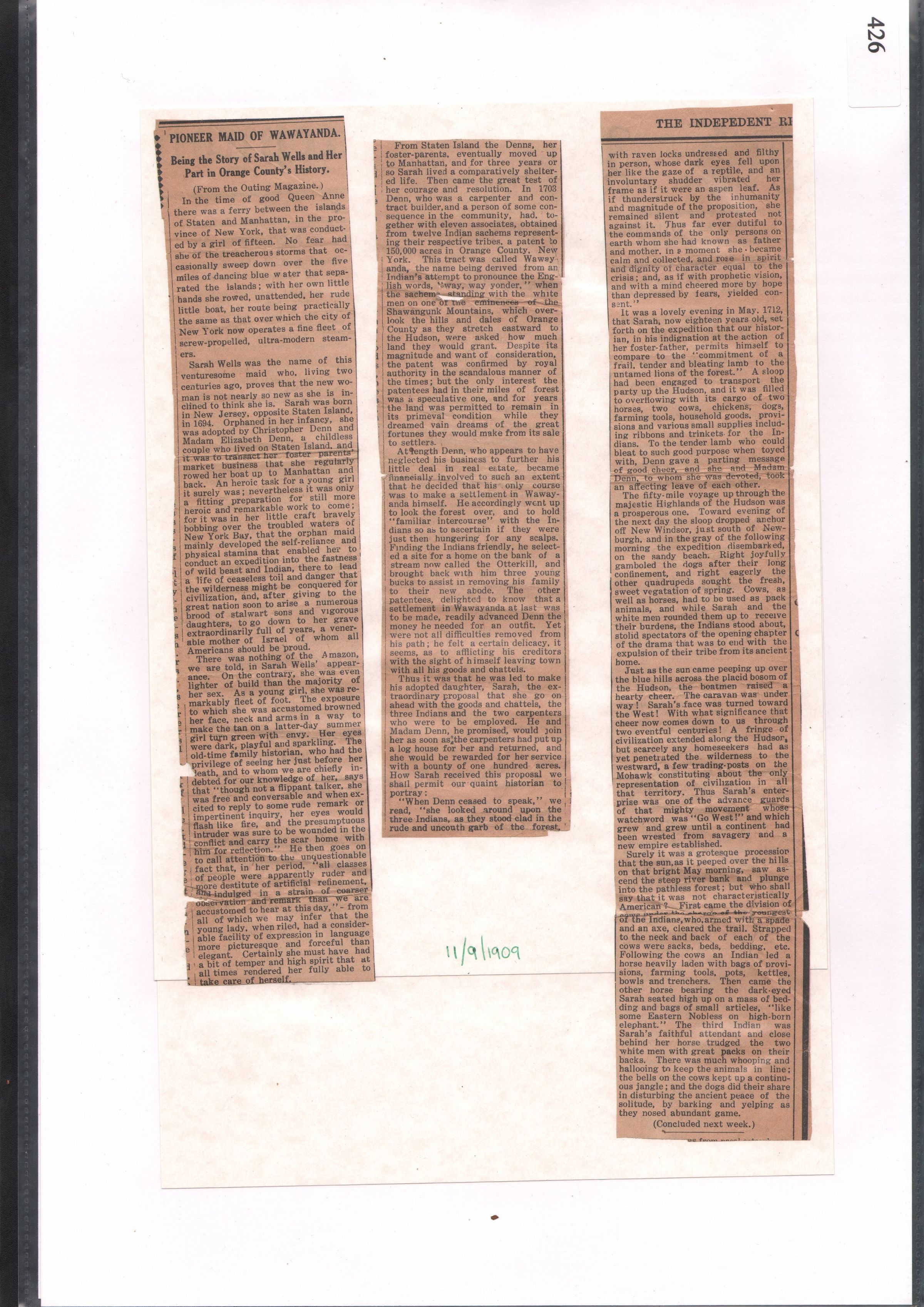
PIONEER MAID OF SAWAWANDA. Being the Story of Sarah Wells and Her Part in Orange County’s History.
(From the Outing Magazine.)
In the time of good Queen Anne there was a ferry between the islands of Staten and Manhattan, in the province of New York, that was conducted by a girl of fifteen. No fear had she of the treacherous storms that occasionally swept down over the five miles of dancing blue water that separated the islands; with her own little hands she rowed, unattended, her rude little boat, her route being practically the same as that over which the city of New York now operates a fine fleet of screw-propelled, ultra-modern steamers.
Sarah Wells was the name of this venturesome maid who, living two centuries ago, proves that the name of woman is not nearly so new as she is. In New Jersey, opposite Staten Island, there lived in her infancy, she was adopted by Christopher Denn and Madam Elizabeth Denn, a childless couple who lived on Staten Island, and market business that she regularly rowed her boat up to Manhattan and back. An heroic task for a young girl it surely was; nevertheless it was only a light preparation for still more heroic and remarkable work to come; for it was in her little craft bravely bobbing over the troubled waters of New York Bay, that the orphan maid mainly developed the self-reliance and physical stamina that enabled her to conduct an expedition into the fastness of wild beast and danger that would have daunted the most hardy of civilization, and, after giving to the great nation soon to arise a numerous brood of stalwart sons and vigorous daughters, to go down to her grave extraordinarily full of years, a venerable mother of Israel of whom all Americans should be proud.
There was nothing of the Amazon, we are told, in Sarah Wells' appearance. On the contrary, she was even lighter of build than the majority of her sex. As a young girl, she was remarkably fleet of foot. The exposure to which she was accustomed browned her face, neck and arms in a way to make the tan on her last before her death, to whom we are chiefly indebted to our knowledge of her, says that "though not a flippant talker, she was free and conversational and when excited to reply to some rude remark or impertinent inquiry, her eyes would flash like fire, and the presumptuous intruder was sure to be wounded in the conflict and carry the scar home with him for reflection." He then goes on to call attention to the unquestionable fact that, in her period, "all classes of people were apparently ruder and more destitute of artificial refinement, and more given to the coaser [coarser] observation and remark than we are accustomed to hear at this day,"—from all of which we may infer that the young lady, when riled, had a considerable facility of expression in language more picturesque and forceful than elegant. Certainly she must have had a bit of temper and high spirit that at all times rendered her fully able to take care of herself.
From Staten Island the Dennis, her foster-parents, eventually moved up to Manhattan, and for some years led a comparatively sheltered life. Then came the great test of courage and resolution. In 1703 Denn, who was a carpenter and contract builder, and a person of some consequence in the community, had, together with eleven associates, obtained a log house in their miles of forest and land they would grant. Despite its being a speculative one, and for years the land was permitted to remain in its primeval condition while they dreamed vain dreams of the great fortunes they would make from its sale to settlers.
Afterward Denn, who appears to have neglected his business to further his scheme, and the others, began to feel financially involved to such an extent that he decided that his only course was to make a settlement in Wawayanda and to hold land they would grant, and to hold "familiar intercourse" with the Indians so as to ascertain if they were just then hungering for any scalps. Finding the Indians friendly, he selected a site for the home on the bank of a stream now called the Otterkill, and brought back with him three young bucks to assist in removing his family to their new abode. The other patentees, delighted to know that a settlement in Wawayanda at last was to be made, readily advised Denn the money he needed for an outfit. Yet were not all difficulties removed from his path: he felt a certain delicacy, it seems, as to affixing his creditors with the sight of himself leaving town with all his goods and chattels.
"When Denn ceased to speak," we read, "she looked around upon the three Indians, as they stood clad in the rude and uncouth garb of the forest, with raven locks undressed and filthy in person, whose dark eyes fell upon her like the gaze of a reptile, and an involuntary shudder vibrated her frame as if it were an aspen leaf. As if thunderstruck by the inhumanity and magnitude of the proposition, she remained silent and protested not against it. Her face was turned toward the earth whom she had known as father and mother. In a moment she became calm and collected, and rose in spirit and dignity as if with prophetic vision, and with a mind cheered more by hope than depressed by fears, yielded consent."
It was a lovely evening in May, 1712, that Sarah, now eighteen years old, set forth on the expedition that our historian, in his indignation at the action of her foster-father, calls the "commitment of a frail, tender and bleating lamb to the untamed lions of the forest." A sloop had been engaged to transport the provisions and various small goods for the Indians, two cows, chickens, dogs, farming tools, household goods, provisions and various small items for the Indians—the tender lamb who could bleat to such good purpose when toyed with, then gave a parting message of good cheer—and she and Madam Denn, to whom she was devoted, took the next day the sloop dropped anchor off New Windsor, just south of Newburgh, and in the following morning the party went up the creek on the sandy beach. Right joyfully gamboled the dogs after their long confinement, and right eagerly the other quadrupeds sought the fresh, sweet vegetation of spring. Cows, as well as horses, had to be used as pack animals, and while Sarah and the white men rounded them up to receive their burdens, the Indians stood about, spectators of the opening chapter of the drama that was to end with the expulsion of their tribe from its ancient home.
Just as the sun came peeping up over the blue hills across the placid bosom of the Hudson, the boatmen raised a hearty cheer. The caravan was under way! With what significance that cheer now comes down to us through two eventful centuries! A fringe of civilization extended along the Hudson, yet penetrated the wilderness to the westward, a few trading-posts on the Mohawk constituting the only representation of civilization, and such was one of the advance guards of that mighty movement whose watchword was "Go West!" and which grew and grew and swept over the continent from savagery and a new empire established.
Surely it was a grotesque procession that the sun as it peeped over the hills saw as it went the steep river bank and plunge into the pathless forest; but who shall say that it was not characteristically American? First of the youngest of the Indians, who, armed with a spade and an axe, cleared the trail. Slipped the pack-horses, heavily laden with a mass of provisions—sacks, beds, kettles, bowls and trenchers, pots, kettles, and other horse bearing the dark-eyed Sarah seated high up on a mass of bedding and bags of small articles, "like the belles of the elephant." The third Indian was Sarah's faithful attendant and close behind her trudged the two white men with great packs on their backs. There was much whooping and hallooing to keep the animals in line; the bells on the cows kept up a continuous jangle; and the dogs did their share in disturbing the ancient peace of the solitude, by barking and yelping as they nosed abundant game. (Concluded next week.)Relationships
Related Person or Organization
Person or Organization
Sarah Wells