Name/Title
Picnic articleEntry/Object ID
000427Tags
William Bull, Bull PicnicScope and Content
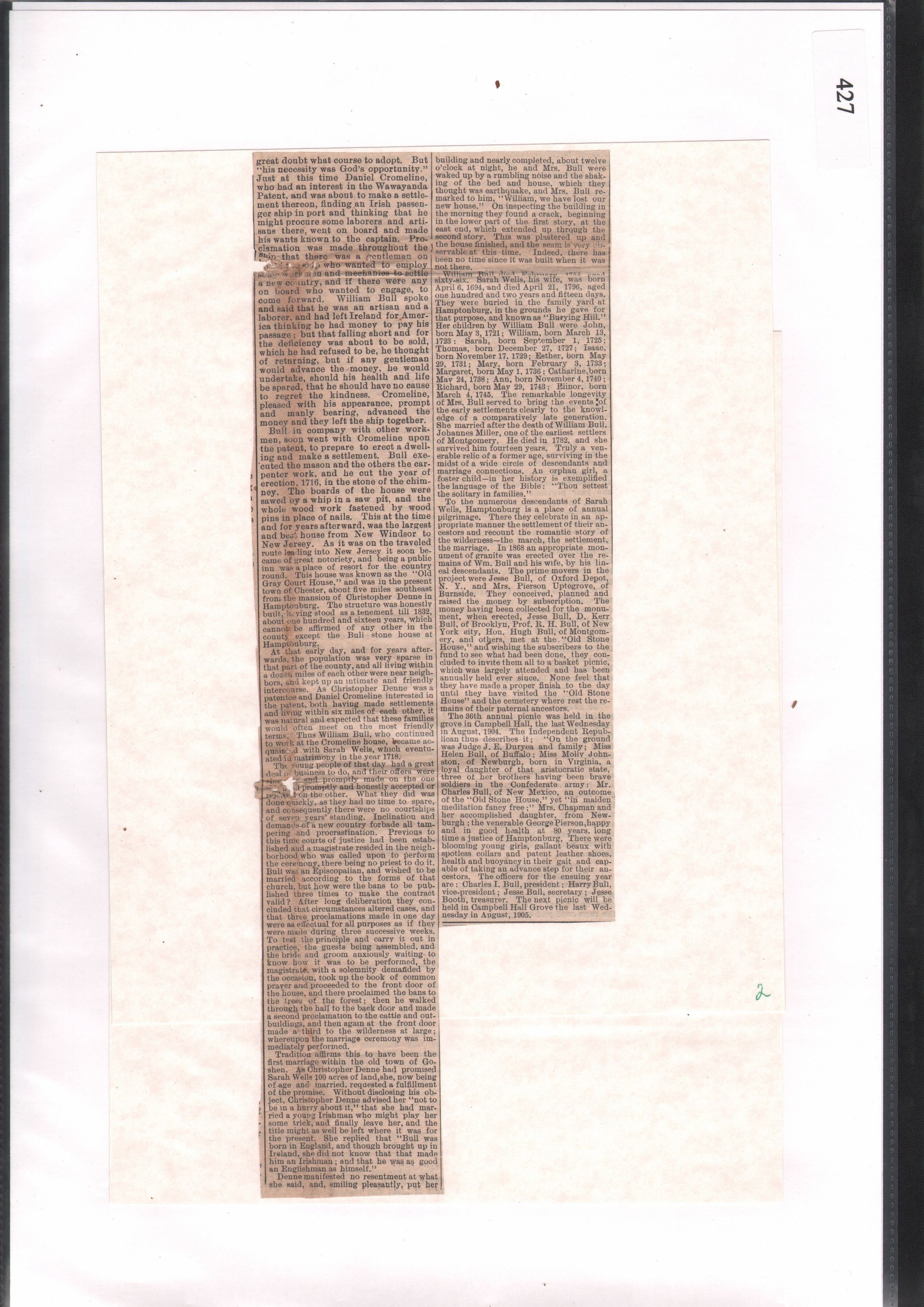
great doubt what course to adopt. But this necessity was God's opportunity. Just at this time Daniel Cromeline, who had an interest in the Wawayanda Patent, and was about to make a settlement thereon, finding an Irish passenger ship in port and thinking that he might procure some laborers and artisans there, went on board and made his wants known to the captain. Proclamation was made throughout the ship that there was a [illegible] who wanted to employ some work men and mechanics to settle a new country, and if there were any on board who wanted to engage, to come forward. William Bull spoke and said that he was an artisan and a laborer, and had left Ireland for America thinking he had money to pay his passage, but that falling short and for the deficiency was about to be sold, which he had refused to be, he thought of returning, but if any gentleman would advance the money, he would undertake, should his health and life be spared, that he should have no cause to regret the kindness. Cromeline, pleased with his appearance, promptly and simply bearing, advanced the money and they left the ship together.
Bull in company with other workmen, soon went with Cromeline upon the patent, to prepare to erect a house and to make a settlement. Bull executed the mason and the others the carpenter work, and he cut the year of erection, 1716, in the stone of the chimney. This house of this house was sawed by a whip in a saw pit, and the whole wood work fastened by wood pins in place of nails. This at the time and for years afterward, was the largest and best house from New Windsor to New Jersey. As it was on the traveled route leading into New Jersey it soon became of great notoriety, and many summer parties made place of resort for the country round. This house was known as the "Old Gray Court House," and was in the present town of Chester, about five miles southeast from the mansion of Christopher Denne in Hamptonburgh. The structure was honestly built, in some cases of settlement till 1832, about one hundred and sixteen years, which cannot be affirmed of any other of the county, except the Bull stone house at Hamptonburgh.
At that early day, and for years afterward, the population was very sparse, in that part of the county, and all living within a dozen miles of each other were near neighbors, and kept up an intimate and friendly intercourse. As Christopher Denne was a patentee and Daniel Cromeline interested in the patent, both having made settlements and living within six miles of each other, it was natural and expected that these families would often meet on the most friendly terms. Thus William Bull, who continued to work at the Cromeline house, became acquainted with Sarah Wells, which eventually led to matrimony in the year 1718.
The young people of that day had a great deal of business to do if they chose marriage, which was promptly made on the one hand, and promptly and honestly accepted or not as the case was. Great work had to be done quickly, as they had no time to spare, and consequently there were no courtships of seven years' standing. Inability to pay magistrates a heavy country forbade all tampering and procrastination. Previous to this time courts of justice had been established but a magistrate resided in the neighborhood who was called upon to perform the ceremony, there being no priest to do it. Bull and his [illegible]s, as it worked to be married according to the forms of that church, but how were the bans to be published these bans to make the contract valid? After long deliberation they concluded that circumstances altered cases, and they chose procrastination mode in one day were as effectual for all purposes as if they were made during three successive weeks. To test the principles and carry it out in practice, the guests being assembled, and the bride and groom anxiously waiting to know how it was to be performed, the magistrate with a solemnity demanded by the occasion, took up the book of common prayer and proceeded to the front door of the house, and there proclaimed the bans to the [trees of the forest; then he walked through the hall to the back door and made a similar proclamation to the trees and the buildings, and then again at the front door made a third to the wilderness at large; where upon the marriage ceremony was immediately performed.
Tradition affirms this to have been the first marriage within that, or town, of Goshen. As Christopher Denne had promised Sarah Wells 100 acres of land, she, now being of age and married, one needed a fulfillment of the promise. Without disclosing his object, Christopher Denne advised her "not to go in a hurry about it," but that he married a young Irishman who might play her some trick, and finally leave her, and the title might as well be left where it was for the present. She replied that "Bull was born in England, and though brought up in Ireland, she did not know that that made him an Irishman; and that he was as good an Englishman as himself."
Denne manifested no resentment at what she said, and, smiling, pleasantly put her
[Second Column]
building and nearly completed, about twelve o’clock at night, and he Mrs. Bull were waked up by a rumbling noise and the shaking of the bed and house, which they thought was earthquake, and Mrs. Bull remarked to him, "William, we have lost our new house." On inspecting the building in the morning they found a crack, beginning in the lower part of the first story, at the east end, which extended up through the second story. This was plastered up and the house finished, and the house is very observable at this time. Indeed, there has been no time since it was built when it was not there.
William Bull died February 1755, aged sixty-six. Sarah Wells, his wife, was born April 6, 1694, and died April 21, 1796, aged one hundred and two years and fifteen days. They were buried in the family plot at Hamptonburgh, in the grounds he gave for that purpose, and known as "Burying Hill." Her children by William Bull: John, born May 3, 1721; William, born March 13, 1723; Sarah, born September 1, 1725; Thomas, born December 27, 1727; Isaac, born November 17, 1729; Esther, born May 29, 1731; Mary, born February 3, 1733; Margaret, born May 1, 1736; Catharine, born May 24, 1738; Ann, born November 4, 1740; Richard, born May 29, 1743; Elinor, born March 4, 1745. The remarkable longevity of Mrs. Bull served to bring the start of the early settlements clearly to the knowledge of a comparatively late generation. Her married survival led him to fourteen years. Truly a venerable relic of a former age, surviving in the midst of a wide circle of descendants and marriage connections. An orphan and a foster child—in her history is exemplified the language of the bible: "Thou settest the solitary in families."
To the numerous descendants of Sarah Wells, Hamptonburgh is a place of annual pilgrimage. There they celebrate in an appropriate manner the settlement of their ancestors and recount the romantic story of the wilderness—the march, the settlement, the marriage. In 1868 an appropriate monument of granite was erected over the remains of Wm. Bull and his wife, by his lineal descendants. The prime movers in the project were Jesse Bull, of Oxford Depot, N. Y., and Mrs. Pierson Uptegrove, of Burnside. They conceived, planned and raised the money by subscription. The money having been collected for the monument, when erected, Jesse Bull, D. Kerr Bull, of Brooklyn, Prof. R. H. Bull, of New York city, Hon. Hugh Bull, of Montgomery, and others, met at the "Old Stone House," and wishing the subscribers to the fund to see what had been done, they concluded to invite them all to a basket picnic, which was largely attended and has been annually held ever since. None feel that they have made a proper finish to the day until they have visited the "Old Stone House" and the cemetery where rest the remains of their paternal ancestors.
The 36th annual picnic was held in the grove in Campbell Hall, the last Wednesday in August, 1904. The Independent Republican thus describes it; "On the ground was Judge J. E. Duryea and family; Miss Helen Bull, of Buffalo; Miss Molly Johnston, of Newburgh, born in Virginia, a loyal daughter of that aristocratic state, three of her brothers having been brave soldiers in the Confederate army; Mr. Charles Bull, of New Mexico, an outcome of the "Old Stone House," yet "in maiden meditation fancy free;" Mrs. Chapman and her accomplished daughter, from Newburgh; the venerable George Pierson, happy and in good health at 80 years, long time a justice of Hamptonburgh, There were blooming young girls, gallant beaux with spotless collars and patent leather shoes, health and buoyancy in their gait and capable of taking an advance step for their ancestors. The officers for the ensuing year are: Charles I. Bull, president; Harry Bull, vice-president; Jesse Bull, secretary; Jesse Booth, treasurer. The next picnic will be held in Campbell Hall Grove the last Wednesday in August, 1905."