Name/Title
August 30, 1912 - 200th Anniversary of Coming of Sarah Wells at Old Stone HouseEntry/Object ID
000432Tags
Sarah Wells, Bull Stone HouseScope and Content
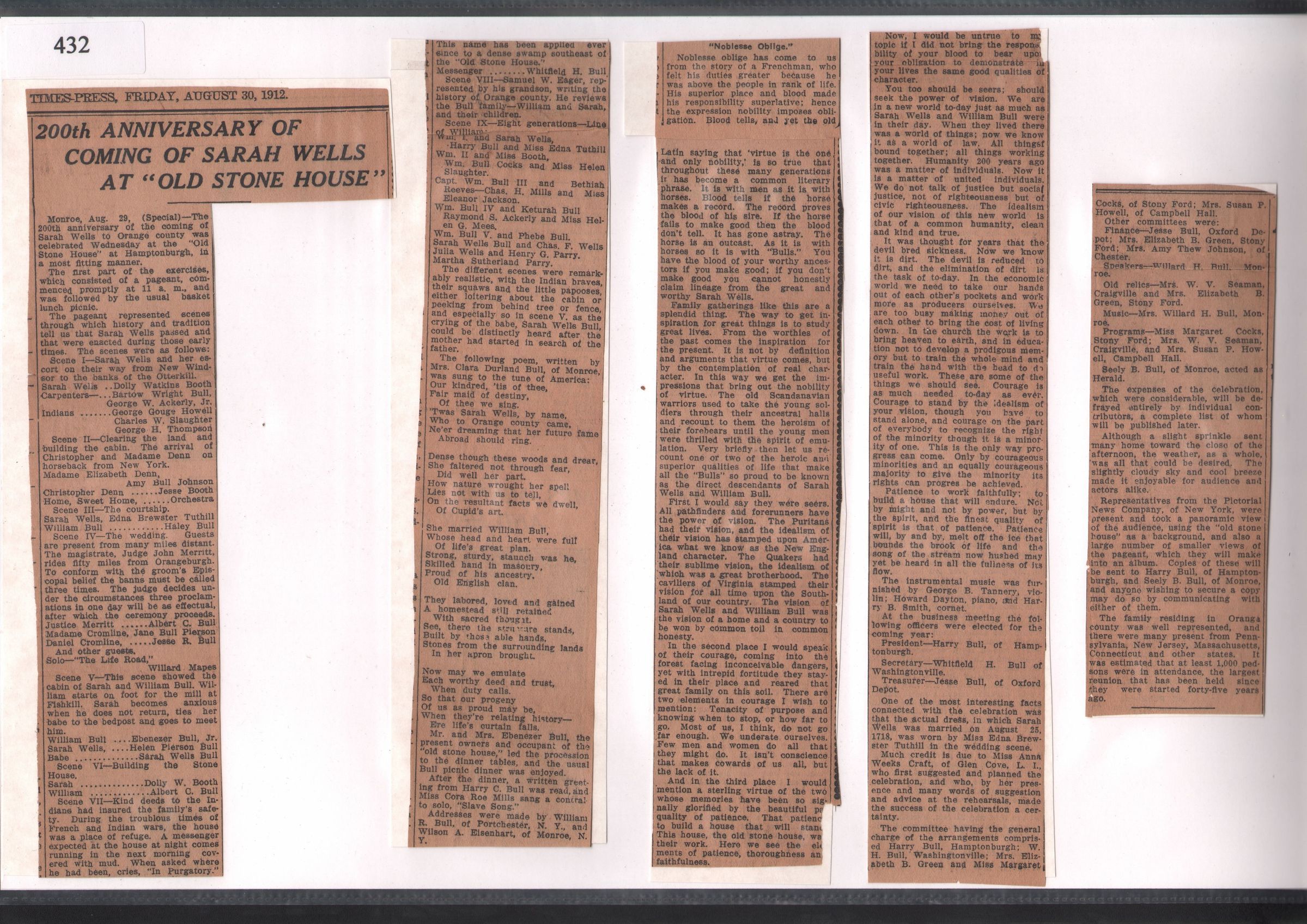
This is a transcript of the historical newspaper clipping titled "200th Anniversary of Sarah Wells Coming of Old Stone House" from the Times-Press, Friday, August 30, 1912.
200th Anniversary of Sarah Wells Coming of "Old Stone House"
Monroe, Aug. 29 (Special) – The 200th anniversary of the coming of Sarah Wells to Orange county was celebrated Wednesday at the "Old Stone House," near Washingtonville, in the presence of many.
The event consisted of a pageant, commenced promptly at 11 a.m., and was followed by the usual basket luncheon.
The pageant represented scenes through which history and tradition tell us that Sarah Wells passed and that were enacted during the pageant. The scenes were arranged as follows:
Scene I—Sarah Wells and her escort on their way from New Windsor to the banks of the Otterkill.
Scene II—Dolly Booth, Sarah Wells, George Gouge, Howel, William W. Wright, George W. Ackerly, Jr., and others.
Scene III—Sarah Wells, land and building the cabin. The arrival of horseback from New York.
Scene IV—The courtship... Christopher Denn, Amy Bull, Johnson, Sarah Wells, Edna Brewster...
Scene V—The wedding. Guests are present from many miles distant. The magistrate, Judge Judge, rides fifty miles from Orange, and in the old days the bride and groom could be the banns must be called. The judge decides under the circumstances three proclamations in one day will be as effectual. Justice Merritt, Caleb, C. Bull, Madame Cromline, Jane Bull, Pierson, Daniel Cromline,... Jesse R. Bull and other guests.
Solo—"The Life Road,"...
Scene V—This scene showed the cabin of Sarah and William Bull. William starts on foot for the mill to buy corn, facing the wild, anxious that he does not return, ties her babe to the bedpost and goes to meet him.
Scene VI—Building the Stone House. William Bull, Ebenezer Bull, Jr., Sarah Wells, Sarah Wells Bull.
Scene VII—Building the Stone House, Sarah... Dolly W. Booth...
Scene VIII—The troubles of the time. The Indian raids. The Indians had insured the troubles of the day. During the troublous times of French and Indian wars, the house was a place of safety; the women and children in the house at night comes running in the next morning covered with mud. When asked where he had been, cries, "In Purgatory."
Column 2
This name has been applied ever since to a dense swamp southeast of the "Old Stone House."
Messenger... Whitfield H. Bull, Scene VIII—Samuel W. Eager, represented by his grandson, writing the history of Orange county. The family of the Bull family—William and Sarah, and their children.
Scene IX—Eight generations—Line of William and Sarah Wells.
William and Sarah Wells.
Sarah Bull and Miss Edna Tuthill.
II and Miss Booth.
Mrs. James Cocks and Miss Helen Slaughter.
Capt. Wm. Bull III and Bethiah Reeves—Chas. H. Mills and Miss Helen Jackson.
Wm. Bull V and Phebe Bull. Raymond S. Ackerly and Miss Helen G. Mees.
Wm. Bull V. and Phebe Bull. Miss Julia Wells and Chas. F. Wells. Martha Sutherland, G. Parry.
The different scenes were remarkably realistic, with the Indian braves, the grass squads and the little papoose, either being led about the cabin or peeking from behind a tree, and especially so in scene V, as the crying of the babe, Sarah Wells Bull, could be distinctly heard after the mother had started in search of the father.
The following poem, written by Mrs. Clara Durland Bull, of Monroe, was sung to the tune of America:
Fair moonlight, 'tis of thee, Fair mountain, 'tis of thee, Of thee we sing.
'Twas Sarah Wells, by name, Who to Orange county came, Ne'er dreaming that her future fame Abroad should ring.
Dense though these woods and drear, She faltered not through fear, "Home, Sweet Home."
She met her lot with well, Lies not with us to tell, On the resultant facts we dwell, Of Cupid's art.
She married William Bull, Whose heart and home were full Of life's great test.
Strong, sturdy, staunch was he, Skilled hand in masonry, Proud of his ancestry, Old English clan.
They labored, loved, and gained. A homestead still retained. With sacred thought.
Built by the stone shrine stands, The fruit of their hands, Stones from the surrounding lands In her apron brought.
Now we may emulate The virtues she held and trust, When duty calls.
So that our progeny Of us as proud may be, When they're relating history—That they may, too, build.
Mr. and Mrs. Edna, Mrs. Bull, the present owners and occupant of the "old stone house," led the procession to the dinner tables, and the usual full basket dinner was enjoyed.
After dinner, there was a brief greeting from Harry C. Bull was read, from Miss Cora Roe mills sang a song! Addresses were made by William H. Bull, of Rochester, N. Y., and Wilson A. Eisenhart, of Monroe, N. Y.
Column 3
"Noblesse Oblige."
Noblesse oblige has come to us from the French. It means those who have the duty greater because one was above the people in rank of life. His superior place and blood made his responsibility superlative; hence the expression nobility imposes obligation. Blood cells, and yet the old Latin saying that "virtue is the one only nobility," is so true that throughout these many generations it has become a common literary phrase. It is with men as it is with thoroughbred horses. The blood makes a record. The record proves the blood of his sire. If the horse fails to make good then the blood doesn't. It has lost it. With horses it is an outcast. It is so with men. It is the truth. We have the proof of your worthy ancestors if you make good; if you don't make you cannot honestly claim lineage from the great and noble blood of the past.
Family gatherings like this are a splendid thing. The way to get inspiration for great things is to study great lives. From the worthies of the past comes the inspiration for the present. It is not the pedigree and arguments that virtue comes, but by the contemplation of real character. In this way we get the nobility passions that bring out the nobility of character. We are proud of the warriors used to take the young soldiers through their ancestral halls and recount to them the heroic and superior qualities of life that make all the "Bulls" so proud to be known as the descendants of Sarah Wells and William Bull.
First, I would say they were seers. All pathfinders and forerunners have the power of vision. The Puritans had their vision, and the idealism of a new world, the germ of this America, what we know as the American character. The Quakers had their sublime vision, the idealism of which was a great brotherhood. The colony of Virginia stamped their vision of a home and a country to be on our country, the vision of Sarah Wells and William Bull was the vision of a home and a country to be won by common toil in common loyalty.
In the second place I would speak of their courage, coming into the forest facing inconceivable dangers, yet with intrepid fortitude they stayed. Sarah Wells endured and reared that great family on this hill. These are two elements in courage: I wish to mention: Tenacity of purpose and knowing what to stop, or how far to go. Most of us, I think, do not go far enough. We need the willpower. Few men and women do the thing they might do. It isn't conscience that makes cowards of us all, but the lack of it.
And in the third place I would mention a sterling worth. Many who whose memories have been so signally glorified by the beautiful quality of patience, that patience to build a house that will stand. The great life is made up of patience in their work. Here we see the merits of patience, thoroughness and faithfulness.
Column 4
Now, I would be untrue to my topic if I did not bring the responsibility of you today, the young, and your obligation to demonstrate in a new world today-just as much as Sarah Wells and William Bull were in their day. When they lived there was a world of things; now we know it is a world of individuals. Now it is a matter of united individuals, bound together; all things bound together. Humanity 200 years ago was a world of individuals. Now it is a matter of united individuals, the no talk of justice but social justice. Not of righteousness but of civic righteousness. The idealism of our vision of this new world is that of a common humanity, clean and kind and true.
The first part of the exercises, devil bred sickness. Now we know it is dirt. The devil is reduced to dirt, and the elimination of dirt is the task of to-day. In the economic world, we must all take our hands out of each other's pockets and work more as producers ourselves. We are too busy making money out of each other to bring the cost of living down. In the church the work is to teach children to live. School is not only to develop a prodigious memory but to train the whole mind and train the hand with the head to do useful work. These are some of the things that require courage. Courage is as much needed today as it was. Courage to stand by the idealism of your vision, these thoughts you have to stand alone, and courage on the part of the minority to stand for the rights of the minority against the tyranny of the one. This is the only way progress can come. Only by courageous minorities and an equally courageous majority to give the minority its rights, can progress be made.
Patience to work faithfully. To build a house that will endure. Not by might and not by power, but by the spirit, and the finest quality of the spirit of this age, the Patience will, and by the melt of the patience song of the brook of life and the song of the stream now hushed may yet be heard in all the fullness of its joy.
The instrumental music was furnished by George B. Tannery, victory; by Howard Dayton, piano, and Harry B. Smith, cornet.
The business meeting the following officers were elected for the coming year:
President—Harry Bull, of Hamptonburgh.
Secretary—Whitfield H. Bull, of Washingtonville.
Treasurer—Jesse Bull, of Oxford Depot.
One of the most interesting facts connected with the celebration was that the actual dress, in which Sarah Wells was married on August 25, 1723, was worn by Miss Edna Brewster Tuthill in the pageant play. Much credit is due to Miss Anna Wells Craft, of Glen Cove, L. I., who first suggested and planned the celebration and who, by her presence and many useful suggestions and advice at the rehearsals, made the success of the celebration a certainty.
The committee having the general charge of the arrangements comprised: Harry Bull, chairman; William H. Bull, Elizabeth B. Green and Miss Margaret,
Column 5
Cocks, of Stony Ford; Mrs. Susan P. Howell, of Campbell Hall.
Other committees were:
House—Mrs. Benjamin Crawford, Depot; Mrs. Elizabeth B. Green, Stony Ford; Mrs. Amy thew Johnson, of Chester;
Speakers—Willard H. Bull. Monroe.
Old relics—Mrs. W. V. Seaman, Craigville and Mrs. Elizabeth B. Green, Stony Ford.
Music—Mrs. Willard H. Bull, Monroe.
Programs—Miss Margaret Cocks, Stony Ford; Miss Elizabeth B. Green, Craigville, and Mrs. Susan P. Howell, Campbell Hall.
Seely B. Bull, of Monroe, acted as Herald.
The expenses of the celebration, which were considerable, will be defrayed by the individual contributors, and a complete list of whom will be published later.
Although a slight sprinkle sent many toward the close of the afternoon, the weather, as a whole, was all that could be desired. The crowds gathered and the old house made it enjoyable for audience and actors alike.
Representatives from the Pictorial News Company, of New York, were present and took a panoramic view of the grounds, including the old house as a background, and also a large number of smaller views of the pageant, which they will make into an album. Copies of these will be for sale. Information can be had from George W. Bull, of Washingtonburgh, and anyone wishing to secure a copy may do so by communicating with either of them.
The family residing in Orange county were well represented in the large mass of men present from Pennsylvania, New Jersey, Massachusetts, Connecticut and other states. It was estimated that at least 1,000 persons were in attendance, the largest gathering that has been held there; they were started forty-five years ago.Relationships
Related Person or Organization
Person or Organization
Bull Stone House, Sarah Wells