Name/Title
Sept 3, 1915 "Orange County Press" Sarah Well's marriage to William Bull recalled by Property SaleEntry/Object ID
000436Tags
Bull Stone House, Sarah WellsScope and Content
ORANGE COUNTY PRESS, FRIDAY, Sept 15, 1915
INTREPID WOMAN WAS FIRST SETTLER IN ORANGE COUNTY
Sarah Wells’ Romantic Marriage to William Bull Recalled by Property Sale
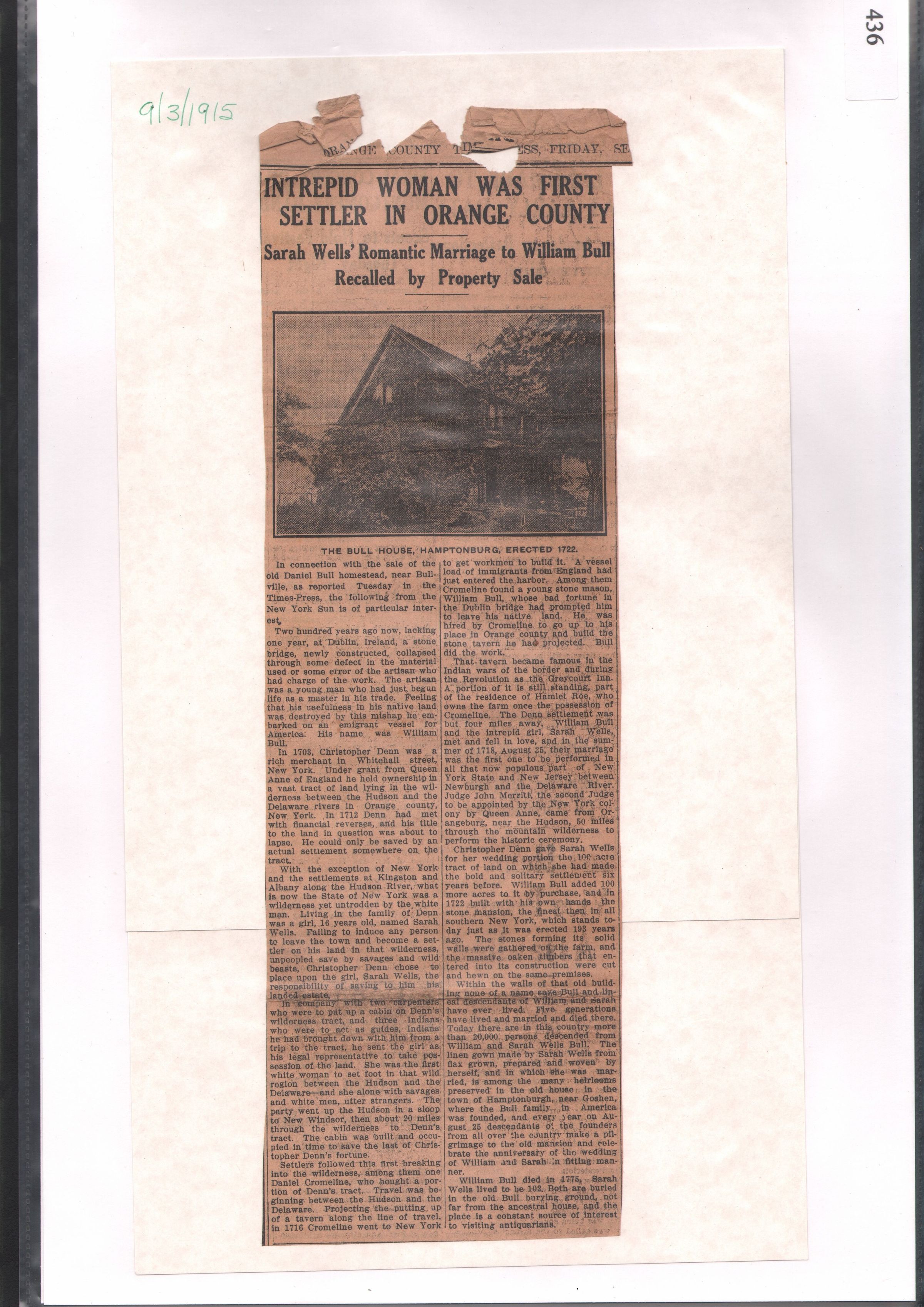
THE BULL HOUSE, HAMPTONBURG, ERECTED 1722.
In connection with the sale of the old Daniel Bull homestead, near Bullville, as reported Tuesday in the Times-Press, the following from the New York Sun is of particular interest. Two hundred years ago now, lacking one year, at Dublin, Ireland, a stone bridge, newly constructed, collapsed through some defect in the material used or some error of the artisan who had charge of the work. The artisan was a young man who had just begun life as a master in his trade. Feeling that his usefulness in his native land was destroyed by this mishap he embarked on the first vessel for America. His name was William Bull. In 1703, Christopher Denn was a rich merchant in Whitehall street, New York. Under grant from Queen Anne of England he held ownership in a vast tract of land lying in the wilderness between the Hudson and the Delaware rivers in Orange county, New York. In 1712 Denn had met with financial reverses, and his title to the land in question was about to lapse. He could only be saved by an actual settlement somewhere on the tract. With the exception of New York and the settlements at Kingston and Albany along the Hudson River, what is now the State of New York was a wilderness yet untrodden by the white man. Living in the family of Denn was a girl, 16 years old, named Sarah Wells. Failing to induce any person to leave the town and become a settler on his land in that wilderness, unpeopled save by savages and wild beasts, Christopher Denn chose to place upon the girl, Sarah Wells, the responsibility of saving to him his landed estate. In company with two carpenters who were to put up a cabin on Denn’s wilderness tract, and three Indians who were to act as guides, Indians he had brought down with him from a trip to the tract, he sent the girl as his legal representative to take possession of the land. She was the first white woman to set foot in that wild region between the Hudson and the Delaware—and she alone with savages and white men, utter strangers. The party went up the Hudson in a sloop to New Windsor, then about 20 miles through the wilderness to Denn’s tract. The cabin was built and occupied in time to save the last of Christopher Denn’s fortune. Settlers followed this first breaking into the wilderness, among them one Daniel Cromeline, who bought a portion of Denn’s tract. Travel was beginning between the Hudson and the Delaware. Projecting the putting up of a tavern along the line of travel, in 1716 Cromeline went to New York to get workmen to build it. A vessel load of immigrants from England had just entered the harbor. Among them Cromeline found a young stone mason, William Bull, whose bad fortune in the Dublin bridge had prompted him to leave his native land. He was hired by Cromeline to go to his place in Orange county and build the stone tavern he had projected. Bull did the work. That tavern became famous in the Indian wars of the border and during the Revolution as the Greycourt Inn. A portion of it is still standing, part of the residence of Hamlet Roe, who owns the farm once the possession of Cromeline. The Denn settlement was but four miles away. William Bull and the intrepid girl, Sarah Wells, met and fell in love, and in the summer of 1718, August 25, their marriage was the first one to be performed in all that now populous part of New York State and New Jersey between Newburgh and the Delaware River. Judge John Merritt, the second Judge to be appointed by the New York colony by Queen Anne, came from Orangeburg, near the Hudson, 50 miles through the mountain wilderness to perform the historic ceremony. Christopher Denn gave Sarah Wells for her wedding portion the 100 acre tract of land on which she had made the bold and solitary settlement six years before. William Bull added 100 more acres to it by purchase, and in 1722 built with his own hands the stone mansion, the finest then in all southern New York, which stands today just as it was erected 193 years ago. The stones forming its solid walls were gathered on the farm, and the massive oaken timbers that entered into its construction were cut and hewn on the same premises. Within the walls of that old building none of a name save Bull and lineal descendants of William and Sarah have ever lived. Five generations have lived and married and died there. Today there are in this country more than 20,000 persons descended from William and Sarah Wells Bull. The linen gown made by Sarah Wells from flax grown, prepared and woven by herself, and in which she was married, is among the many heirlooms preserved in the old house in the town of Hamptonburgh, near Goshen, where the Bull family in America was founded, and every year on August 25 descendants of the founders from all over the country make a pilgrimage to the old mansion and celebrate the anniversary of the wedding of William and Sarah in fitting manner. William Bull died in 1775. Sarah Wells lived to be 102. Both are buried in the old Bull burying ground, not far from the ancestral house, and the place is a constant source of interest to visiting antiquarians.Relationships
Related Person or Organization
Person or Organization
Sarah Wells, Bull Stone House