Name/Title
Ebenezer Bull - Dairy Farmer article April 25, 1919Entry/Object ID
000442Tags
Ebenezer BullScope and Content
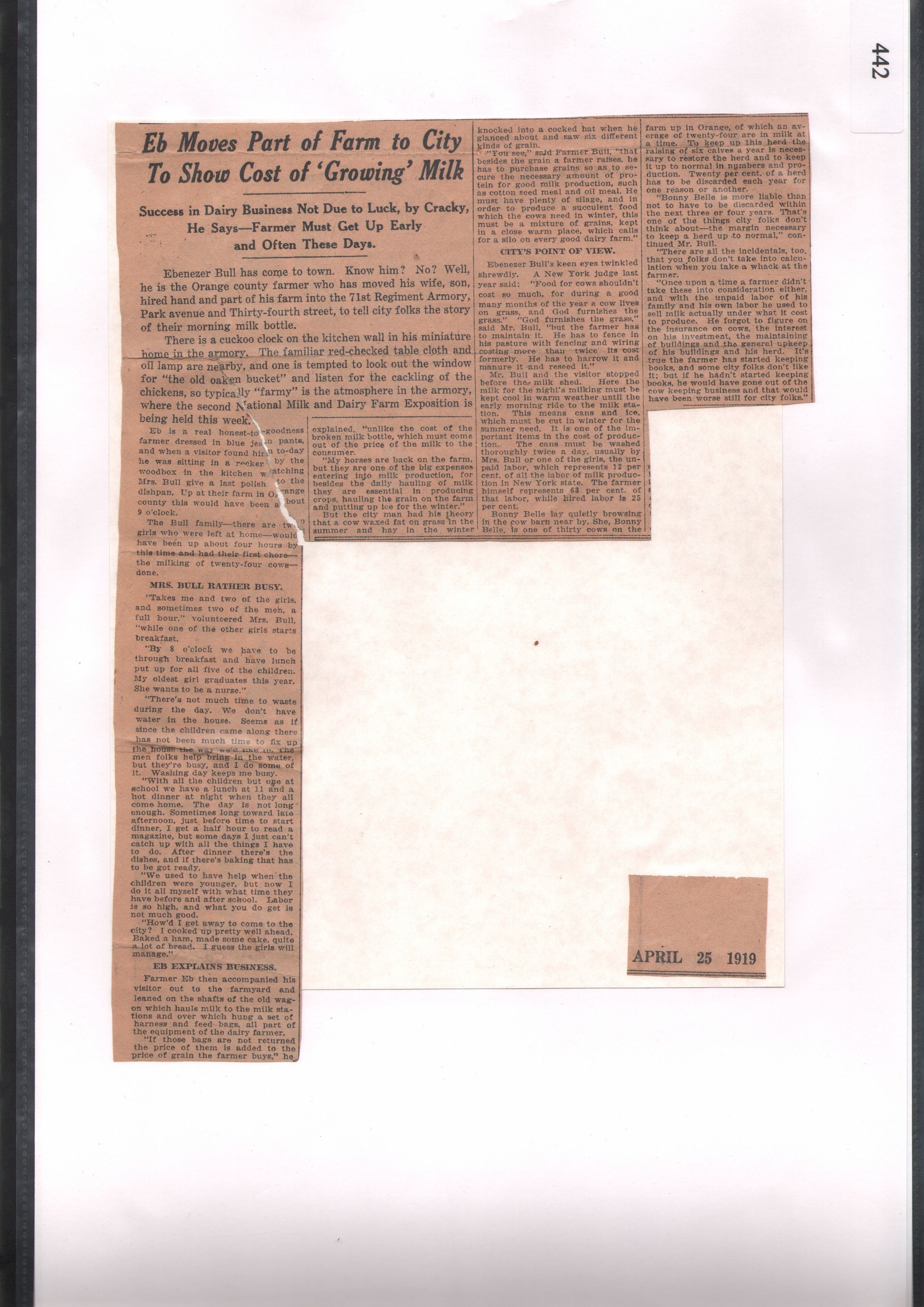
APRIL 25 1919
Eb Moves Part of Farm to City To Show Cost of 'Growing' Milk
Success in Dairy Business Not Due to Luck, by Cracky, He Says-Farmer Must Get Up Early and Often These Days.
Ebenezer Bull has come to town. Know him? No? Well, he is the Orange county farmer who has moved his wife, son, hired hand and part of his farm into the 71st Regiment Armory, Park avenue and Thirty-fourth street, to tell city folks the story of their morning milk bottle.
There is a cuckoo clock on the kitchen wall in his miniature home in the armory. The familiar red-checked table cloth and oil lamp are nearby, and one is tempted to look out the window for "the old oaken bucket" and listen for the cackling of the chickens, so typically "farmy" is the atmosphere in the armory, where the second National Milk and Dairy Farm Exposition is being held this week.
Eb is a real honest-to-goodness farmer dressed in blue jean pants, and when a visitor found him today he was sitting in a rocker by the woodbox in the kitchen watching Mrs. Bull give a last polish to the dishpan. Up at their farm in Orange county this would have been about 9 o'clock.
The Bull family-there are two girls who were left at home-would have been up about four hours by this time and had their first chore-the milking of twenty-four cows-done.
MRS. BULL RATHER BUSY.
"Takes me and two of the girls, and sometimes two of the men, a full hour," volunteered Mrs. Bull, "while one of the other girls starts breakfast.
"By 8 o'clock we have to be through breakfast and have lunch put up for all five of the children. My oldest girl graduates this year. She wants to be a nurse."
"There's not much time to waste during the day. We don't have water in the house. Seems as if since the children came along there has not been much time to fix up the house. The day is not long enough. Sometimes long toward late afternoon, just before time to start dinner, I get a half hour to read a magazine, but some days I just can't catch up with all the things I have to do. After dinner there's the dishes, and if there's baking that has to be got ready.
"We used to have help when the children were younger, but now I do it all myself with what time they have before and after school. Labor is so high, and what you do get is not much good."
"How'd I get away to come to the city? I cooked up pretty well ahead. Baked a ham, made some cake, quite a lot of bread. I guess the girls will manage."
EB EXPLAINS BUSINESS.
Farmer Eb then accompanied his visitor out to the farmyard and leaned on the shafts of the old wagon on which hauls milk to the milk stations and over which hung a set of harness and feed bags, all part of the equipment of the dairy farmer.
"If those bags are not returned the price of grain the farmer buys," he
(Second Column)
knocked into a cocked hat when he glanced about and saw six different kinds of grain.
"You see," said Farmer Bull, "that besides the grain a farmer raises, he has to purchase grains so as to secure the necessary amount of protein for good milk production, such as cotton seed meal and oil meal. He must have plenty of silage, and in order to produce a succulent food which the cows need in winter, this must be a mixture of grains, kept in a close warm place, which calls for a silo on every good dairy farm."
CITY'S POINT OF VIEW.
Ebenezer Bull's keen eyes twinkled shrewdly. A New York judge last year said: "Food for cows shouldn't cost so much, for during a good many months of the year a cow lives on grass, and God furnishes the grass."
" 'God furnishes the grass,' " said Mr. Bull, "but the farmer has his pasture with fencing and wiring costing more than twice it cost formerly. He has to harrow it and manure it and reseed it."
Mr. Bull and the visitor stopped before the milk shed. Here the broken milk bottle, which must come out of the price of the milk to the consumer.
explained, "unlike the cost of the "My horses are back on the farm, but they are one of the big expenses entering into milk production, for they are essential in producing crops, hauling the grain on the farm and putting up ice for the winter."
But the city man had his theory that a cow waxed fat on grass in the summer and hay in the winter. Bonny Belle lay quietly browsing in the cow barn near by. She, Bonny Belle, is one of thirty cows on the
(Third Column)
farm up in Orange, of which an average of twenty-four are in milk at a time. To keep up this herd the raising of six calves a year is necessary to restore the herd and to keep it up to normal in numbers and production. Twenty per cent. of a herd has to be discarded each year for one reason or another.
"Bonny Belle is more liable than not to have to be discarded within the next three or four years. That's one of the things city folks don't think about-the margin necessary to keep a herd up to normal," continued Mr. Bull.
"There are all the incidentals, too, that you folks don't take into calculation when you take a whack at the farmer.
"Once upon a time a farmer didn't take these into consideration either, and with the unpaid labor of his family and his own labor he used to sell milk actually under what it cost to produce. He forgot to figure on the insurance on cows, the interest on his investment, the maintaining of buildings and his herd. It's true the farmer has started keeping books, and some city folks don't like it; but if he hadn't started keeping books, he would have gone out of the cow keeping business and that would have been worse still for city folks."Relationships
Related Person or Organization
Person or Organization
Ebenezer Bull