Name/Title
January 12, 1941 "Sunday Mirror Magazine" Bull Stone House articleEntry/Object ID
000487Tags
Bull Stone HouseScope and Content
SUNDAY MIRROR MAGAZINE SECTION JANUARY 12, 1941
Pioneer Sarah's 25,000 Descendants
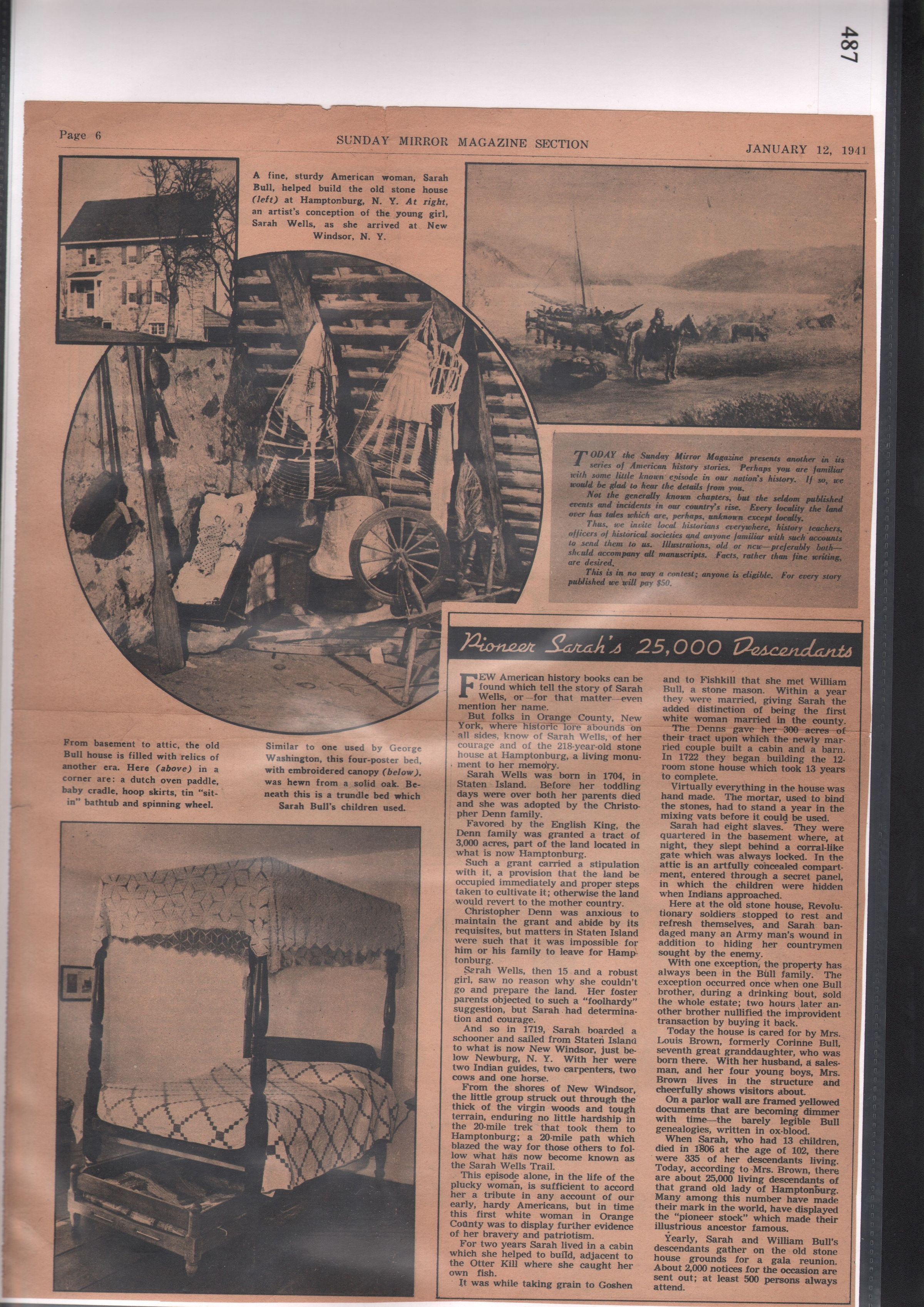
[Main Image: A collage showing a large stone house, a colonial-style trundle bed, and a photo of a woman, Sarah Wells.]
A fine, sturdy American woman, Sarah Bull, helped build the old stone house (left) at Hamptonburg, N. Y. At right, an artist's conception of the young girl, Sarah Wells, as she arrived at New Windsor, N. Y.
TODAY the Sunday Mirror Magazine presents another in its series of American history stories. Perhaps you are familiar with some little known episode in our nation's history. If so, we would be glad to hear the details from you. Not the generally known chapters, but the seldom published events and incidents in our country's rise. Every locality the land over has tales which are, perhaps, unknown except locally. Thus, we invite local historians everywhere, history teachers, officers of historical societies and anyone familiar with such accounts to send them to us. Illustrations, old or new-preferably both-should accompany all manuscripts. Facts, rather than fine writing, are desired. This is in no way a contest; anyone is eligible. For every story published we will pay $50.
FEW American history books can be found which tell the story of Sarah Wells, or-for that matter-even mention her name. But folks in Orange County, New York, where historic lore abounds on all sides, know of Sarah Wells, of her courage and of the 218-year-old stone house at Hamptonburg, a living monument to her memory. Sarah Wells was born in 1704, in Staten Island. Before her toddling days were over both her parents died and she was adopted by the Christopher Denn family. Favored by the English King, the Denn family was granted a tract of 3,000 acres, part of the land located in what is now Hamptonburgh. Such a grant carried a stipulation with it, a provision that the land be occupied immediately and proper steps taken to cultivate it; otherwise the land would revert to the mother country. Christopher Denn was anxious to maintain the grant and abide by its requisites, but matters in Staten Island were such that it was impossible for him or his family to leave for Hamptonburg. Sarah Wells, then 15 and a robust girl, saw no reason why she couldn't go and prepare the land. Her foster parents objected to such a "foolhardy" suggestion, but Sarah had determination and courage. And so in 1719, Sarah boarded a schooner and sailed from Staten Island to what is now New Windsor, just below Newburg, N. Y. With her were two Indian guides, two carpenters, two cows and one horse. From the shores of New Windsor, the little group struck out through the thick of the virgin woods and tough terrain, enduring no little hardship in the 20-mile trek that took them to Hamptonburg; a 20-mile path which blazed the way for those others to follow what has now become known as the Sarah Wells Trail. This episode alone, in the life of the plucky woman, is sufficient to accord her a tribute in any account of our early, hardy Americans, but in time this first white woman in Orange County was to display further evidence of her bravery and patriotism. For two years Sarah lived in a cabin which she helped to build, adjacent to the Otter Kill where she caught her own fish. It was while taking grain to Goshen and to Fishkill that she met William Bull, a stone mason. Within a year they were married, giving Sarah the added distinction of being the first white woman married in the county. The Denns gave her 100 acres of their tract upon which the newly married couple built a cabin and a barn. In 1722 they began building the 12-room stone house which took 13 years to complete. Virtually everything in the house was hand made. The mortar, used to bind the stones, had to stand a year in the mixing vats before it could be used. Sarah had eight slaves. They were quartered in the basement where, at night, they slept behind a corral-like gate which was always locked. In the attic is an artfully concealed compartment, entered through a secret panel, in which the children were hidden when Indians approached. Here at the old stone house, Revolutionary soldiers stopped to rest and refresh themselves, and Sarah bandaged many an Army man's wound in addition to hiding her countrymen sought by the enemy. With one exception, the property has always been in the Bull family. The exception occurred once when one Bull brother, during a drinking bout, sold the whole estate; two hours later another brother nullified the improvident transaction by buying it back. Today the house is cared for by Mrs. Louis Brown, formerly Corinne Bull, seventh great granddaughter, who was born there. With her husband, a salesman, and her four young boys, Mrs. Brown lives in the structure and cheerfully shows visitors about. On a parlor wall are framed yellowed documents that are becoming dimmer with time-the barely legible Bull genealogies, written in ox-blood. When Sarah, who had 13 children, died in 1806 at the age of 102, there were 335 of her descendants living. Today, according to Mrs. Brown, there are about 25,000 living descendants of that grand old lady of Hamptonburg. Many among this number have made their mark in the world, have displayed the "pioneer stock" which made their illustrious ancestor famous. Yearly, Sarah and William Bull's descendants gather on the old stone house grounds for a gala reunion. About 2,000 notices for the occasion are sent out; at least 500 persons always attend.
From basement to attic, the old Bull house is filled with relics of another era. Here (above) in a corner are: a dutch oven paddle, baby cradle, hoop skirts, tin "sit-in" bathtub and spinning wheel.
Similar to one used by George Washington, this four-poster bed, with embroidered canopy (below), was hewn from a solid oak. Beneath this is a trundle bed which Sarah Bull's children used.Relationships
Related Person or Organization
Person or Organization
Bull Stone House