Name/Title
91st annual Bull picnicEntry/Object ID
000519Tags
Bull PicnicScope and Content
The Legacy of the Bull Stone House
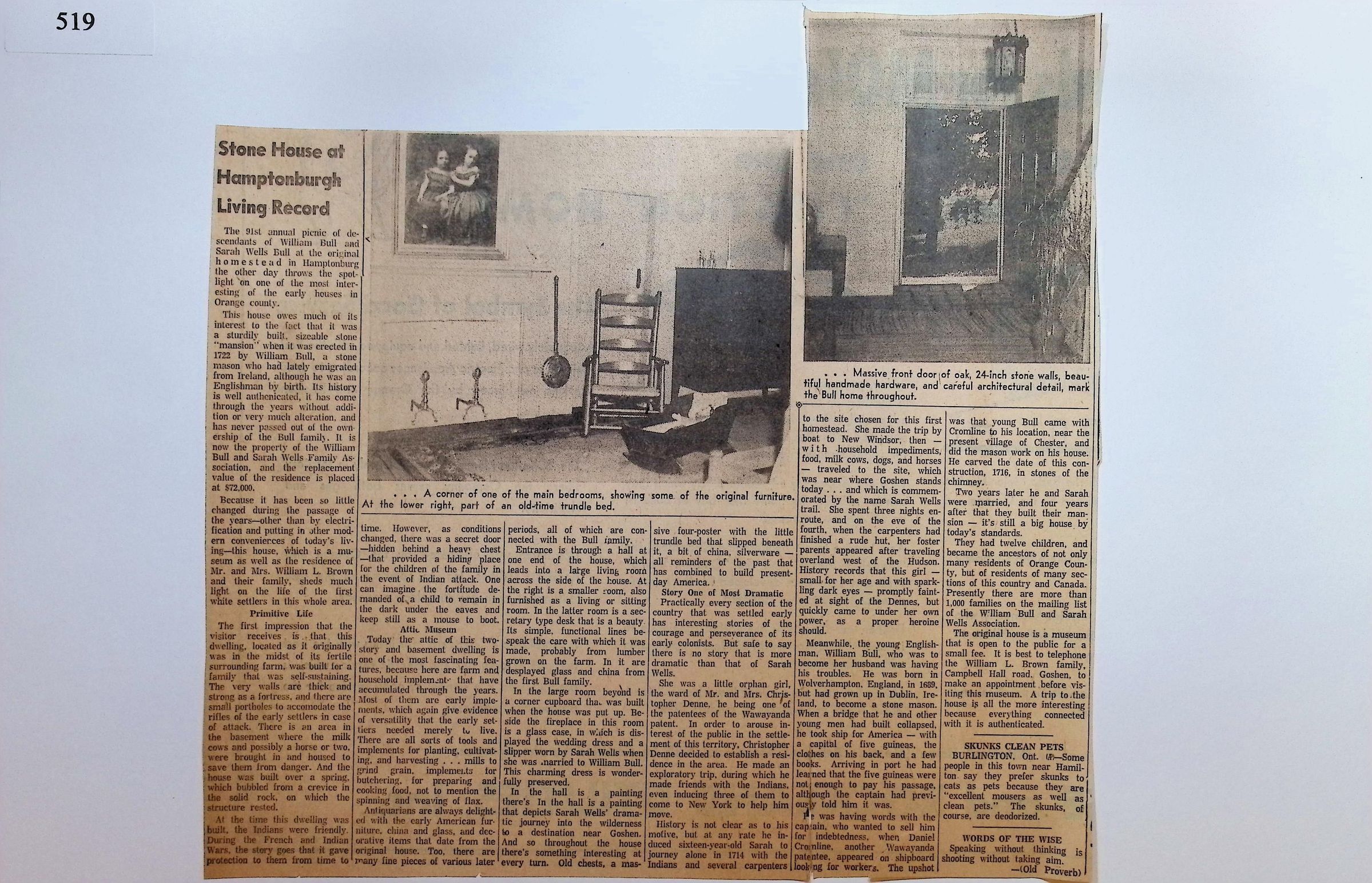
The 91st annual picnic of the descendants of William Bull and Sarah Wells Bull at their original homestead in Hamptonburgh recently shined a spotlight on one of the most fascinating early residences in Orange County. Built in 1722 by William Bull—an English-born stone mason who had recently emigrated from Ireland—this sturdy, sizeable stone "mansion" remains a marvel of historical preservation. The home has survived through the centuries without significant additions or alterations, and it has never left the ownership of the Bull family. Today, it is owned by the William Bull and Sarah Wells Family Association, with a replacement value estimated at $72,000. Serviced by modern conveniences like electricity but otherwise unchanged, the house serves as both an authenticated museum and the private residence of the William L. Brown family, offering an authentic glimpse into the lives of the area's first settlers.
Designed for complete self-sustenance and defense, the homestead is built like a fortress. Its massive 24-inch stone walls feature small portholes to accommodate rifles in the event of an attack, and the structure is anchored directly onto solid rock over a bubbling natural spring, ensuring a continuous water supply. In the basement, a designated area allowed the family to bring in milk cows and horses to protect them from danger. While relations with local Native Americans were friendly during the home's early years—and the house even provided them shelter during the French and Indian Wars—changing conditions prompted the addition of a secret hiding door. Hidden behind a heavy chest, this door led to a tight space under the eaves where the family’s children could hide in complete silence during times of threat.
The interior of the two-story-and-basement dwelling is a treasure trove of early American history. In the attic, visitors can explore a vast collection of early agricultural and household implements that highlight the versatility required of early pioneers, including tools for planting, harvesting, grain milling, butchering, cooking, and spinning flax. The lower floors showcase elegant, functional period furniture, much of it crafted from timber grown on the surrounding farm. Notable features include a beautiful built-in corner cupboard, a massive four-poster bed with a trundle bed tucked beneath, and a stunning secretary desk displaying original family china and glass. Perhaps most remarkable of all is a glass display case beside the fireplace containing the wonderfully preserved wedding dress and slipper worn by Sarah Wells, while a painting in the hall depicts her dramatic journey into the wilderness.
The legend of the family matriarch, Sarah Wells, is one of the most dramatic stories of early colonial perseverance. As a sixteen-year-old orphan and ward of Christopher Denne (a patentee of the Wawayanda patent), Sarah was tasked with leading a pioneering expedition into the wilderness in 1714 to establish a homestead near present-day Goshen. Accompanied only by three Native American guides and several carpenters, she traveled by boat to New Windsor and then overland with cows, dogs, horses, and household goods along what is now known as the Sarah Wells Trail. After spending three nights in the wild, she arrived at the site where a rude hut was constructed. When her foster parents finally arrived via an overland route west of the Hudson, the young girl promptly fainted from the sheer physical and emotional toll, only to quickly recover under her own power as a true heroine of her time.
Meanwhile, young William Bull was navigating his own trials. Born in Wolverhampton, England, in 1689, he grew up in Dublin, Ireland, where he trained as a skilled stone mason. After a bridge he helped construct collapsed, he decided to seek his fortune in America, boarding a ship with nothing but the clothes on his back, a few books, and five guineas. Upon arrival, the ship’s captain informed him that his funds were insufficient and threatened to sell him into indentured servitude to settle the debt. Fortunately, Daniel Cromline, another Wawayanda patentee, arrived at the docks looking for skilled laborers. Cromline paid Bull’s passage, and in exchange, Bull constructed the stone masonry for Cromline’s home near Chester, carving the date "1716" into the chimney stones. Two years later, William and Sarah were married, and by 1722, they began constructing their enduring stone home.
William and Sarah Bull raised twelve children, becoming the ancestors of a vast lineage spanning Orange County, the wider United States, and Canada. Today, the William Bull and Sarah Wells Association boasts a mailing list of over 1,000 families, keeping their shared history alive. The original stone house, located on Campbell Hall Road, remains open to the public as a fully authenticated museum for a small fee, though visitors are encouraged to call the Brown family ahead of time to secure an appointment. Alongside this rich family history, old local news from the era of this record notes a peculiar trend in nearby Burlington, Ontario, where residents favored deodorized skunks over cats as clean, highly efficient household mousers. Ultimately, as the old proverb wisely reminds us of the thoughtful deliberation that built such lasting legacies: "Speaking without thinking is shooting without taking aim."