Name/Title
March 6, 1965 Artist grows up in Bull Stone House "THE TIMES HERALD RECORD"Entry/Object ID
000533Tags
Bull FamilyScope and Content
Document Summary
This document is a newspaper clipping from The Times Herald Record dated Saturday, March 6, 1965. The article, titled "An artist grows up in old Bull homestead" by Chris Farlekas, profiles Louis E. Brown, an artist from Hamptonburgh, New York. Brown grew up in the historic Bull Stone House, widely recognized as the oldest house in Orange County.
The article reflects on Brown's early life and artistic development, shaped heavily by the natural surroundings of his historic home, childhood experiences, and family. It describes his graduation from Washingtonville High School (1958) and Union College (1962), his decision to register as a conscientious objector during the draft, and his subsequent service as a missionary-teacher to the Navajo Indians in Ganado, Arizona. The clipping includes photographs of Brown's paintings and his home, capturing the connection between his roots in Orange County and his artistic evolution.
Saturday, March 6, 1965 THE TIMES HERALD RECORD
Dorothy Mills TH-Record art editor art news
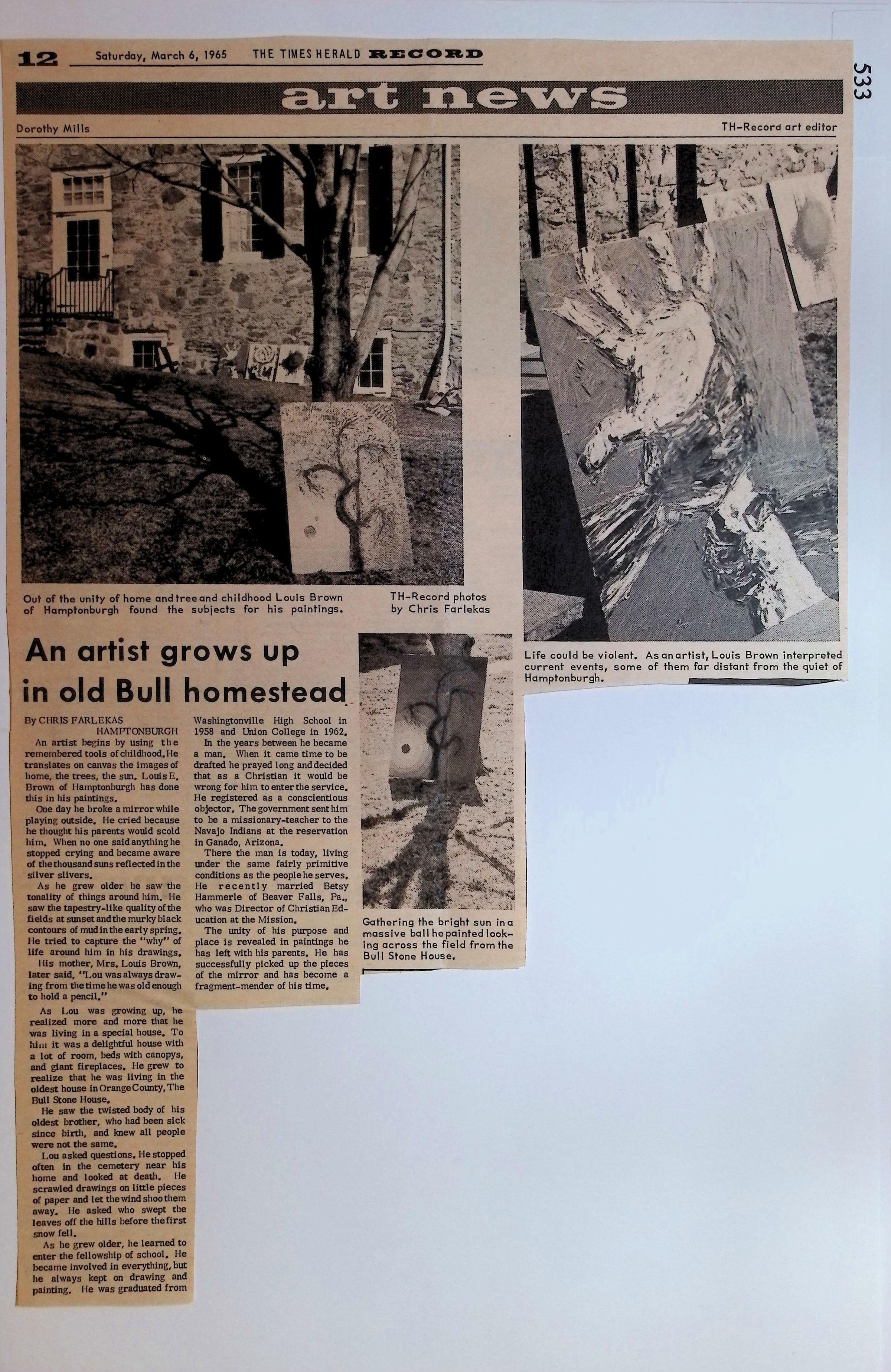
Out of the unity of home and tree and childhood Louis Brown
of Hamptonburgh found the subjects for his paintings.
TH-Record photos by Chris Farlekas
Life could be violent. As an artist, Louis Brown interpreted
current events, some of them far distant from the quiet of
Hamptonburgh.
Gathering the bright sun in a massive ball he painted looking across the field from the Bull Stone House.
An artist grows up in old Bull homestead
By CHRIS FARLEKAS HAMPTONBURGH
An artist begins by using the remembered tools of childhood. He
translates on canvas the images of home, the trees, the sun. Louis E.
Brown of Hamptonburgh has done this in his paintings. One day he broke a mirror while playing outside. He cried because he thought his parents would scold him. When no one said anything he stopped crying and became aware
of the thousand suns reflected in the silver slivers. As he grew older he saw the tonality of things around him. He saw the tapestry-like quality of the
fields at sunset and the murky black contours of mud in the early spring.
He tried to capture the "why" of life around him in his drawings.
His mother, Mrs. Louis Brown, later said, "Lou was always drawing from the time he was old enough to hold a pencil." As Lou was growing up, he
realized more and more that he was living in a special house. To
him it was a delightful house with a lot of room, beds with canopy's,
and giant fireplaces. He grew to realize that he was living in the
oldest house in Orange County, The Bull Stone House.
He saw the twisted body of his oldest brother, who had been sick
since birth, and knew all people were not the same.
Lou asked questions. He stopped often in the cemetery near his
home and looked at death. He scrawled drawings on little pieces
of paper and let the wind shoo them away. He asked who swept the
leaves off the hills before the first snow fell. As he grew older, he learned to
enter the fellowship of school. He became involved in everything, but
he always kept on drawing and painting. He was graduated from
Washingtonville High School in 1958 and Union College in 1962.
In the years between he became a man. When it came time to be
drafted he prayed long and decided that as a Christian it would be
wrong for him to enter the service. He registered as a conscientious
objector. The government sent him to be a missionary-teacher to the
Navajo Indians at the reservation in Ganado, Arizona. There the man is today, living under the same fairly primitive conditions as the people he serves.
He recently married Betsy Hammerle of Beaver Falls, PA., who was Director of Christian Education at the Mission. The unity of his purpose and
place is revealed in paintings he has left with his parents. He has
successfully picked up the pieces of the mirror and has become a
fragment-mender of his time.