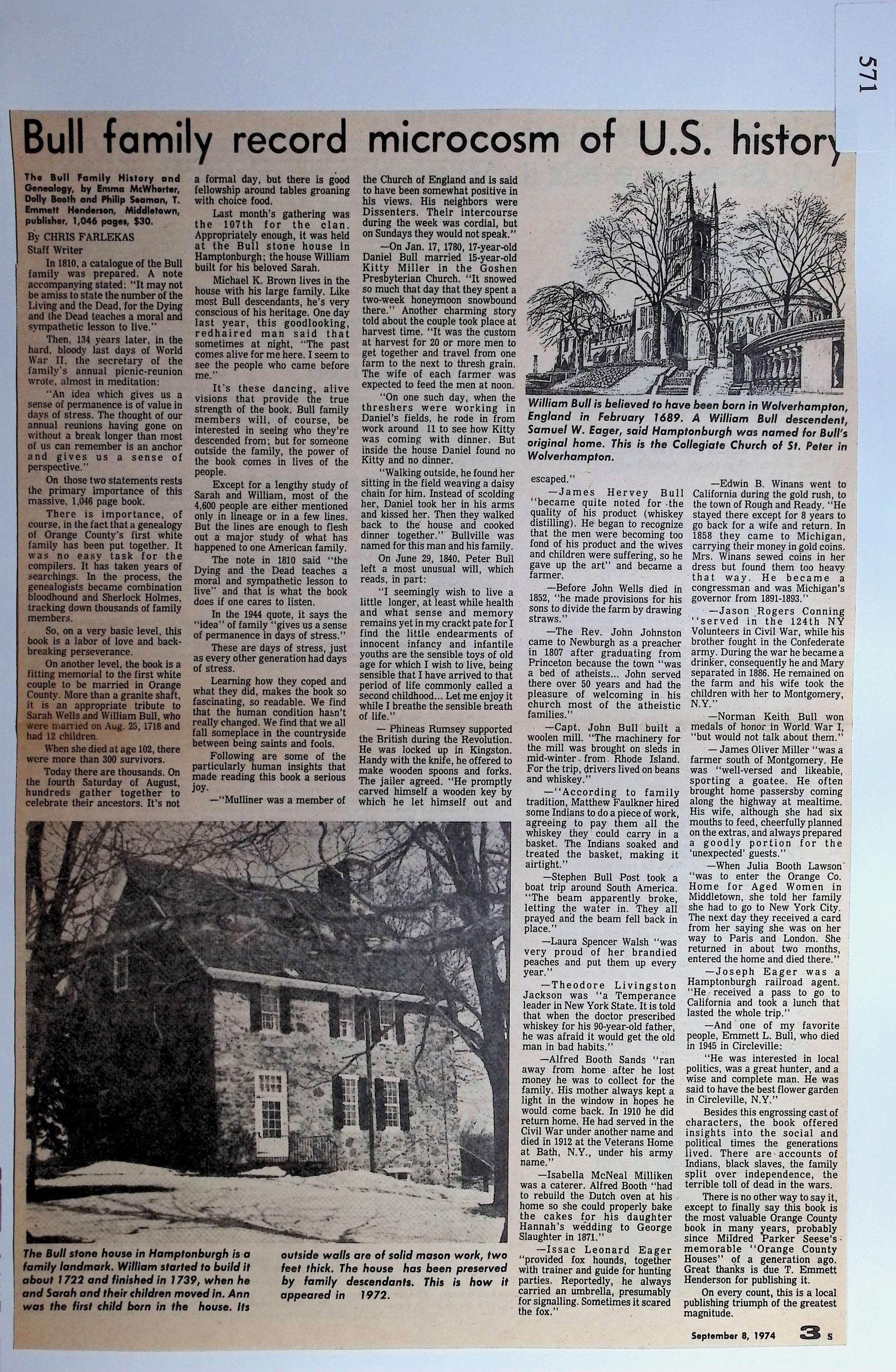
Name/Title
The Wiiiam Bull and Sarah Wells StoryEntry/Object ID
000571Tags
William Bull and Sarah Wells Stone House AssociationScope and Content
Key Historical & Family Elements
The Founders: William Bull (born in Wolverhampton, England, in 1689) and Sarah Wells were the first white couple to be married in the town of Goshen. They had 12 children. Sarah lived to be 102 years old, and by her death, she had more than 300 survivors.
The Bull Stone House: A landmark in Hamptonburgh, the home's construction was started by William Bull around 1722 and finished in 1739. Sarah gave birth to the first child born in the house, and the structure still stands today, preserved by family descendants.
The Annual Reunion: The article highlights the family's deep-rooted tradition of gathering every year. At the time of writing, they were celebrating their 107th annual reunion at the stone house.
Anecdotes and Micro-Histories
The review highlights several short vignettes from the book that showcase how the family's lineage intersected with major historical eras and local folklore:
Revolutionary War & Capture: Phiness Rumsey, a British supporter during the Revolution, was locked up in Kingston but escaped by using a knife to fashion wooden spoons and forks to trade with his jailer for a wooden key.
The Gold Rush & Politics: Edwin B. Witsons went to California during the 1849 Gold Rush, made a fortune in gold coins, and later became a Michigan congressman.
Civil War Service: Jason Rogers Conning served in the 124th N.Y. Volunteers during the Civil War, while Theodore Livingston Jackson was a "Temperance Jester" in New York State.
Local Legends: Stories include a boat trip around South America where the beam broke (Stephen Bull Fost), an indentured girl carried into a swamp by Indians to pluck ash baskets (Station Skellenger), and a man named Alfred Booth Sands who ran away to collect money for his family, leaving his mother to keep a light in the window for years until he returned after serving in the Civil War.
Significance of the Book
The reviewer praises the volume not just as a list of names, but as an insightful social and political history that chronicles generations of ordinary people—including black slaves, Indians, and various early American workers—undergoing times of war, peace, stress, and joy. It is described as a "book of life" that serves as an anchor of continuity for the family and an invaluable record of Orange County history.