Name/Title
Bull Wedding Dress Aug 1975Entry/Object ID
000575Tags
Wedding dressScope and Content
By CHRIS FARLEKAS Staff Writer
HAMPTONBURGH - Lisa Brown usually runs
around climbing trees or riding horses or playing ball
with her older brothers. There’s a lot of tomboy in
this pretty, freckle-faced 13-year-old girl.
But Saturday, she suddenly became a young
woman. The fairy godmother that did it was Sarah
Wells Bull. Lisa is the ninth-generation descendant of Sarah.
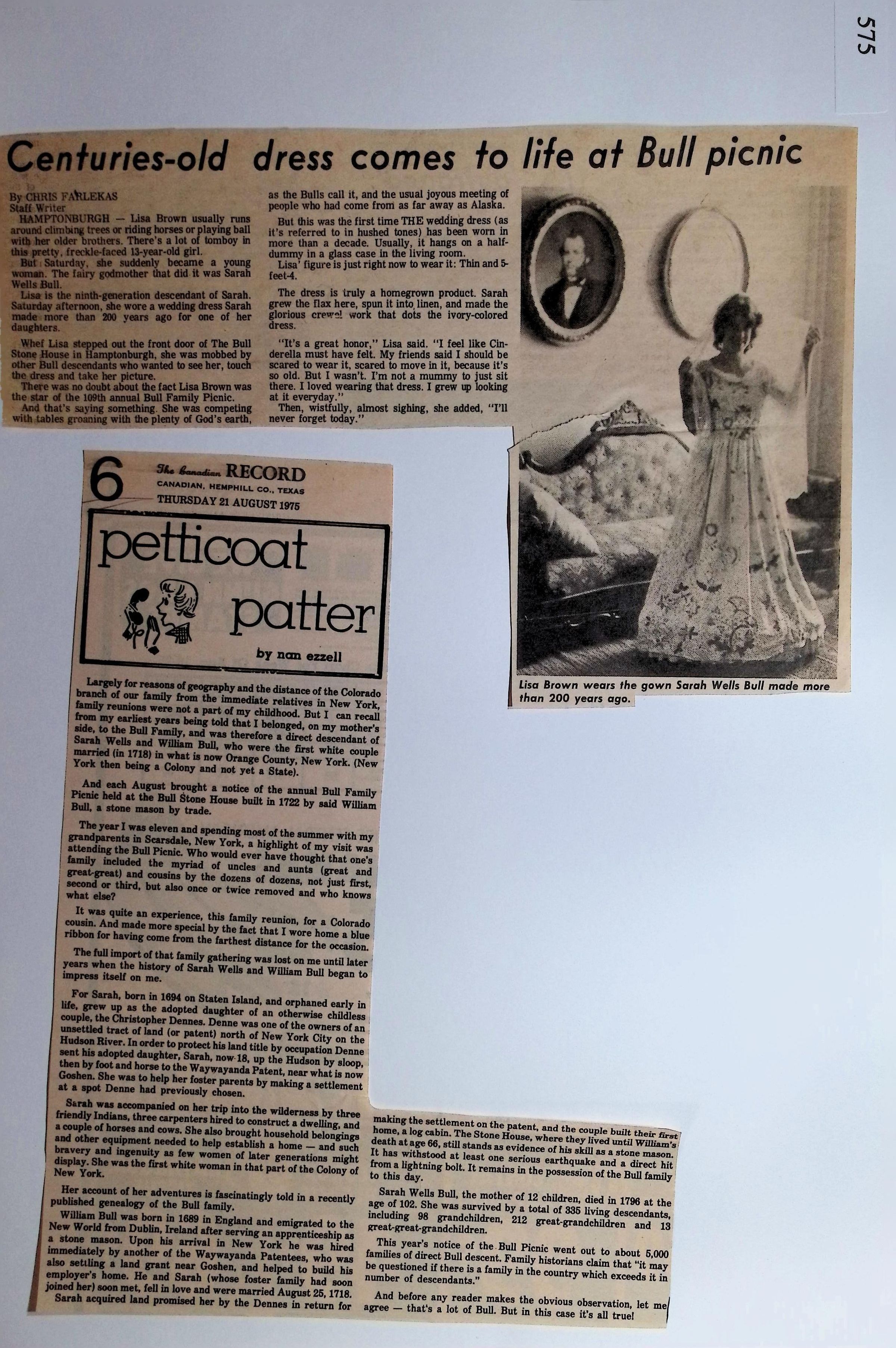
Saturday afternoon, she wore a wedding dress Sarah
made more than 200 years ago for one of her
daughters. When Lisa stepped out the front door of The Bull
Stone House in Hamptonburgh, she was mobbed by
other Bull descendants who wanted to see her, touch
the dress and take her picture.
There was no doubt about the fact Lisa Brown was
the star of the 109th annual Bull Family Picnic.
And that’s saying something. She was competing
with tables groaning with the plenty of God’s earth,
as the Bulls call it, and the usual joyous meeting of
people who had come from as far away as Alaska.
But this was the first time THE wedding dress (as
it’s referred to in hushed tones) has been worn in
more than a decade. Usually, it hangs on a half-
dummy in a glass case in the living room.
Lisa’s figure is just right now to wear it: Thin and 5-
feet-4. The dress is truly a homegrown product. Sarah
grew the flax here, spun it into linen, and made the
glorious crewel work that dots the ivory-colored
dress. “It’s a great honor,” Lisa said. “I feel like Cinderella
must have felt. My friends said I should be
scared to wear it, scared to move in it, because it’s
so old. But I wasn’t. I’m not a mummy to just sit
there. I loved wearing that dress. I grew up looking
at it everyday.” Then, wistfully, almost sighing, she added, “I’ll
never forget today.”
Caption: Lisa Brown wears the gown Sarah Wells made more
than 200 years ago.
The Canadian RECORD
CANADIAN, HEMPHILL CO., TEXAS
THURSDAY 21 AUGUST 1975
Petticoat Patter by Nan Ezzell
Largely for reasons of geography and the distance of the Colorado
branch of our family from the immediate relatives in New York,
family reunions were not a part of my childhood. But I can recall
from my earliest years being told that I belonged, on my mother’s
side, to the Bull Family, and was therefore a direct descendant of
Sarah Wells and William Bull, who were the first white couple
married (in 1718) in what is now Orange County, New York. (New
York then being a Colony and not yet a State).
And each August brought a notice of the annual Bull Family
Picnic held at the Bull Stone House built in 1722 by said William
Bull, a stone mason by trade.
The year I was eleven and spending most of the summer with my
grandparents in Scarsdale, New York, a highlight of my visit was
attending the Bull Picnic. Who would ever have thought that one’s
family included the myriad of uncles and aunts (great and
great-great) and cousins by the dozens of dozens, not just first,
second or third, but also once or twice removed and who knows
what else?
It was quite an experience, this family reunion, for a Colorado
cousin. And made more special by the fact that I wore home a blue
ribbon for having come from the farthest distance for the occasion.
The full import of that family gathering was lost on me until later
years when the history of Sarah Wells and William Bull began to
impress itself on me.
For Sarah, born in 1694 on Staten Island, and orphaned early in
life, grew up as the adopted daughter of an otherwise childless
couple, the Christopher Dennes. Denne was one of the owners of an
unsettled tract of land (or patent) north of New York City on the
Hudson River. In order to protect his land title by occupation Denne
sent his adopted daughter, Sarah, now 18, up the Hudson by sloop,
then by foot and horse to the Wawayanda Patent, near what is now
Goshen. She was to help her foster parents by making a settlement
at a spot Denne had previously chosen.
Sarah was accompanied on her trip into the wilderness by three
friendly Indians, three carpenters hired to construct a dwelling, and
a couple of horses and cows. She also brought household belongings
and other equipment needed to help establish a home - and such
bravery and ingenuity as few women of later generations might
display. She was the first white woman in that part of the Colony of
New York.
Her account of her adventures is fascinatingly told in a recently
published genealogy of the Bull family.
William Bull was born in 1689 in England and emigrated to the
New World from Dublin, Ireland after serving an apprenticeship as
a stone mason. Upon his arrival in New York he was hired
immediately by another of the Wawayanda Patentees, who was
also settling a land grant near Goshen, and helped to build his
employer’s home. He and Sarah (whose foster family had soon
joined her) soon met, fell in love and were married August 25, 1718.
Sarah acquired land promised her by the Dennes in return for
making the settlement on the patent, and the couple built their first
home, a log cabin. The Stone House, where they lived until William’s
death at age 66, still stands as evidence of his skill as a stone mason.
It has withstood at least one serious earthquake and a direct hit
from a lightning bolt. It remains in the possession of the Bull family
to this day.
Sarah Wells Bull, the mother of 12 children, died in 1796 at the
age of 102. She was survived by a total of 335 living descendants,
including 98 grandchildren, 212 great-grandchildren and 13
great-great-grandchildren.
This year’s notice of the Bull Picnic went out to about 5,000
families of direct Bull descent. Family historians claim that “it may
be questioned if there is a family in the country which exceeds it in
number of descendants.”
And before any reader makes the obvious observation, let me
agree - that’s a lot of Bull. But in this case it’s all true!