Name/Title
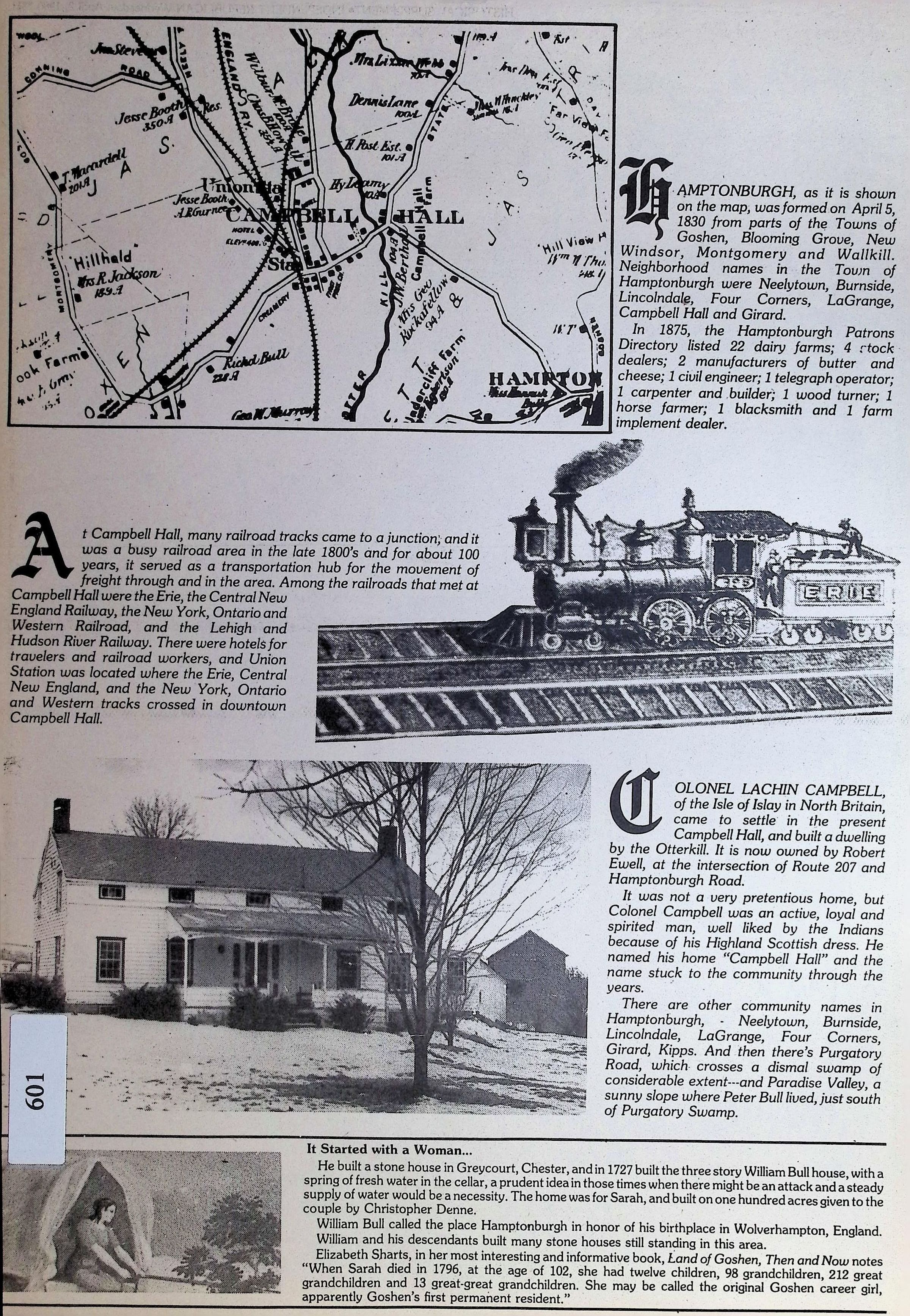
Hamptonburgh, Campbell Hall HistoryEntry/Object ID
000601Tags
Campbell Hall, HamptonburghScope and Content
1. Campbell Hall as a Railroad Hub
Active Era: In the late 1800s and for approximately 100 years, Campbell Hall was a bustling railroad junction and major transportation hub for freight and passenger movement.
Key Railroads: The area served major lines, including the Erie, the Central New England Railway, the New York, Ontario and Western Railroad, and the Lehigh and Hudson River Railway.
Local Amenities: The junction featured hotels for travelers and railroad workers. The Union Station was located where the Erie, Central New England, and New York, Ontario and Western tracks crossed in downtown Campbell Hall.
2. The Foundation of Hamptonburgh
Establishment: Hamptonburgh was formed on April 5, 1830, using parts of the towns of Goshen, Blooming Grove, New Windsor, Montgomery, and Wallkill.
Historic Neighborhood Names: Traditional neighborhood names in the Town of Hamptonburgh included Neelytown, Burnside, Lincolndale, Four Corners, LaGrange, Campbell Hall, and Girard.
1875 Directory Statistics: In 1875, the local directory recorded:
22 dairy farms and 4 stock dealers.
2 manufacturers of butter and cheese.
1 civil engineer, 1 telegraph operator, 1 carpenter and builder, and 1 wood turner.
1 horse farrier, 1 blacksmith, and 1 farm implement dealer.
3. Colonel Lachlin Campbell
Origins: Colonel Lachlin Campbell, of the Isle of Islay in North Britain, was the original settler of Campbell Hall.
The Settlement: He built a dwelling by the Otterkill (now owned by Robert Ewell) at the intersection of Route 207 and Hamptonburgh Road.
The Name: Described as an active, loyal, and spirited man who was well-liked by local Native Americans, he named his unpretentious home "Campbell Hall" after his Highland Scottish estate. The name eventually came to represent the entire community.
Other Local Geography: Other notable area landmarks mentioned include Purgatory Road (which crossed a dismal swamp of considerable extent) and Paradise Valley (a sunny slope where Peter Bull lived, located just south of Purgatory Swamp).
4. "It Started with a Woman..." (The Bull Family Legacy)
William Bull's House: In 1727, William Bull built a three-story stone house in Greycourt, Chester. The house was built with a spring of fresh water in the cellar to ensure a steady water supply in case of an attack. It was built on a 100-acre tract given to the couple by Christopher Denne.
The Bull Family Genealogy: William Bull named the place "Hamptonburgh" in honor of his birthplace in Wolverhampton, England. He and his descendants constructed many of the stone houses still standing in the area.
Sarah Wells Bull: When William's wife, Sarah, died in 1796 at the age of 102, she left behind 12 children, 98 grandchildren, 212 great-grandchildren, and 13 great-great-grandchildren. She is remembered as "the original Goshen career girl" and was likely Goshen's first permanent resident.