Name/Title
Historical View of Campbell HallEntry/Object ID
000603Tags
Campbell HallScope and Content
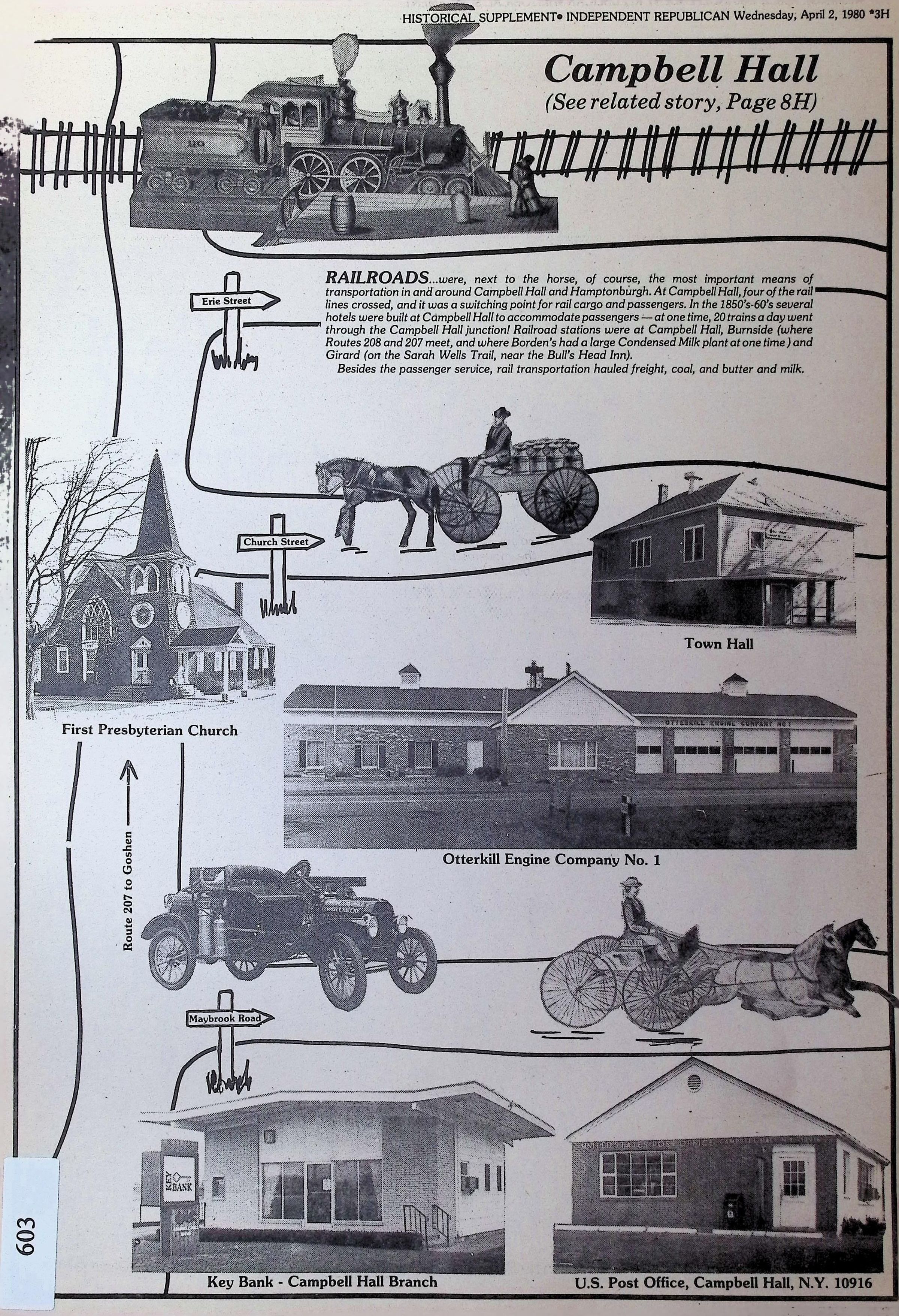
This historical page from the Independent Republican (dated Wednesday, April 2, 1980) provides a visual and historical overview of Campbell Hall, New York.
Here is a summary of the key information and landmarks featured on the page:
The Historical Role of Railroads
The text highlights how crucial rail transport was to the development of Campbell Hall and Hamptonburgh:
A Major Hub: Next to horse-drawn transport, railroads were the most vital means of travel. Campbell Hall served as a major switching point where four rail lines crossed.
Rapid Growth: In the 1850s and 1860s, several hotels were built to accommodate the influx of passengers. At one point, 20 trains a day passed through the Campbell Hall junction.
Stations: Notable stations were located at Campbell Hall, Burnside (where Routes 208 and 207 meet, near the site of Borden's large Condensed Milk plant), and Girard (near the historic Bull's Head Inn).
Cargo: Beyond passengers, the rails hauled vital goods such as freight, coal, butter, and milk.
Local Landmarks & Institutions
The illustrated map traces a path through the community, highlighting several key structures:
First Presbyterian Church: Located along the route toward Goshen (Route 207).
Otterkill Engine Company No. 1: The local fire station.
Town Hall: The civic heart of the community.
Key Bank (Campbell Hall Branch) & U.S. Post Office: Modern community services located at the edge of the map (Campbell Hall, NY 10916).
Historical Transit Methods: The illustrations depict the evolution of local travel, featuring a steam locomotive on the tracks, horse-drawn carriages, and early 20th-century automobiles.