Name/Title
Articles of Early SettlersEntry/Object ID
000607Tags
William Bull and Sarah Wells Stone House AssociationScope and Content
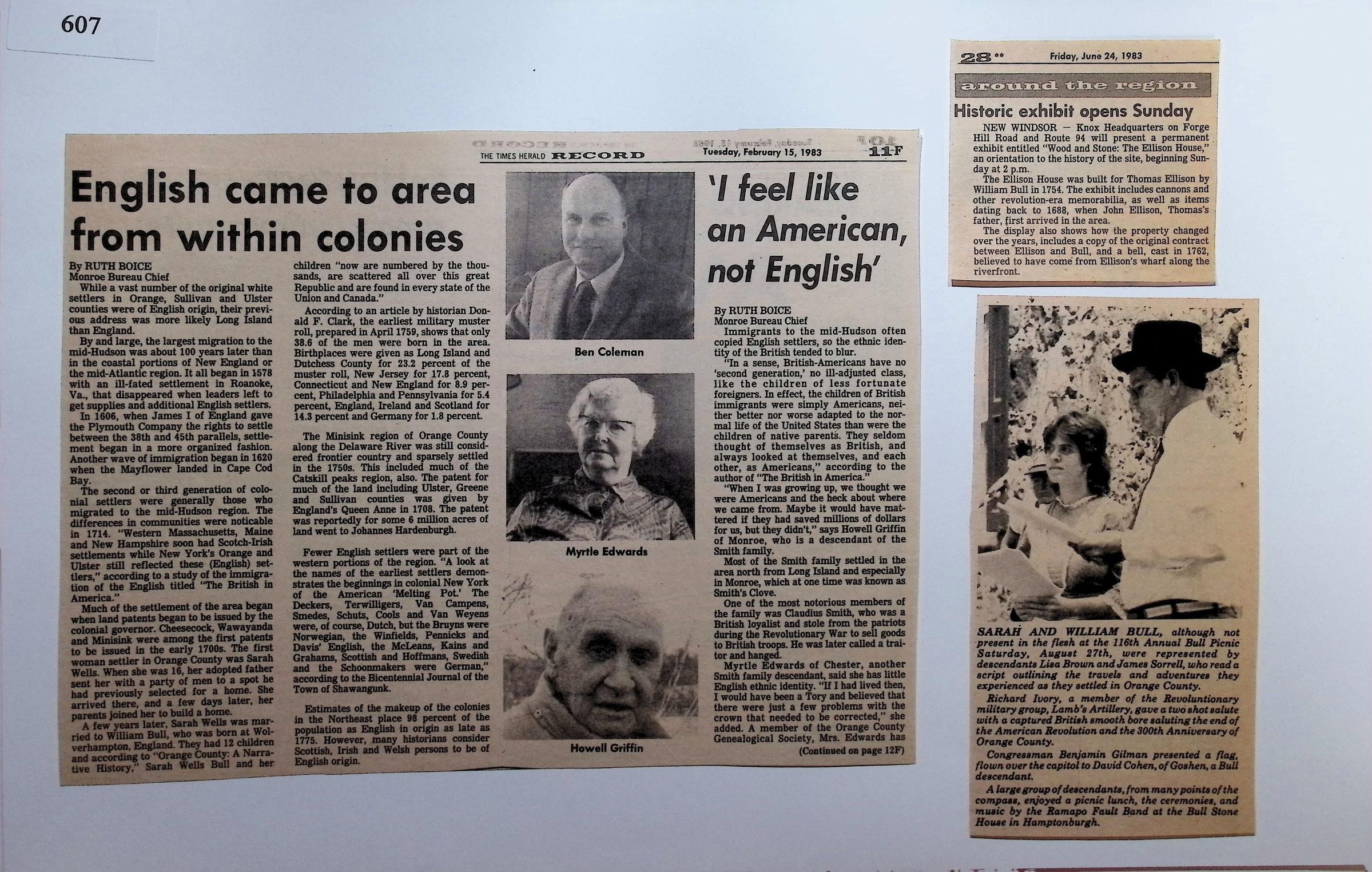
1. "English came to area from within colonies"
Overview: Written by Ruth Boice, this article discusses the migration patterns of early settlers in the mid-Hudson region (Orange, Sullivan, and Ulster counties).
Key Details:
While many early settlers had English roots, they did not migrate directly from England. Instead, they arrived about 100 years later from existing American coastal settlements, primarily Long Island and other mid-Atlantic regions.
The first land patents in Orange County (like Cheesecock and Minisink) were granted in the early 1700s. A notable pioneer, Sarah Wells, settled the area at age 16 and later married William Bull, an English immigrant; together they had 12 children, whose descendants went on to number in the thousands.
Historian Donald F. Clark's analysis of an April 1759 military muster roll shows only 38.6% of the men were born locally, with others hailing from Long Island, New Jersey, Connecticut, New England, Philadelphia, Ireland, Scotland, and Germany.
The western parts of the region showcase a "melting pot" of names, combining Dutch, German, French, Swedish, and English origins.
2. "'I feel like an American, not English'"
Overview: Also by Ruth Boice, this piece explores how quickly British immigrants to the mid-Hudson region assimilated and lost their distinct British identity.
Key Details:
Unlike other immigrant groups, British-Americans quickly blended in and did not form a distinct "second generation" class. They viewed themselves, and were viewed by others, simply as Americans.
Howell Griffin of Monroe, a descendant of the prominent Smith family, notes that growing up, his family simply considered themselves American rather than focusing on their ancestral roots.
One of the family's most infamous members was Claudius Smith, a British loyalist during the Revolutionary War who stole from patriots to sell to British troops, and was ultimately executed as a traitor.
Myrtle Edwards of Chester, another Smith family descendant, shares that she feels very little English identity, joking that if she had lived back then, she likely would have been a Tory who just felt the Crown had "a few problems... that needed to be corrected."
3. "Historic exhibit opens Sunday"
Overview: A brief event announcement from the "around the region" section dated Friday, June 24, 1983.
Key Details:
The Knox Headquarters (located on Forge Hill Road and Route 94 in New Windsor) opened a permanent, free exhibit entitled "Wood and Stone: The Ellison House."
The Ellison House was built in 1754 for Thomas Ellison by William Bull. The exhibit features historic military artifacts (including cannons), items dating back to 1688 when John Ellison first arrived, and a 1762 bell from Ellison's riverfront wharf.
4. "Sarah and William Bull" (Photo Caption & Event Summary)
Overview: A clipping detailing the 116th Annual Bull Picnic held on a Saturday, August 27th.
Key Details:
The historic couple Sarah and William Bull were represented by descendants Lisa Brown and James Sorrell, who read a script about the couple's adventures settling in Orange County.
The event included a two-shot salute by Richard Ivory of Lamb's Artillery (honoring both the end of the American Revolution and the 300th anniversary of Orange County), a flag presentation by Congressman Benjamin Gilman, and a picnic with music performed by the Ramapo Fault Band at the Bull Stone House in Hamptonburgh.