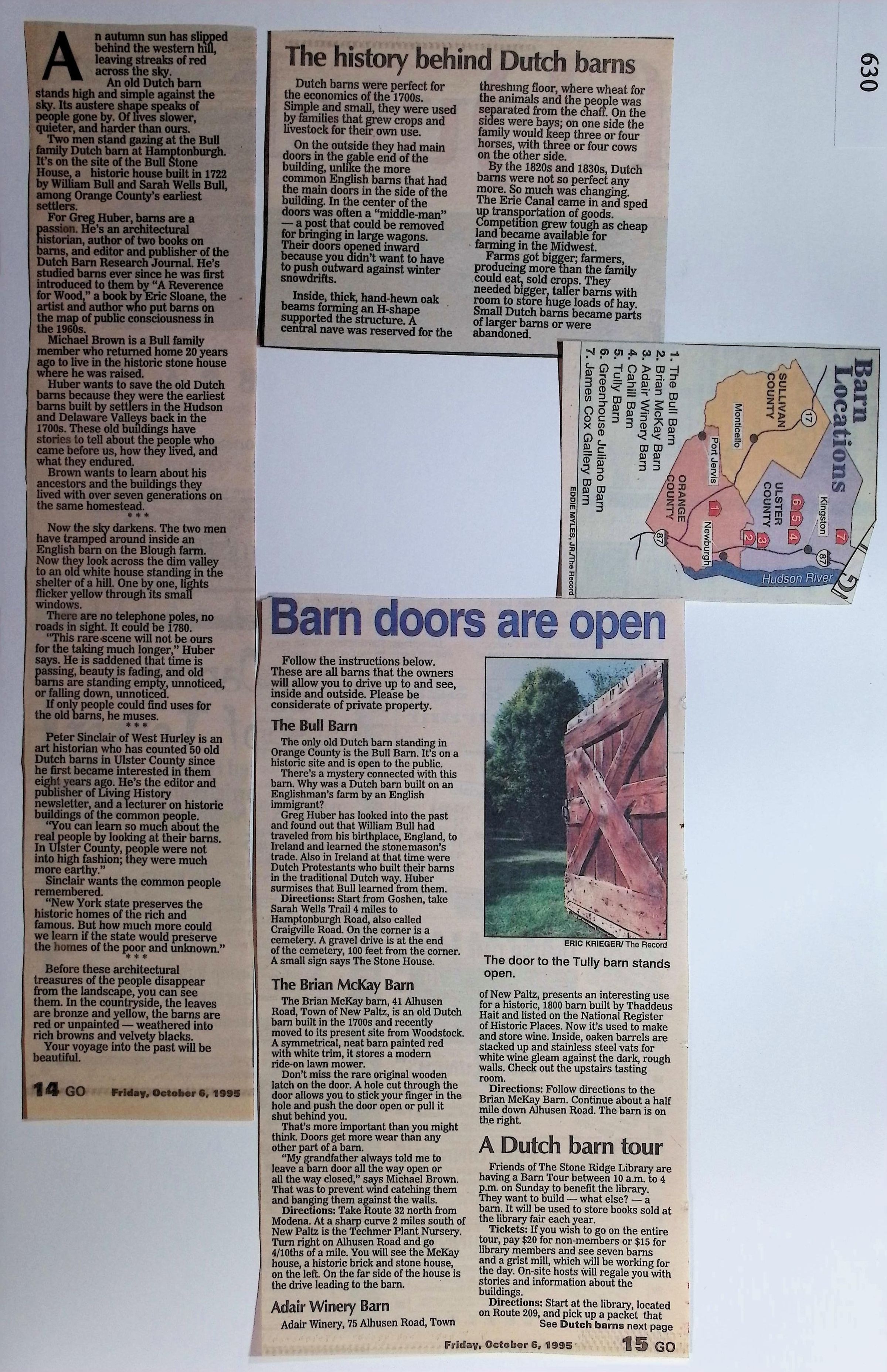
Name/Title
History of Dutch Barns in Orange, Ulster and Sullivan CountiesEntry/Object ID
000630Tags
William Bull and Sarah Wells Stone House AssociationScope and Content
Based on the provided newspaper clipping from October 6, 1995, here is a summary of the articles and information regarding historic Dutch barns in the Hudson Valley area (specifically Orange, Ulster, and Sullivan counties):
1. The History Behind Dutch Barns
Economic Design: Dutch barns were perfectly suited for 1800s family farming, housing both livestock and crops under one roof. Unlike English barns, their main doors were on the gable end of the building.
Structural Engineering: They featured massive, hand-hewn, H-shaped anchor beams that supported a central nave reserved for the threshing floor. Doors opened inward to avoid being blocked by snow.
The Decline: As farming grew and the Erie Canal opened up cheaper Midwestern competition, farms expanded. Dutch barns were replaced by larger, specialized barns to hold more hay, leading many old Dutch barns to be abandoned or integrated into larger structures.
2. Dutch Barn Tour (Ulster and Orange Counties)
An upcoming self-guided "Dutch Barn Tour" organized by the Friends of the Stone Ridge Library was scheduled for a Sunday between 10 a.m. and 4 p.m. to benefit the library. The tour featured seven historic barns, including:
Notable Barns Highlighted:
The Bull Barn (Orange County): The only old Dutch barn in Orange County on a historic site open to the public. It was built on an Englishman's farm by an immigrant, and is connected to a local mystery researched by historian Greg Huber.
The Brian McKay Barn (Ulster County): Located in West Shokan/New Paltz, this 1700s barn was moved to its current site from Woodstock. It features a modern ride-on lawnmower inside, an original wooden latch on the door, and beautifully weathered siding.
Adair Winery Barn (Ulster County): An interesting 1800s barn built by Thaddeus Hair and listed on the National Register of Historic Places. Today, it is used to store wine, featuring stainless steel vats and wine barrels on a dirt floor.
3. The Preservation Movement
Key Advocates: Historians like Greg Huber (author and publisher of the Dutch Barn Research Journal) and Peter Sinclair (editor of Living History) have spent years researching, counting, and trying to save these historic structures.
Cultural Importance: Advocates argue that while state preserves often save the mansions of the wealthy, these barns represent the everyday history, sweat, and lives of the "common people." Saving them prevents a vital piece of early American history from quietly decaying and disappearing.