Name/Title
A Dutch Barn on English SoilEntry/Object ID
000632Tags
William Bull and Sarah Wells Stone House AssociationScope and Content
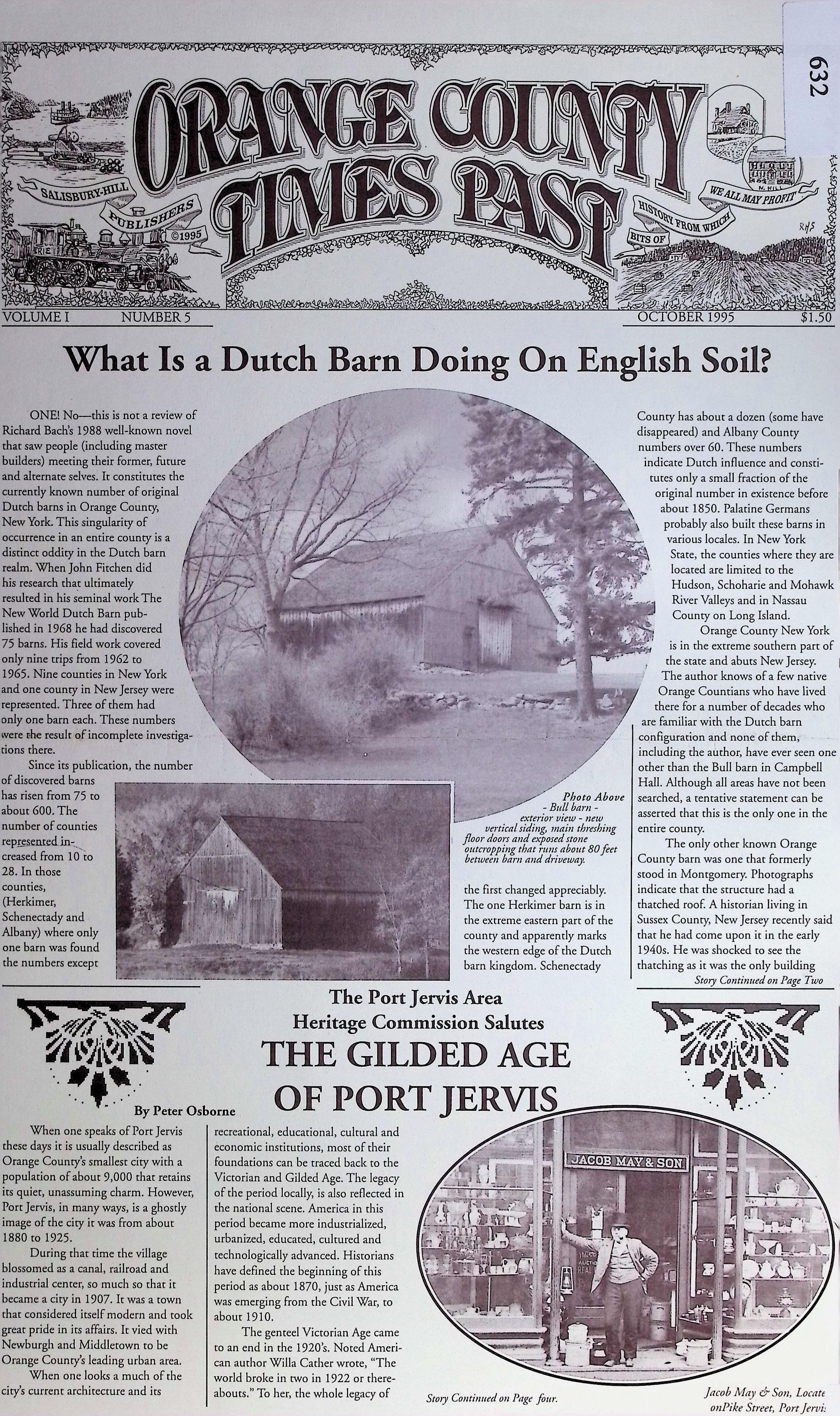
The provided image is of a historical publication titled "Orange County Times Past" (Volume 1, Number 5, October 1993). This issue features two primary historical articles regarding local architecture and heritage in Orange County, New York:
1. "What Is a Dutch Barn Doing On English Soil?"
The Subject: This article explores the rare presence of historic Dutch barns in Orange County, New York—an area traditionally dominated by English settlement.
Key Details:
It references John Fitchen’s seminal 1968 book, The New World Dutch Barn, which originally identified only 73 such barns across ten counties in New York and New Jersey.
Since Fitchen's publication, the number of documented Dutch barns has risen to about 600.
The article highlights the rarity of these structures in Orange County, noting that only a few native residents are familiar with their unique structural configurations.
It features a historic photograph of the "Bull Barn," showcasing its distinct vertical siding, main threshing floor door, and exposed eave overhang.
More specific.....
Based on the specific details in the article, here is a more detailed breakdown of the history, features, and status of the Dutch barns mentioned:
The "Only" Barn in Orange County: The Bull Barn
Location: The only known original Dutch barn still standing in Orange County is the Bull Barn, located in Campbell Hall.
Architectural Features: The featured photograph highlights specific physical characteristics of this structure, including its vertical siding, a main threshing floor door, and a massive exposed eave overhang that stretches about 80 feet between the barn and the driveway.
Rarity: Because Orange County is in the extreme southern part of New York (bordering New Jersey), the "Dutch barn configuration" is an extreme anomaly for the area, which was historically dominated by English settlers.
The Lost Barn of Montgomery
The article mentions only one other Dutch barn historically known to have existed in Orange County, which formerly stood in Montgomery.
The Thatched Roof: This destroyed barn was exceptionally rare because photographs and a local historian's account from the early 1940s confirmed it had a thatched roof—making it a shocking find even to historians of that era.
Geographic Scope & The "Dutch Barn Kingdom"
Distribution: True Dutch barns in New York are heavily concentrated in specific regions: the Hudson, Schoharie, and Mohawk River Valleys, as well as Nassau County on Long Island.
The Western Border: The westernmost boundary of this architectural style is marked by a single barn located in the extreme eastern part of Herkimer County.
The Builders: Although they are called "Dutch" barns, the text notes that Palatine Germans also built these structures in various locales prior to 1850.
Documenting the Survival Rate
When John Fitchen published his landmark study The New World Dutch Barn in 1968, he had only documented 73 barns across 10 counties.
By the time this article was published in 1993, continued research had raised that number to about 600 barns across 28 counties—though they represent only a tiny fraction of what existed before 1850.