Name/Title
Dutch Barn ExplanationEntry/Object ID
000633Tags
William Bull and Sarah Wells Stone House AssociationScope and Content
This entry is continued in entry 634, please reference that document.
1. The Core Mystery
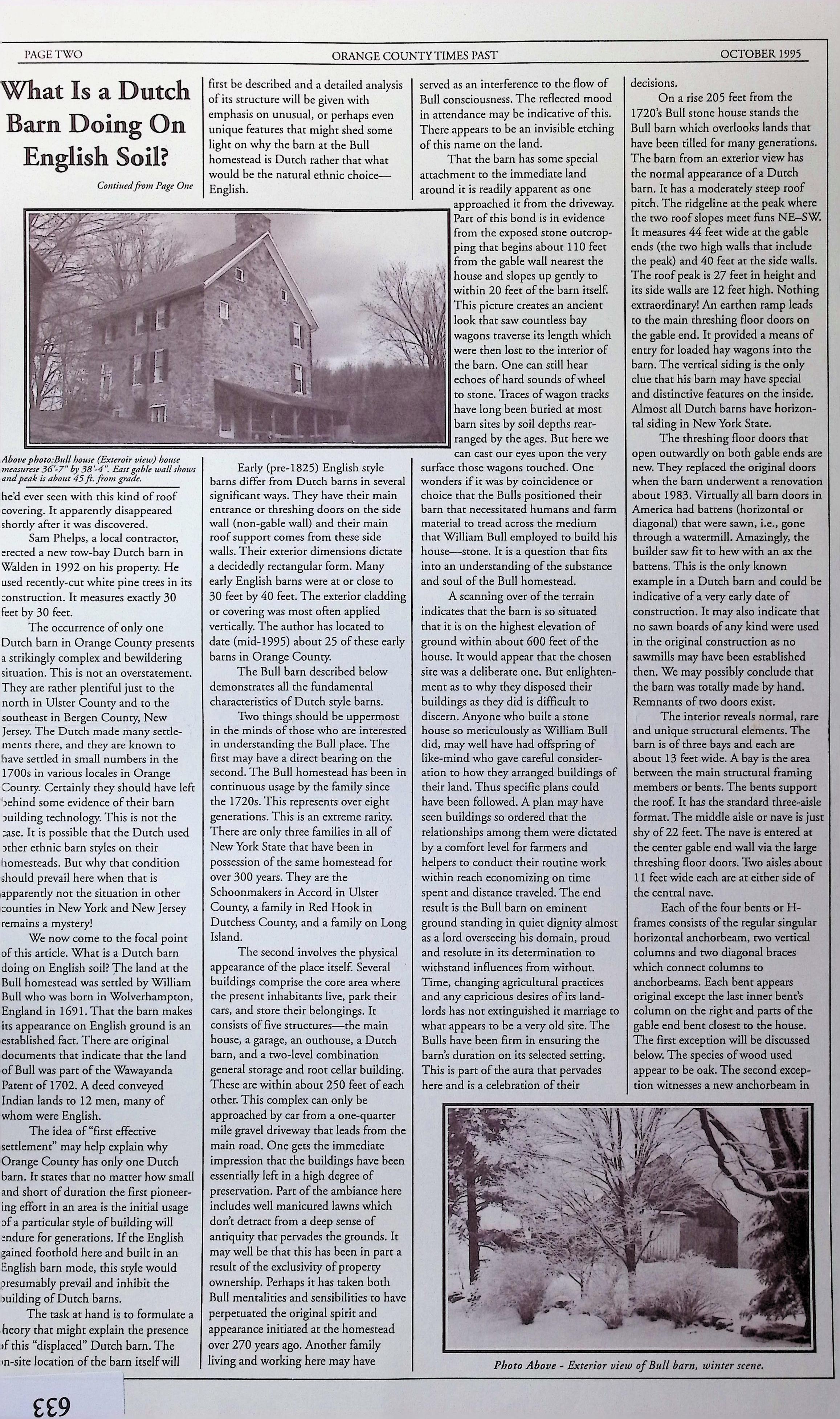
English Settlement, Dutch Architecture: The barn is located on the historic Bull homestead, settled in 1719 by William Bull, an Englishman from Wolverhampton.
An Anomalous Discovery: While Orange County has a very small, rare concentration of early Dutch barns (often concentrated in Ulster County or Bergen County, New Jersey), finding a textbook Dutch barn on an English homestead is highly unusual.
2. Dutch vs. English Barn Architecture
The article highlights key differences between the two styles to show why this barn is distinctly Dutch:
Structural Framing: Dutch barns utilize massive H-shaped frames (anchor-beams) running parallel to the length of the building to support the roof, whereas English barns rely on side-wall support.
Entrance Placement: Dutch barns feature large wagon doors on the gable ends (the shorter sides), allowing wagons to drive straight through the center aisle. English barns typically feature doors on the longer side walls.
Dimensions: True early Dutch barns (pre-1825) have a distinctive, nearly square floor plan (often around 50x50 feet) with a low, sweeping roofline.
3. Features of the Bull Barn
Unique Hybrid Characteristics: The Bull barn is a 1720s three-bay Dutch barn measuring 44 feet wide at the gable and 40 feet long.
Materials & Construction: It features five heavy H-frames made of oak and pine, with evidence of early hand-tool craftsmanship (such as broadax and adze marks).
Preservation: The homestead has remained in the hands of the same family for over 270 years, keeping the barn and its surrounding stone house remarkably well-preserved.
4. Why is it on "English Soil"?
The author proposes a few theories for why an English settler constructed a Dutch-style barn:
The "First Effective Settlement" Theory: In early frontier environments, minority cultures with superior specialized technology or regional dominance often influenced newcomers. Early English settlers in the region likely hired experienced Dutch builders or adopted the highly efficient Dutch barn design because it was the most practical option available at the time.
Local Collaboration: The barn's construction may have been a collaborative effort between English landowners and Dutch craftsmen from neighboring settlements.