Name/Title
Dutch Barn ArchitectureEntry/Object ID
000635Tags
William Bull and Sarah Wells Stone House AssociationScope and Content
Architectural Features & Anomalies
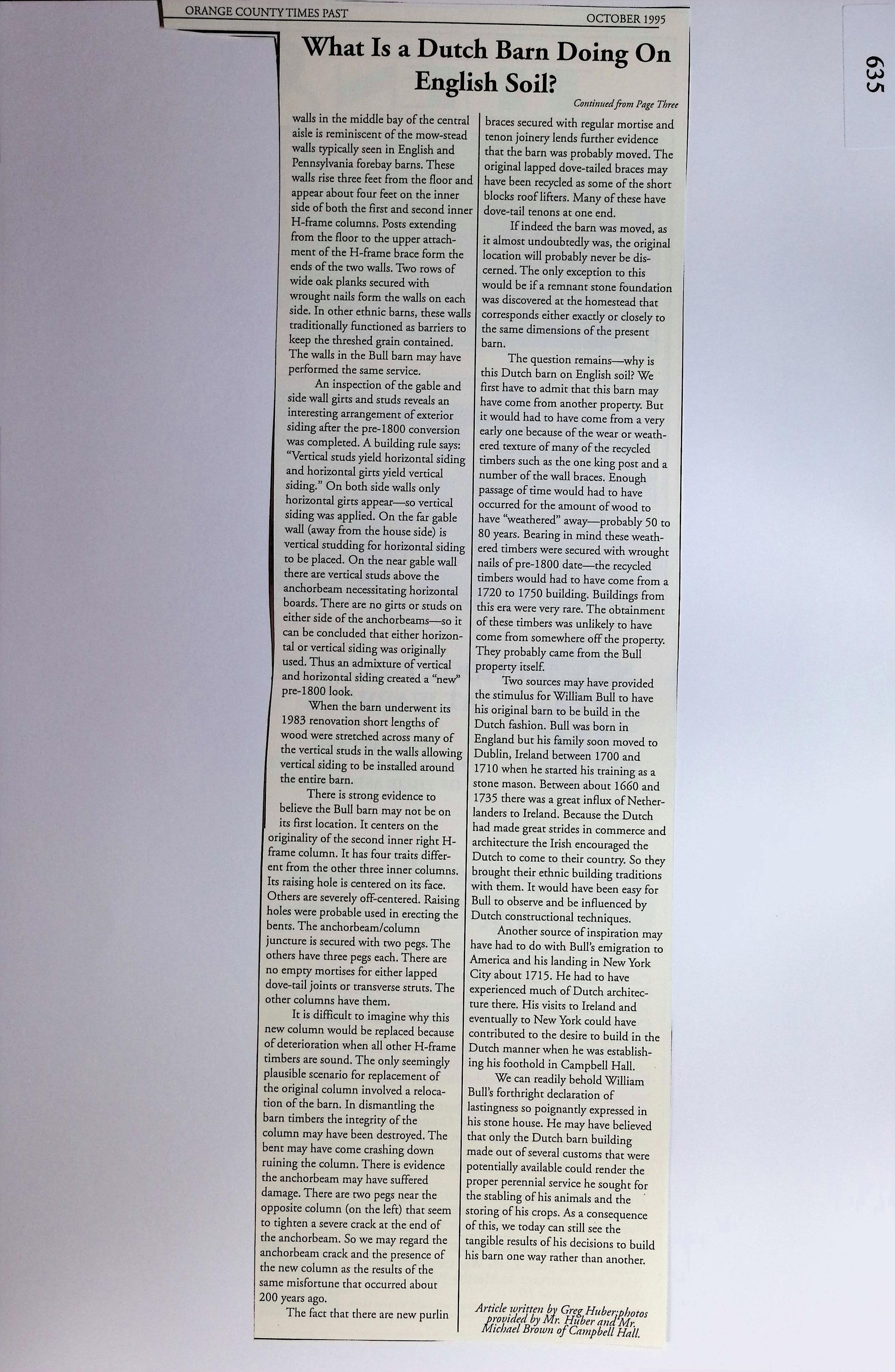
Hybrid Framing: The barn features a mix of architectural traditions. It has internal "H-frame" columns typical of Dutch barns, but also incorporates walls in the middle bay reminiscent of English and Pennsylvania-German "forebay" barns.
Siding Transitions: Physical evidence on the gables and side walls suggests a transition in siding styles. It appears to have shifted from an older style (such as vertical siding) to a post-1800 horizontal siding configuration.
Evidence of Relocation & Reuse:
The presence of regular mortise-and-tenon joinery, empty mortise holes, and recycled dove-tailed braces strongly indicates the barn was moved from another location or reconstructed using salvaged timbers.
Many of the recycled timbers show significant weathering that likely predates the current barn's assembly (estimated to have occurred around 1720 to 1750).
Structural Repairs: There is evidence of a major past structural failure (possibly a falling timber or a collapsing bent about 200 years ago) that required replacing an original column and repairing cracked anchorbeams.
Historical Context & Influences
The article poses the central question of why a Dutch-style barn was built on "English soil" by William Bull. It offers two primary explanations for this cultural crossover:
The Irish-Dutch Connection: William Bull was born in England but raised in Dublin, Ireland, during a period (between 1700 and 1715) marked by a massive influx of Dutch settlers to Ireland. Bull likely received his training as a stone mason in this environment, exposing him directly to Dutch building techniques.
The New York Influence: After immigrating to America around 1715, Bull landed in New York City and traveled through areas where Dutch architecture was heavily established. His exposure to these standing structures further influenced his decision to build a Dutch-style barn to safely stable his animals and store his crops.