Name/Title
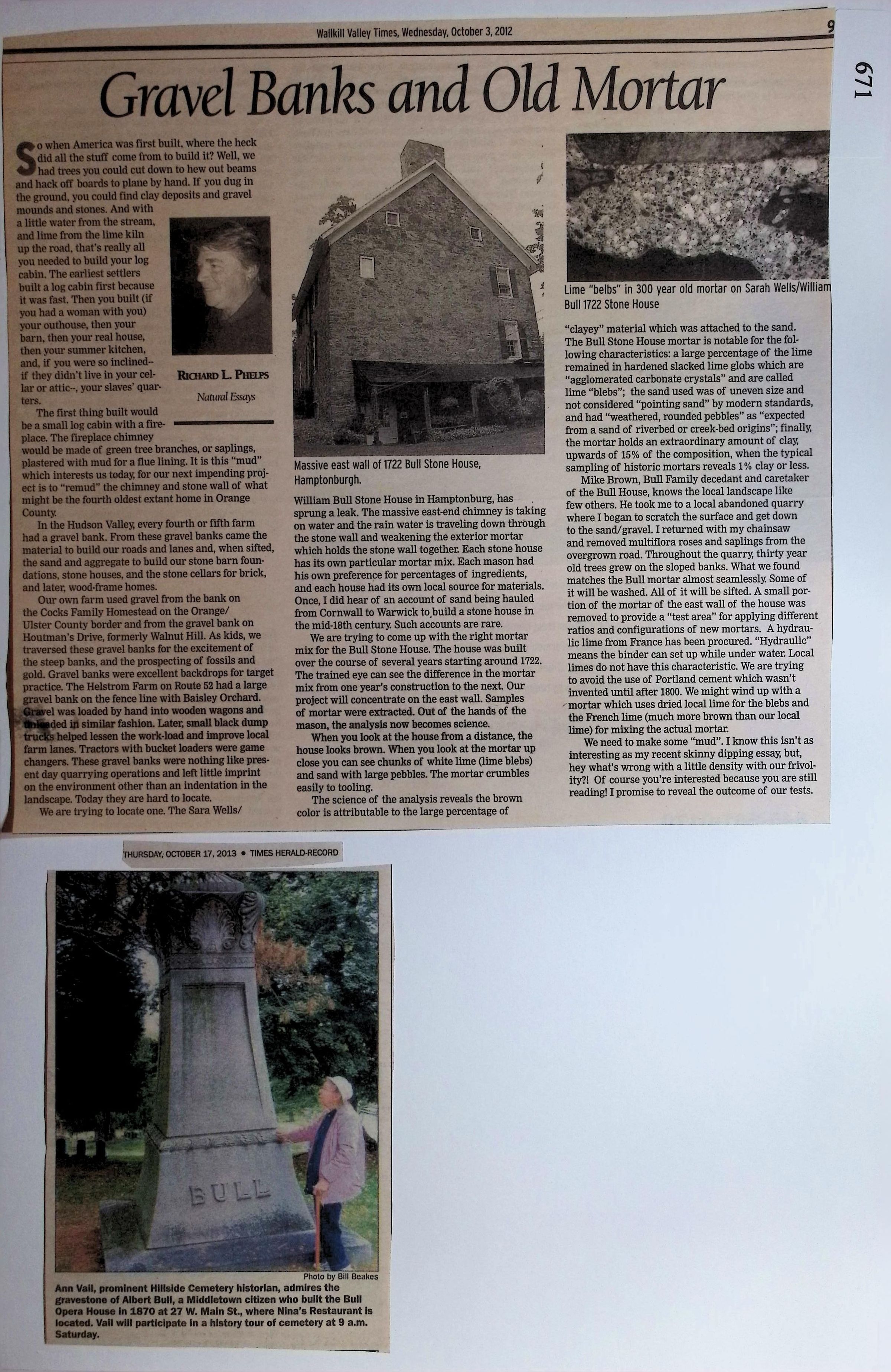
Clippings: Gravel Banks and Old Mortar and Gravestone Photo for Albert BullEntry/Object ID
000671Tags
William Bull and Sarah Wells Stone House AssociationScope and Content
Two Newspaper Clippings
Top
"Gravel Banks and Old Mortar" written by Richard L. Phelps
Wallkill Valley Times, Wednesday, Oct. 3, 2012
The article explores the historic construction materials and techniques used by early settlers in the Hudson Valley, specifically focusing on the restoration and scientific analysis of the mortar at the Sarah Wells/William Bull 1722 Stone House in Hamptonburgh (believed to be the fourth oldest extant home in Orange County).
Key Names Mentioned
Richard L. Phelps: The author of the essay ("Natural Essays"), who shares his childhood memories of local gravel banks and details his current project to analyze and replicate the historic mortar of the Bull Stone House.
Sarah Wells & William Bull: The original 18th-century settlers and owners of the 1722 Bull Stone House.
Mike Brown: A descendant of the Bull family and the current caretaker of the Bull Stone House. He assisted the author by guiding him to a local abandoned quarry to source matching sand and gravel.
Core Topics and Summary
The History of Early Construction: The author explains how early settlers utilized local, raw materials—timber, clay, stones, gravel, and lime—to build their homesteads. They typically started with a temporary log cabin before constructing barns, permanent stone houses, summer kitchens, and other outbuildings.
Local Gravel Banks: In the Hudson Valley, many farms had their own gravel banks.
The author's family used gravel from the Cocks Family Homestead (on the Orange/Ulster County border) and a bank on Houtman's Drive (formerly Walnut Hill).
The Helstrom Farm on Route 52 (bordering Baisley Orchard) also had a large gravel bank.
The Mortar Restoration Project: The massive east-wall chimney of the 1722 Bull Stone House has sprung a leak, with rainwater damaging the exterior mortar. Because each historic stone house used a unique, highly localized mortar mix, the author and Mike Brown are working to scientifically replicate the original 1722 recipe.
Scientific Analysis of the Mortar:
The original mortar contains "lime blebs" (hardened, slacked lime globs of "agglomerated carbonate crystals"), weathered rounded pebbles, and an unusually high clay content (up to 15%, giving it a brown color).
To match this without using modern Portland cement (which wasn't invented until after 1800), the restorers are experimenting with a mix of local lime (for the blebs), local quarry sand, and imported hydraulic lime from France to allow the mortar to set under wet conditions.
Bottom
Thursday, October 17, 2013, Times Herald-Recorder
Ann Vail, prominent Hillside Cemetery historian, admires the gravestone of Albert Bull, a citizen of Middleton who built the Bull Opera House in 1870 at 27 W. Main St., where Nina's Restaurant is located. Vail will participate in a history tour of cemetery at 9 a.m. Saturday