Name/Title
Newspaper clipping on Dairy FarmingEntry/Object ID
000740Tags
Unknown NewspaperScope and Content
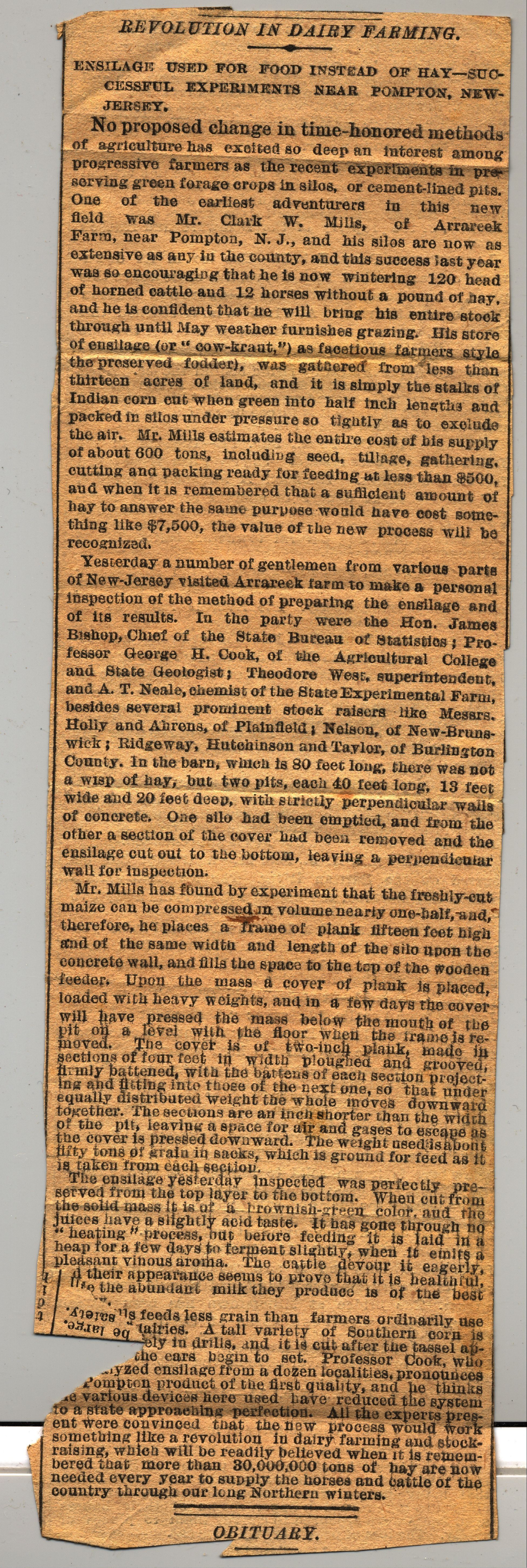
REVOLUTION IN DAIRY FARMING.
Ensilage used for food instead of hay -- successful experiments near Pompton, New-Jersey.
No proposed change in time-honored methods of agriculture has excited so deep and interest among progressive farmers as the recent experiments in preserving green forage crops in silos, or cement-lined pits. One of the earliest adventurers in this new field was Mr. Clark W. Mills, of Arrareek Farm, near Pompton, N. J., and his silos are now as extensive as any in the county, and this success last year was so encouraging that he is now wintering 120 head of horned cattle and 12 horses without a pound of hay, and he is confident that he will bring his entire stock through until May weather furnishes grazing. His store of ensilage (or “cowkrant,”) as facetious farmers style the preserved fodder), was gathered from less than thirteen acres of land, and it is simply the stalks of Indian corn cut when green into half inch lengths and packed in silos under pressure so tightly as to exclude the air. Mr. Mills estimates the entire cost of his supply of about 600 tons, including seed, tillage, gathering, cutting and packing ready for feeding at less than $500, and when it is remembered that a sufficient amount of hay to answer the same purpose would have cost something like $7,500, the value of the new process will be recognized.
Yesterday a number of gentlemen from various parts of New-Jersey visited Arrareek farm to make a personal inspection of the method of preparing the ensilage and of its results. In the party were the Hon. James Bishop, Chief of the State Bureau of Statistics; Professor George H. Cook, of the Agricultural College and State Geologist; Theodor West, superintendent, and A. T. Neale, chemist of the State Experimental Farm, besides several prominent stock raisers like Messrs. Holly and Ahrens, of Plainfield; Nelson, of New-Brunswick; Ridgeway, Hutchinson and Taylor, of Burlington County. In the barn, which is 80 feet long, there was not a wisp of hay, but two pits, each 40 feet long, 13 feet wide and 20 feet deep, with strictly perpendicular walls of concrete. One silo had been emptied and from the other section of the cover had been removed and the ensilage cut out to be bottom, leaving a perpendicular wall for inspection.
Mr. Mills has found by experiment that the freshly-cut maize can be compressed in volume nearly one-half, and, therefore, he places a frame of plank fifteen feet high and of the same width and length of the silo upon the concrete wall, and fills the space to the top of the wooden feeder. Upon the mass a cover of plank is placed, loaded with heavy weights, and in a few days the cover will have pressed the mass below the mouth of the pit on a level with the floor when the frame is removed. The cover is of two-inch plank, made in sections of four feet in width ploughed and grooved, firmly battened, with the battens of each section projecting and fitting into those of the next one, so that under equally distributed weight the whole moves downward together. The sections are an inch shorter than the width of the pit, leaving a space for air and gases to escape as the cover is pressed downward. The weight used is about fifty tons of grain in sacks, which is ground for feed as it is taken from each section.
The ensilage yesterday inspected was perfectly preserved from the top layer to the bottom. When cut from the solid mass it is of a brownish-green color, and the juices have a slightly acid taste. It has gone through no “heating” process, but before feeding it is laid in a heap for a few days to ferment slightly, when it emits a pleasant vinous aroma. The cattle devour it eagerly, adn their appearance seems to prove that it is healthful, ? the abundant milk they produce is of the best ?.
? feeds less grain than farmers ordinarily use? dairies. A tall variety of Southern corn is ? in drills, and is cut after the tassel ap? the ears begin to set. Professor Cook, who ?yzed ensilage from a dozen localities, pronounces ? Pompton product of the first quality, and he thinks the various devices here used have reduced the system to a state approaching perfection. All of the experts present were convinced that the new process would work something like a revolution in dairy farming and stock-raising, which will be readily believed when it is remembered that more than 30,000,000 tons of hay are now needed every year to supply the horses and cattle of the country through our long Northern winters.