Name/Title
The Seventh Day RestEntry/Object ID
000742Tags
Unknown NewspaperScope and Content
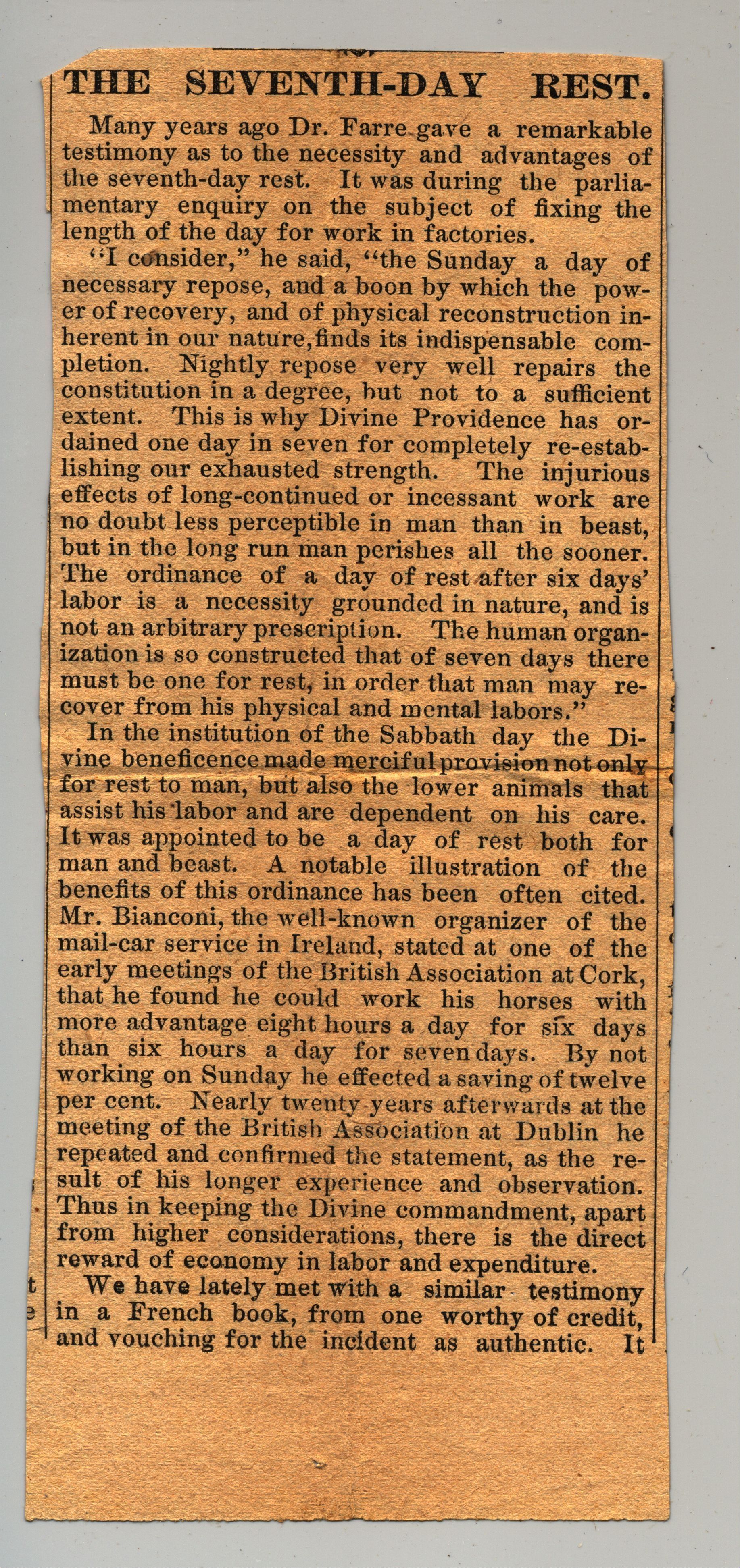
THE SEVENTH-DAY REST.
Many years ago Dr. Farre gave a remarkable testimony as to the necessity and advantages of the seventh-day rest. It was during the parliamentary enquiry on the subject of fixing the length of the day for work in factories.
“I consider,” he said, “the Sunday a day of necessary repose, and a boon by which the power of recovery, and of physical reconstruction inherent in our nature, finds its indispensable completion. Nightly repose very well repairs the constitution in a degree, but not to a sufficient extent. This is why Divine Providence has ordained one day in seven for completely re-establishing our exhausted strength. The injurious effects of long-continued or incessant work are no doubt less perceptible in man than in beast, but in the long run man perishes all the sooner. The ordinance of a day of rest after six days’ labor is a necessity grounded in nature, and is not an arbitrary prescription. The human organization is so constructed that of seven days there must be one for rest, in order that man may recover from his physical and mental labors.”
In the institution of the Sabbath day the Divine beneficence made merciful provision not only for rest to man, but also the lower animals that assist his labor and are dependent on his care. It was appointed to be a day of rest both for man and beast. A notable illustration of the benefits of this ordinance has been often cited. Mr. Bianconi, the well-known organizer of the mail-car service in Ireland, stated at one of the early meetings of the British Association at Cork, that he found he could work his horses with more advantage eight hours a day for six days than six hours a day for seven days. By not working on Sunday he effected a saving of twelve per cent. Nearly twenty years afterwards at the meeting of the British Association at Dublin he repeated and confirmed the statement, as the result of his longer experience and observation. Thus in keeping the Divine commandment, apart from higher considerations, there is the direct reward of economy in labor and expenditure.
We have lately met with a similar testimony in a French book, from one worthy of credit, and vouching for the incident as authentic.