Name/Title
The First Printed Book - Gutenberg BibleEntry/Object ID
000744Tags
Unknown NewspaperScope and Content
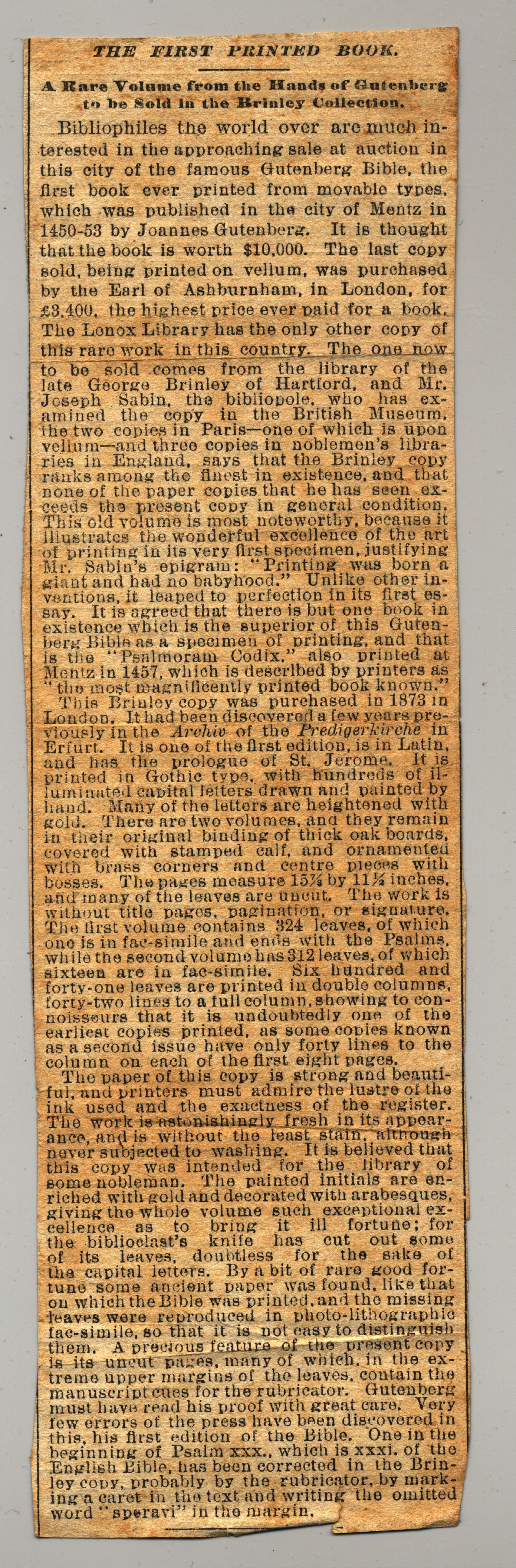
THE FIRST PRINTED BOOK.
A Rare Volume from the Hands of Gutenberg to be Sold in the Brinley Collection.
Bibliophiles the world over are much interested in the approaching sale at auction in this cit of the famous Gutenberg Bible, the first book ever printed from movable types, which was published in the city of Mentz in 1450-53 by Joannes Gutenberg. It is thought that the book is worth $10,000. The last copy sold, being printed on vellum, was purchased by the Earl of Ashburnham, in London, for (L)3,400, the highest price ever paid for a book. The Lenox Library has the only other copy of this rare work in this country. The one now to be sold comes from the library of the late George Brinley of Hartford, and Mr. Joseph Sabin, the bibliopole, who has examined the copy in the British Museum, the two copies in paris -- one of which is upon vellum -- and three copies in noblemen’s libraries in England, says that the Brinley copy ranks among the finest in existence, and that none of the paper copies that he has seen exceeds the present copy in general condition. This old volume is most noteworthy, because it illustrates the wonderful excellence of the art of printing in its very first specimen, justifying Mr. Sabin’s epigram: “Printing was born a giant and had no babyhood.” unlike other inventions, it leaped to perfection in its first essay. It is agreed that there is but one book in existence which is the superior of this Gutenberg Bible as a specimen of printing, and that is the “Psalmoram Codix,” also printed at Mentz in 1457, which is described by printers as “the most magnificently printed book known.”
This Brinley copy was purchased in 1873 in London. It had been discovered a few years previously in the Archiv of the Predigerkirche in Erfurt. It is one of the first edition, is in Latin, and has the prologue of St. Jerome. It is printed in Gothic type, with hundreds of illuminated capital letters drawn and painted by hand. Many of the letters are heightened with gold. There are two volumes, and they remain in their original binding of thick oak boards, covered with stamped calk, and ornamented with brass corners and centre pieces with bosses. The pages measure 15-7/8 by 11-½ inches and many of the leaves are uncut. The work is without title pages, pagination, or signature. The first volume contains 324 leaves, of which one is in fac-simile and ends with the Psalms, while the second volume has 312 leaves, of which sixteen are in fac-simile. Six hundred and forty-one leaves are printed in double columns, forty-two lines to a full column, showing to connoisseurs that it is undoubtedly one of the earliest copies printed, as some copies known as a second issue have only forty lines to the column on each of the first eight pages.
The paper of this copy is strong and beautiful, and printers must admire the lustre of the ink used and the exactness of the register. The work is astonishingly fresh in its appearance, and is without the least stain, although never subjected to washing. It is believed that this copy was intended for the library of some nobleman. The painted initials are enriched with gold and decorated with arabesques, giving the whole volume such exceptional excellence as to bring it ill fortune; for the biblioclast’s knife has cut out some of its leaves, doubtless for the sake of the capital letters. By a bit of rare good fortune some ancient paper was found, like that on which the Bible was printed, and the missing leaves were reproduced in photo-lithographic fac-simile, so that it is not easy to distinguish them. A precious feature of the present copy is its uncut pages, many of which, in the extreme upper margins of the leaves, contain the manuscript cues for the rubricator. Gutenberg must have read his proof with great care. Very few errors of the press have been discovered in this, his first edition of the Bible. One in the beginning Psalm xxx., which is xxxi, of the English Bible, has been corrected in the Brinley copy, probably by the rubricator, by marking a caret in the text and writing the omitted word “speravi” in the margin.