Name/Title
Bull Homestead pg 658 copied from History of Orange County NYEntry/Object ID
000042Tags
Orange County HistoryScope and Content
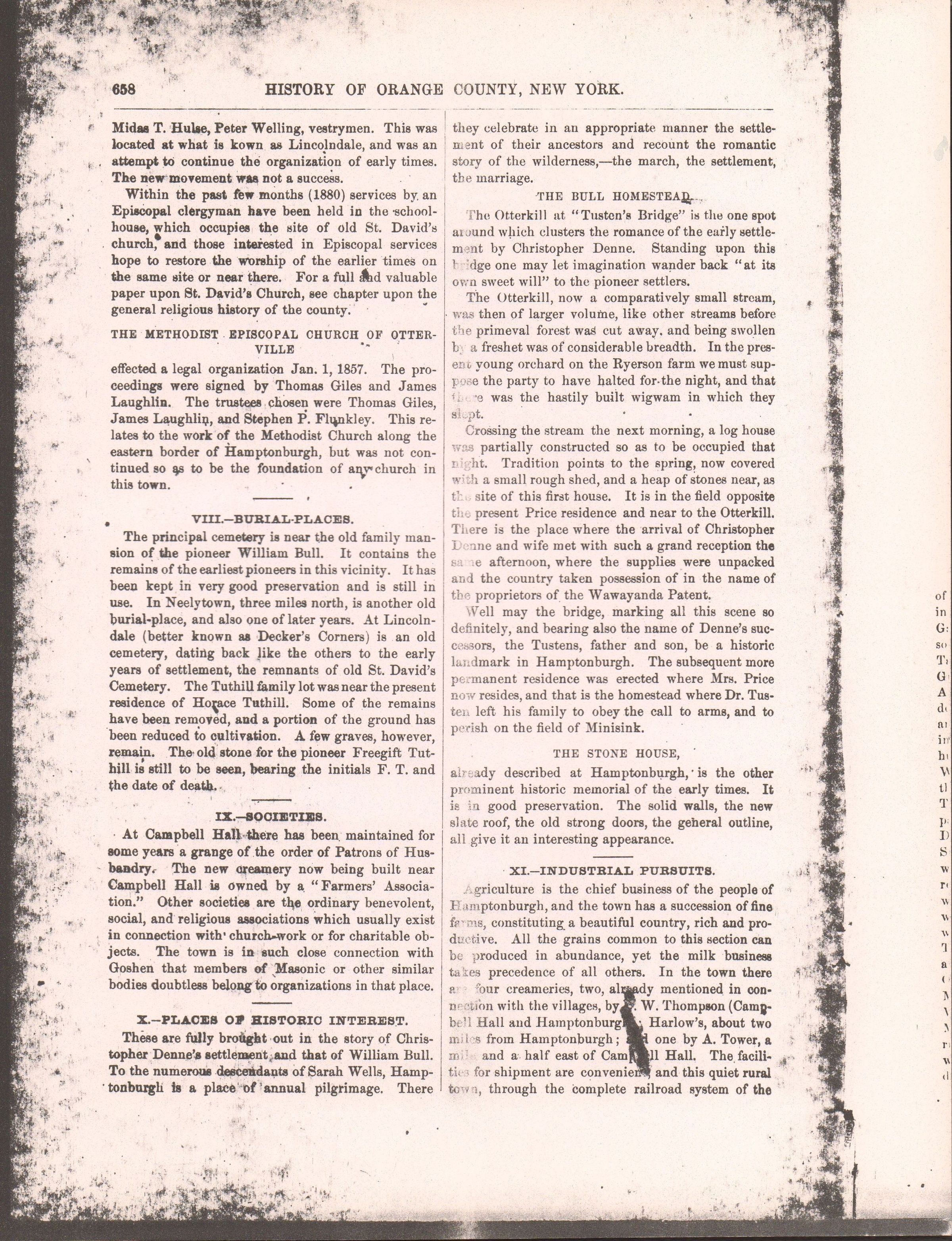
658 HISTORY OF ORANGE COUNTY, NEW YORK.
Midas T. Hulse, Peter Welling, vestrymen. This was located at what is known as Lincolnldale, and was an attempt to continue the organization of early times. The new movement was not a success.
Within the past few months (1880) services by an Episcopal clergyman have been held in the school-house, which occupies the site of old St. David’s church, and those interested in Episcopal services hope to restore the worship of the earlier times on the same site or near there. For a full and valuable paper upon St. David’s Church, see chapter upon the general religious history of the county.
THE METHODIST EPISCOPAL CHURCH OF OTTERVILLE
effected a legal organization Jan. 1, 1857. The proceedings were signed by Thomas Giles and James Laughlin. The trustees chosen were Thomas Giles, James Laughlin, and Stephen P. Flukey. This relates to the work of the Methodist Church along the eastern border of Hamptonburgh, but was not continued so as to be the foundation of any church in this town.
VIII.—BURIAL-PLACES.
The principal cemetery is near the old family mansion of the pioneer William Bull. The remains of the earliest pioneers in this vicinity. It has been kept in very good preservation and is still in use. Lately, now and then, interments in another old burial-place, and also one of later years. At Lincolnldale (better known as Decker’s Corners) is an old cemetery, dating back like the others to the early years of settlement, the remains of old St. David’s Cemetery. The Tuthill family lie at or near the present residence of Hoque Tuthill. Some of the remains have been removed, and a portion of the ground has been reduced to cultivation. A few graves, however, remain. The old stone for the pioneer Freegift Tuthill is still to be seen, bearing the initials F. T. and the date of death.
IX.—SOCIETIES.
At Campbell Hall there has been maintained for some years a grange of the order of Patrons of Husbandry. The new creamery now being built near Campbell Hall is owned by a “Farmers’ Association.” Other societies are the ordinary benevolent, social, and religious associations which usually exist in connection with church-work or for charitable objects. The town is in such close connection with Goshen that members of Masonic or other similar bodies doubtless belong to organizations in that place.
X.—PLACES OF HISTORIC INTEREST.
These are fully brought out in the story of Christopher Denne’s settlement, and that of William Bull. The numerous descendants of Sarah Wells, Hamptonburgh is a place of annual pilgrimage. There they celebrate in an appropriate manner the settlement of their ancestors and recount the romantic story of the wilderness—the march, the settlement, the marriage.
THE BULL HOMESTEAD.
The Otterkill at “Tusten’s Bridge” is the one spot around which clusters the romance of early settlement by Christopher Denne. Standing upon that bridge one may let imagination wander back “at its own sweet will” to the pioneer settlers.
The Otterkill, now a comparatively small stream, was then of larger volume, like other streams before the primeval forest was cut away, and being swollen, a freshet was of considerable breadth. In the previous young orchard on the Ryerson farm we must suppose the party to have halted for the night, and that was the hastily built wigwam in which they slept.
Crossing the stream the next morning, a log house was partially constructed so as to be occupied that night. Tradition points to the spring, now covered with a small rough shed, and a heap of stones near, as the site of this first house. It is in the field opposite the present Price residence and near to the Otterkill.
There is the place where the arrival of Christopher Denne and wife met with such a grand reception the late afternoon, where the supplies were unpacked and the foray took possession of the mansion. Well may the bridge, marking all these spots so definitely, and bearing also the name of Denne’s successor, the Tustens, father and son, be a historic landmark in Hamptonburgh. The subsequent more permanent residence was where Mrs. Price now resides, and that is the homestead where Dr. Tusten left his family to obey the call to arms, and to perish on the field of Minisink.
THE STONE HOUSE,
already described at Hamptonburgh, is the other prominent historic memorial of the early times. It is in good preservation. The solid walls, the new slate roof, the old strong doors, the general outline, all give it an interesting appearance.
XI.—INDUSTRIAL PURSUITS.
Agriculture is the chief business of the people of Hamptonburgh, and the town has a succession of fine farms, constituting a beautiful country, rich and productive. All the grains common to this section can be produced in abundance, yet the milk business has precedence of all others. In the town there are four creameries, two, already mentioned in connection with the village, by W. W. Thompson (Campbell Hall and Hamptonburgh); Harlow’s, about two miles from Hamptonburgh; one by A. Tower, a mile and a half east of Campbell Hall. The facilities for shipment are convenient and this quiet rural town, through the complete railroad system of the—Relationships
Related Person or Organization
Person or Organization
Orange County History