Name/Title
Campbell Hall NY Pages copied from History of Orange County NYEntry/Object ID
000037Tags
Orange County HistoryScope and Content
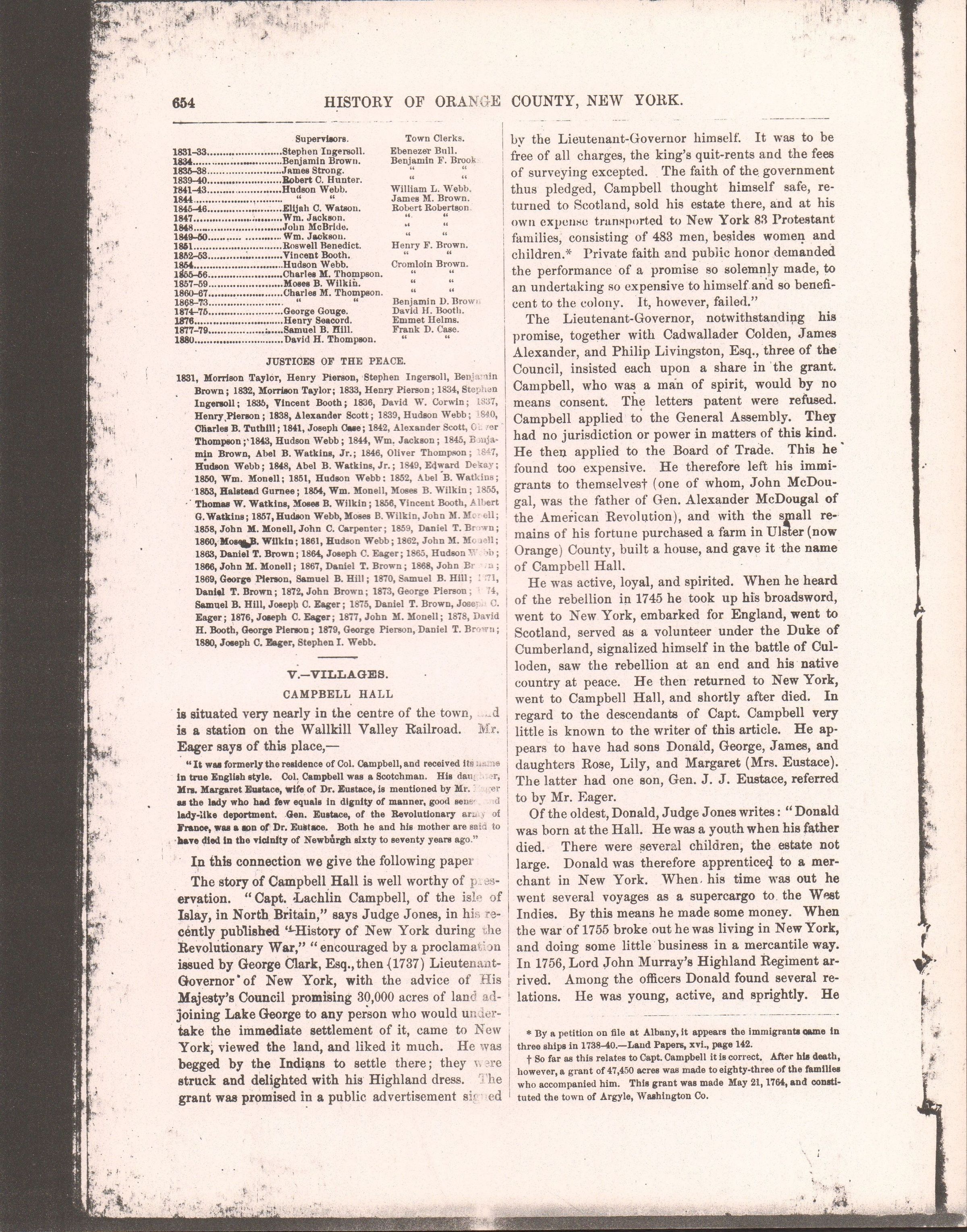
654 HISTORY OF ORANGE COUNTY, NEW YORK.
Supervisors. Town Clerks.
1831–33.................. Stephen Ingersoll. Ebenezer Bull.
1834..................... Benjamin Brown. Benjamin F. Brook.
1835–38.................. James Strong. “ “
1839–40.................. Robert C. Hunter.
1841–43.................. Hudson Webb. William L. Webb.
1844..................... “ “ James M. Brown.
1845–46.................. Elijah C. Watson. Robert Robertson.
1847..................... Wm. Jackson. “ “
1848..................... John McBride. “ “
1849–50.................. Wm. Jackson. “ “
1851..................... Roswell Benedict. Henry F. Brown.
1852–53.................. Vincent Booth. “ “
1854..................... Hudson Webb. Cromlin Brown.
1855–56.................. Charles W. Thompson. “ “
1857–59.................. Moses B. Wilkin. “ “
1860–67.................. Charles M. Thompson. “ “
1868..................... —— Benjamin D. Brown.
1869..................... George Gouge. David H. Booth.
1870–75.................. Henry Seacord. Emmet Helms.
1876..................... Samuel B. Hill. Frank D. Case.
1877–79.................. David H. Thompson. “ “
1880..................... David H. Thompson. “ “
JUSTICES OF THE PEACE.
1831, Morrison Taylor, Henry Pierson, Stephen Ingersoll, Benjamin Brown; 1832, Morrison Taylor; 1833, Henry Pierson; 1834, Stephen Ingersoll; 1835, Vincent Booth; 1836, David W. Corwin; 1837, Henry Pierson; 1838, Alexander Scott; 1839, Hudson Webb; 1840, Charles B. Tuthill; 1841, Joseph Cole; 1842, Alexander Scott; 1843, Thomas; 1843, Hudson Webb; 1844, Wm. Jackson; 1845, Benjamin Brown, Abel B. Watkins, Jr.; 1846, Oliver Thompson; 1847, Hudson Webb; 1848, Abel B. Watkins, Jr.; 1849, Edward Dekay; 1850, Wm. Monell; 1851, Hudson Webb; 1852, Abel B. Watkins; 1853, Halstead Gurnee; 1854, Wm. Monell, Moses B. Wilkin; 1855, Thomas W. Watkins, Moses B. Wilkin; 1856, Vincent Booth, Albert G. Watkins; 1857, Hudson Webb, Moses B. Wilkin, John M. Morell; 1858, John M. Monell, John C. Carpenter; 1859, Daniel T. Brown; 1860, Moses B. Wilkin; 1861, Hudson Webb; 1862, John M. Morell; 1863, Daniel T. Brown; 1864, Joseph C. Eager; 1865, Hudson Webb; 1866, John M. Monell; 1867, Daniel T. Brown; 1868, John Brown; 1869, George Pierson, Samuel B. Hill; 1870, Samuel B. Hill; 1871, Daniel T. Brown; 1872, John Brown; 1873, George Pierson; 1874, Samuel B. Hill, Joseph C. Eager; 1875, Daniel T. Brown, Joseph C. Eager; 1876, Joseph C. Eager; 1877, John M. Monell; 1878, David H. Booth, George Pierson; 1879, George Pierson, Daniel T. Brown; 1880, Joseph C. Eager, Stephen L. Webb.
V.—VILLAGES.
CAMPBELL HALL
is situated very nearly in the centre of the town, and is a station on the Walkill Valley Railroad. Mr. Eager says of this place,—
“It was formerly the residence of Col. Campbell, and received its name in true English style. Col. Campbell was a Scotchman. His daughter, Mrs. Margaret Eustace, wife of Dr. Eustace, is mentioned by Mr. Eager as the lady who had few equals in dignity of manner, good sense and lady-like deportment. Gen. Eustace, of the Revolutionary army in France, was a son of Dr. Eustace. Both he and his mother are said to have died in the vicinity of Newburgh sixty to seventy years ago.”
In this connection we give the following paper.
The story of Campbell Hall is well worthy of preservation. “Capt. Lachlin Campbell, of the isle of Islay, in North Britain,” says Judge Jones, in his recently published “History of New York during the Revolutionary War,” “encouraged by a proclamation issued by George Clark, Esq., then (1737) Lieutenant-Governor of New York, with the advice of His Majesty’s Council promising 30,000 acres of land adjoining Lake George to any person who would undertake the immediate settlement of it, came to New York, viewed the land, and liked it much. He was begged by the Indians to settle there; they were struck and delighted with his Highland dress. The grant was promised in a public advertisement signed by the Lieutenant-Governor himself. It was to be free of all charges, the king’s quit-rents and the fees of surveying excepted. The faith of the government thus pledged, Campbell thought himself safe, returned to Scotland, sold his estate there, and at his own expense transported to New York 83 Protestant families, consisting of 483 men, besides women and children.” Private faith and public honor demanded the performance of a promise so solemnly made, to an undertaking so expensive to himself and so beneficent to the colony. It, however, failed.”
The Lieutenant-Governor, notwithstanding his promise, together with Cadwallader Colden, James Alexander, and Philip Livingston, Esq., three of the Council, insisted each upon a share in the grant. Campbell, who was a man of spirit, would by no means consent. The letters patent were refused. Campbell applied to the General Assembly. They had no jurisdiction or power in matters of this kind. He then applied to the Board of Trade. This he found too expensive. He therefore left his immigrants to themselves (one of whom, John McDougal, was the father of Gen. Alexander McDougal of the American Revolution), and with the small remains of his fortune purchased a farm in Ulster (now Orange) County, built a house, and gave it the name of Campbell Hall.
He was active, loyal, and spirited. When he heard of the rebellion in 1745 he took up his broadsword, went to New York, embarked for England, went to Scotland, served as a volunteer under the Duke of Cumberland, signalized himself in the battle of Culloden, saw the rebellion at an end and his native country at peace. He then returned to New York, went to Campbell Hall, and shortly after died. In regard to the descendants of Capt. Campbell very little is known to the writer of this article. He appears to have had sons Donald, George, James, and daughters Rose, Lily, and Margaret (Mrs. Eustace). The latter had one son, Gen. J. J. Eustace, referred to by Mr. Eager.
Of the eldest, Donald, Judge Jones writes: “Donald was born at the Hall. He was a youth when his father died. There were several children, the estate not large. Donald was therefore apprenticed to a merchant in New York. When his time was out he went several voyages as a supercargo to the West Indies. By this means he made some money. When the war of 1755 broke out he was living in New York, and doing some little business in a mercantile way. In 1756, Lord John Murray’s Highland Regiment arrived. Among the officers Donald found several relations. He was young, active, and sprightly. He”
By a petition on file at Albany, it appears the immigrants came in three ships in 1738–40.—Land Papers, xvi., page 142.
† So far as this relates to Capt. Campbell it is correct. After his death, however, a grant of 47,450 acres was made to eighty-three of the families who accompanied him. This grant was made May 21, 1764, and constituted the town of Argyle, Washington Co.Relationships
Related Person or Organization
Person or Organization
Orange County History