Name/Title
History of George Bull in the Revolutionary WarEntry/Object ID
002748Tags
George BullScope and Content
Early Life and Revolutionary War Service
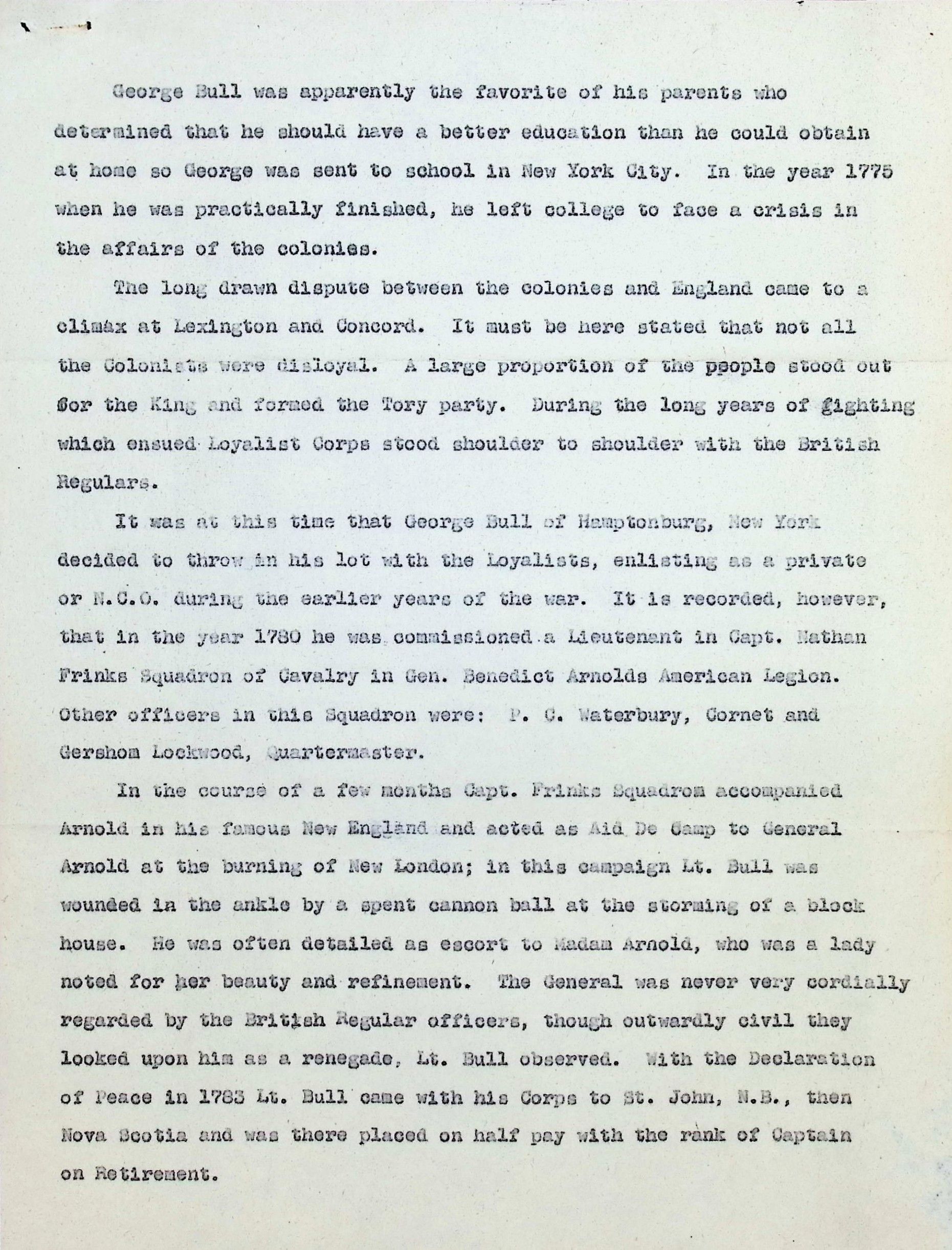
Education: George Bull of Hamptonburgh, New York, was sent to school in New York City by his parents. He left college in 1775 at the outbreak of the American Revolutionary War.
Loyalist Enlistment: Siding with the British Crown (Tories), he initially enlisted as a private or N.C.O.
Commission: In 1780, he was commissioned as a Lieutenant in Capt. Nathan Frink’s Squadron of Cavalry within General Benedict Arnold’s "American Legion."
Military Action: He served as an Aid-De-Camp to General Arnold during the burning of New London, Connecticut, where he was wounded in the ankle by a spent cannonball. He frequently escorted Arnold’s wife (Peggy Shippen).
Retirement: Following the 1783 Declaration of Peace, he traveled with his corps to St. John, New Brunswick (then part of Nova Scotia), where he retired with the rank of Captain on half-pay.
Pioneer Life and Settlement in New Brunswick
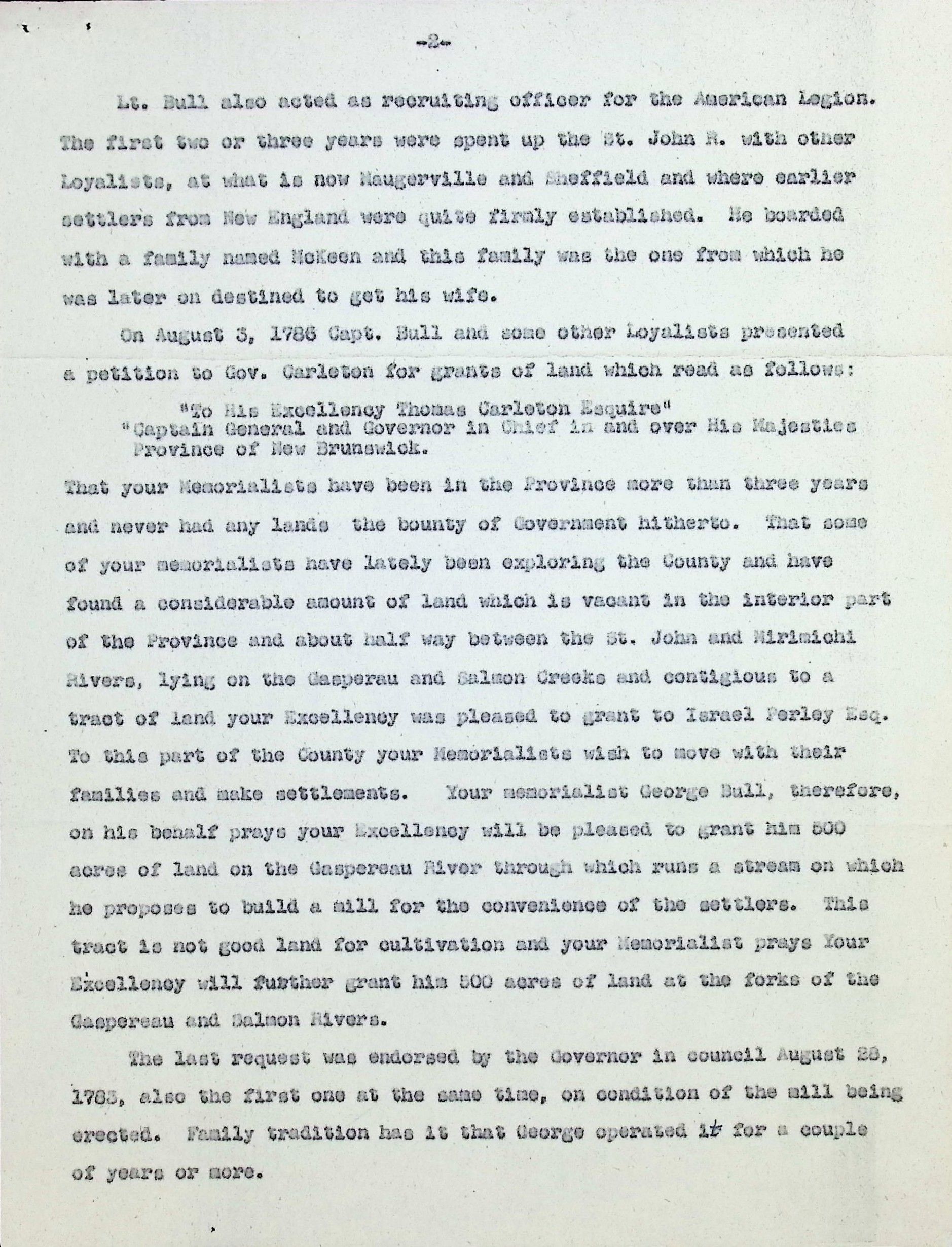
Land Grants: After temporarily staying in Maugerville and Sheffield, Capt. Bull petitioned Governor Thomas Carleton in August 1786. He was granted land at the forks of the Gaspereau and Salmon Rivers on the condition that he build a mill.
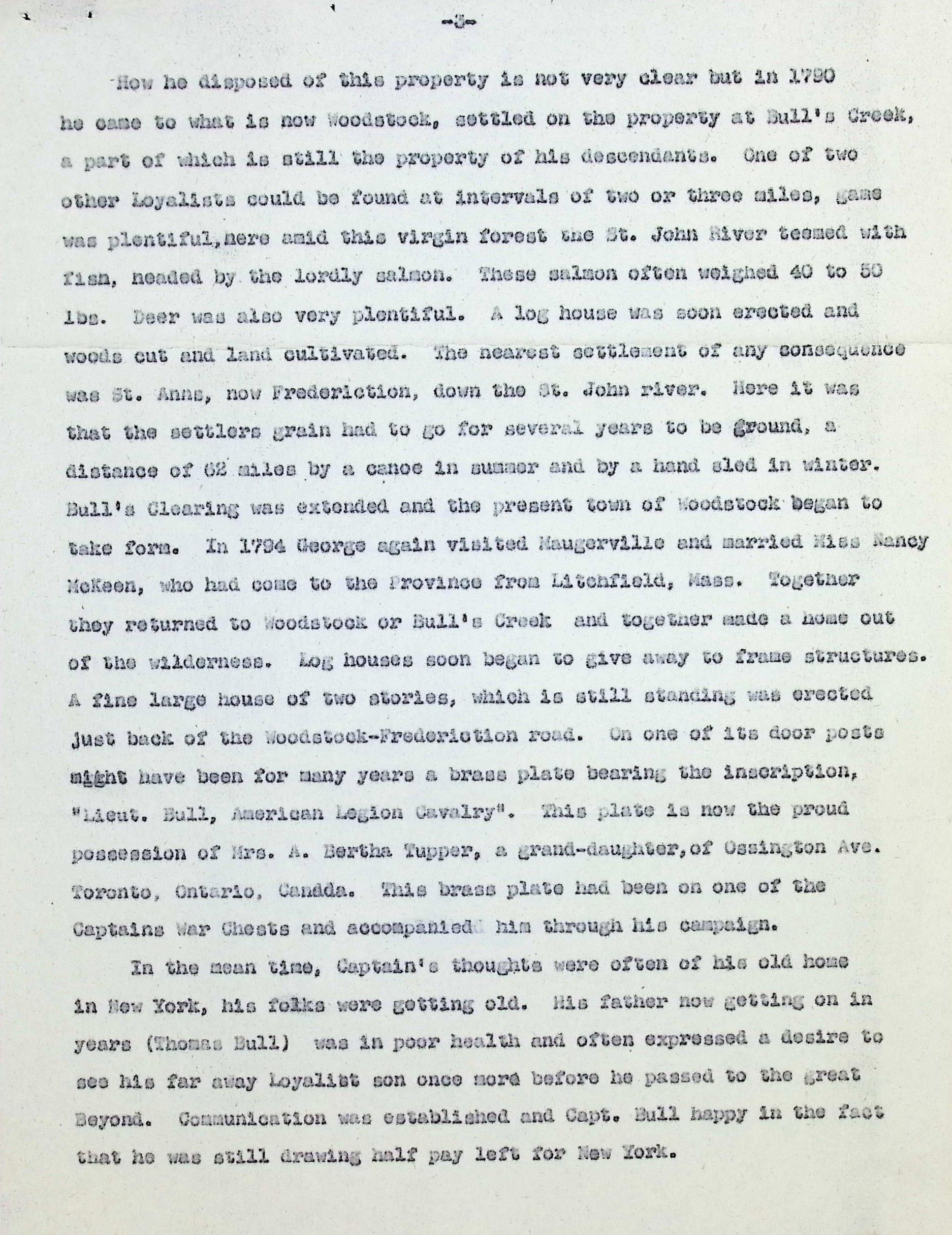
Move to Woodstock: By 1790, he relocated to Bull's Creek in Woodstock, New Brunswick, becoming one of the earliest settlers to clear the wilderness there.
Marriage: In 1794, he married Miss Nancy McKeen (originally from Litchfield, Massachusetts). They built a prominent two-story frame house in Woodstock.
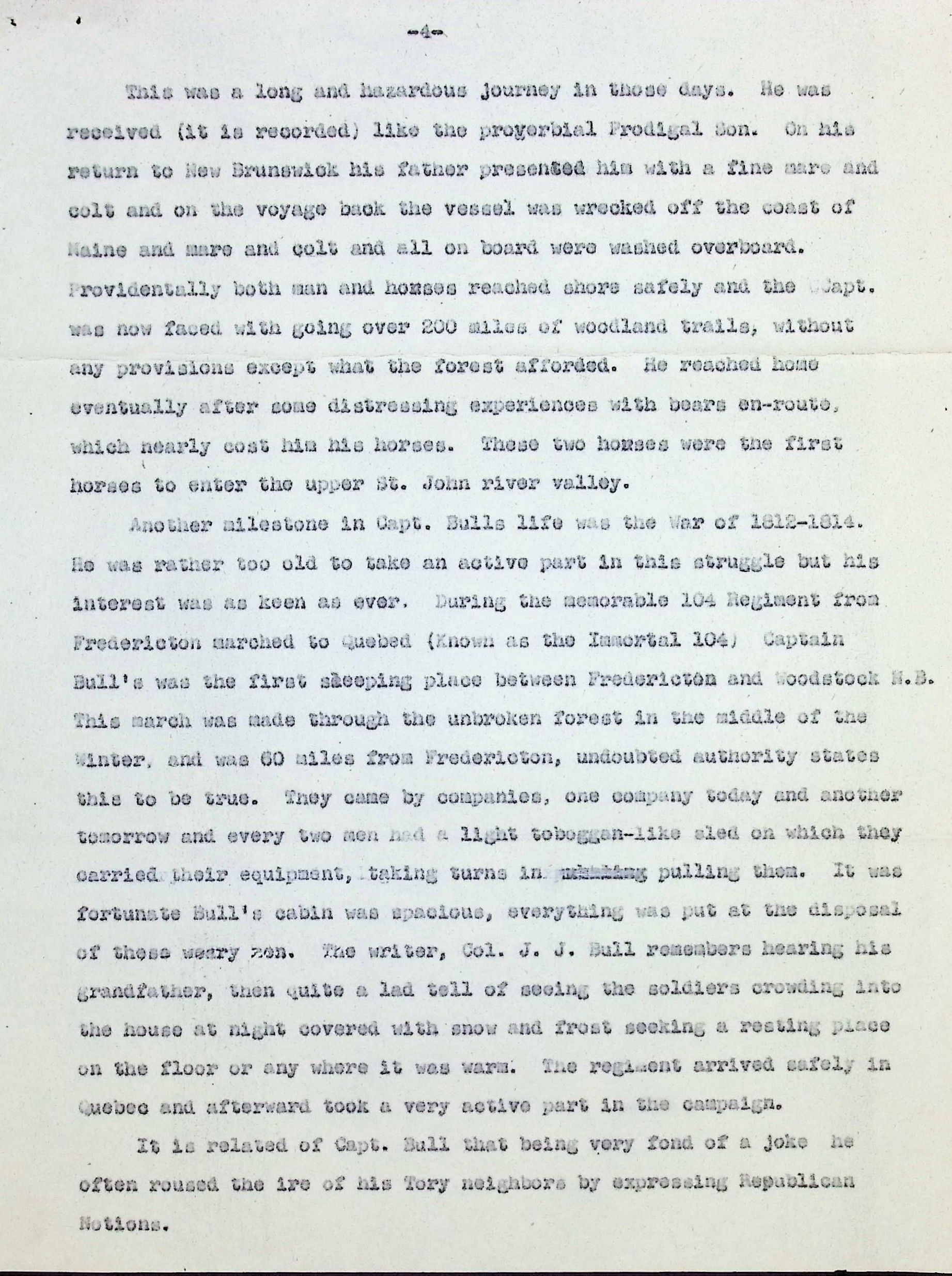
A Journey Back to NY: Capt. Bull made a hazardous journey back to New York to visit his aging father, Thomas Bull. On his return trip to New Brunswick, his ship capsized off the coast of Maine. Though his newly gifted mare and colt were lost, he survived a 200-mile trek through the woods back to the St. John River Valley.
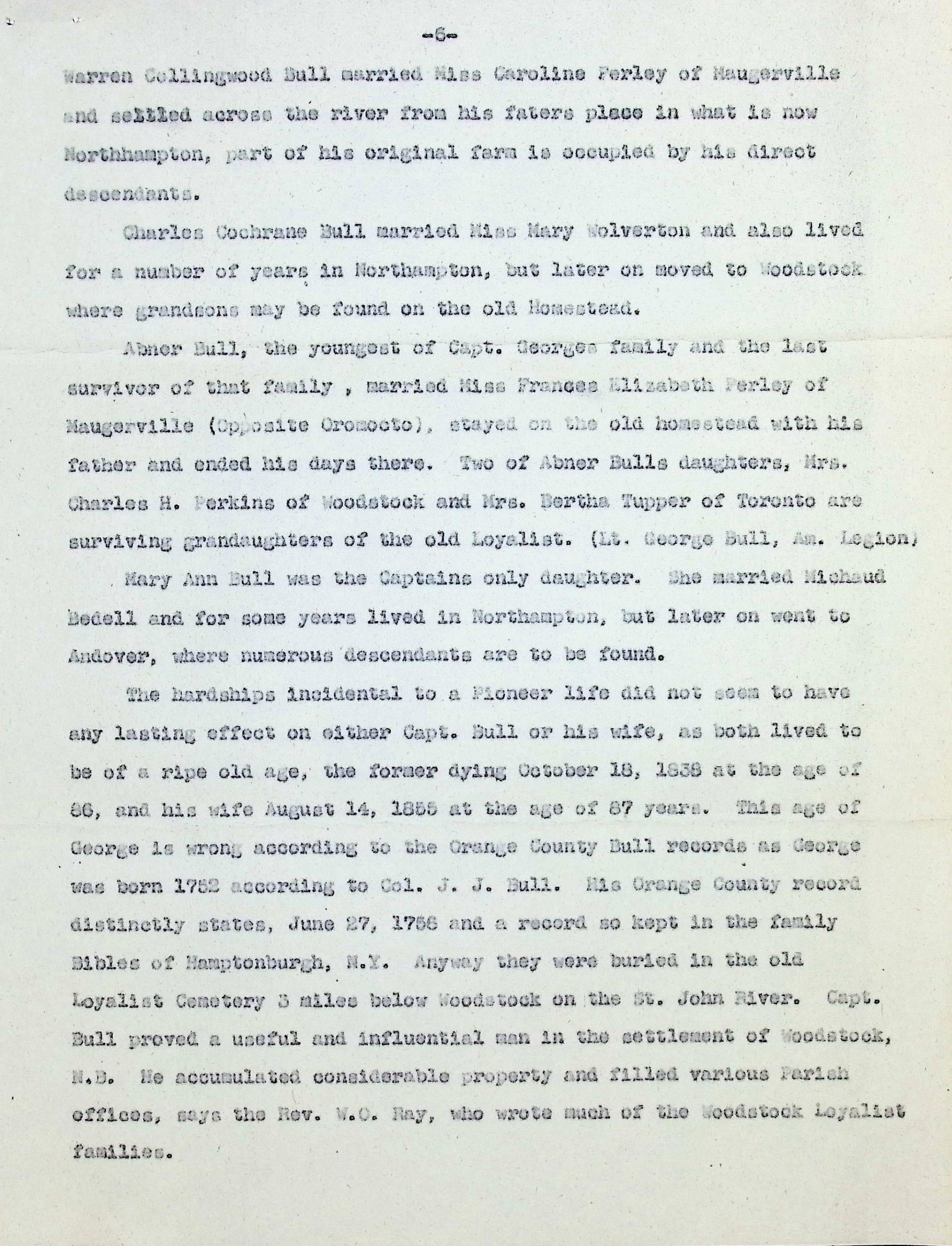
Later Life: During the War of 1812, his home served as the first winter sheltering station for the famed 104th Regiment during their march to Quebec. He was known for his humor, often teasing his Tory neighbors by expressing "Republican Notions." He passed away on October 18, 1838, at age 86 (or 82, based on conflicting family bible records indicating a 1756 birthdate), and his wife died in 1855 at age 87. Both are buried in the old Loyalist Cemetery near Woodstock.
Children and Family Legacy
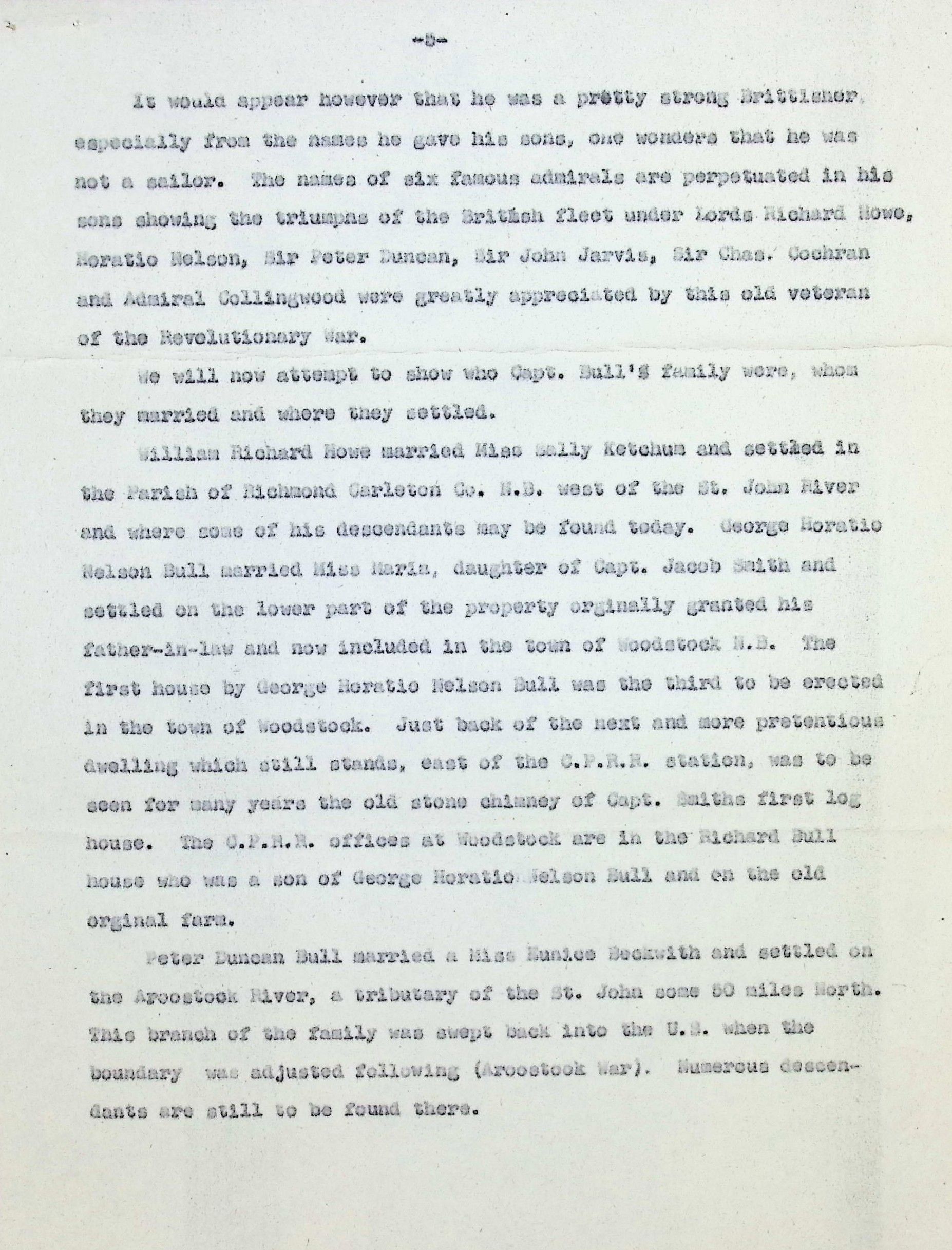
Capt. Bull named his six sons after famous British admirals to reflect his strong British patriotism:
William Richard Howe Bull: Married Miss Sally Ketchum; settled in Richmond, Carleton Co.
George Horatio Nelson Bull: Married Miss Maria Smith; built the third house ever erected in the town of Woodstock.
Peter Duncan Bull: Married Miss Eunice Beckwith; settled on the Aroostook River (later swept back into U.S. territory following the Aroostook War boundary adjustment).
Warren Collingwood Bull: Married Miss Caroline Perley; settled in Northampton.
Charles Cochrane Bull: Married Miss Mary Wolverton; lived in Northampton, later moving to Woodstock.
Abner Bull: The youngest son; married Miss Frances Elizabeth Perley and stayed on the original homestead.
Mary Ann Bull: The Captain's only daughter; married Michaud Bedell and settled in Andover.
World War I Service and Sacrifices
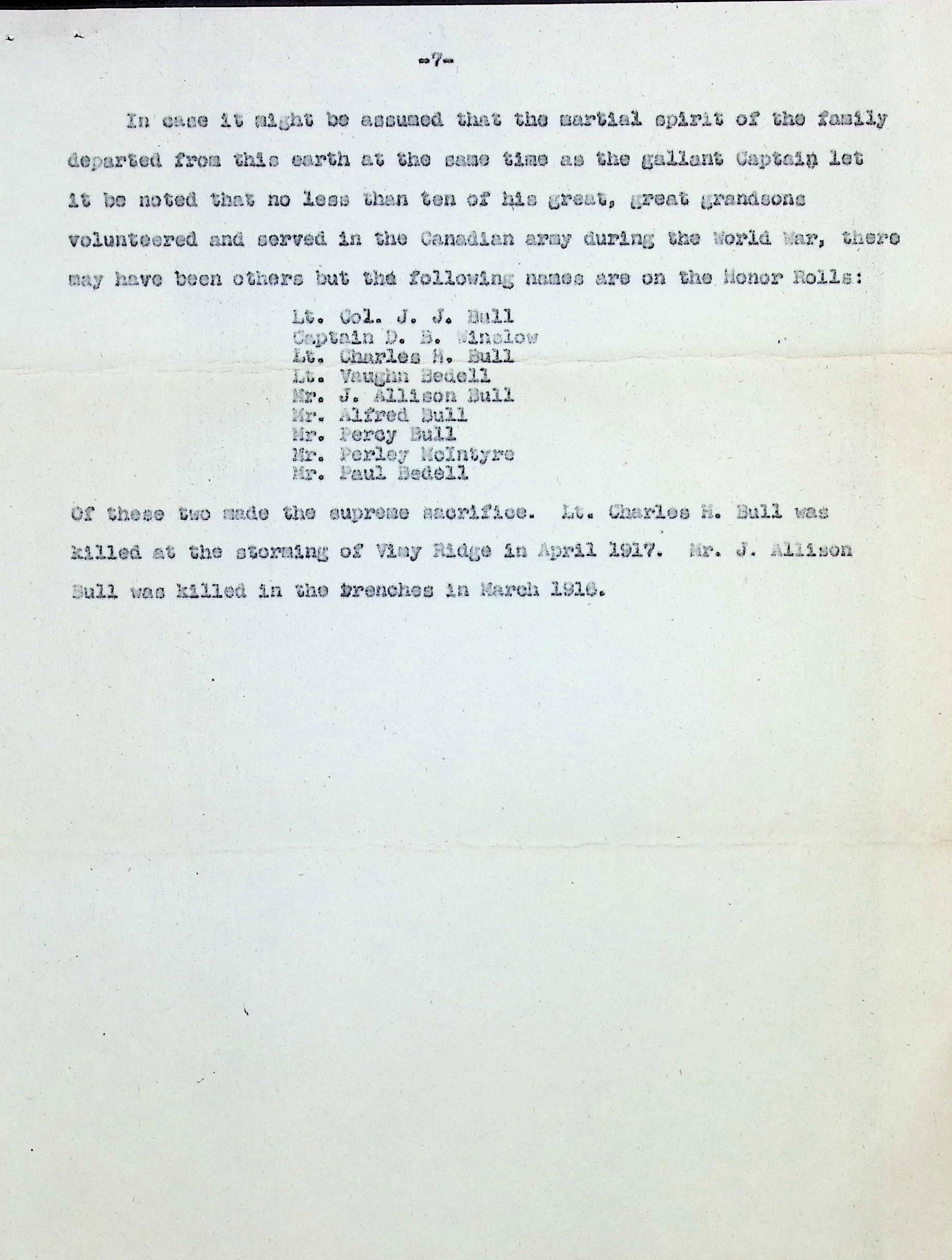
The narrative concludes by highlighting that Capt. Bull’s "martial spirit" continued through his descendants. At least ten of his great-great-grandsons volunteered for the Canadian Army during World War I (the World War).
The listed family members on the Honor Rolls are:
Lt. Col. J. J. Bull (the writer of this record)
Captain D. B. Winslow
Lt. Charles H. Bull (Killed in action at Vimy Ridge, April 1917)
Lt. Vaughn Bedell
Mr. J. Allison Bull (Killed in action in the trenches, March 1916)
Mr. Alfred Bull
Mr. Percy Bull
Mr. Perley McIntyre
Mr. Paul Bedell