Name/Title
Hamptonburgh NY Pages copied from History of Orange County NYEntry/Object ID
000039Tags
Orange County HistoryScope and Content
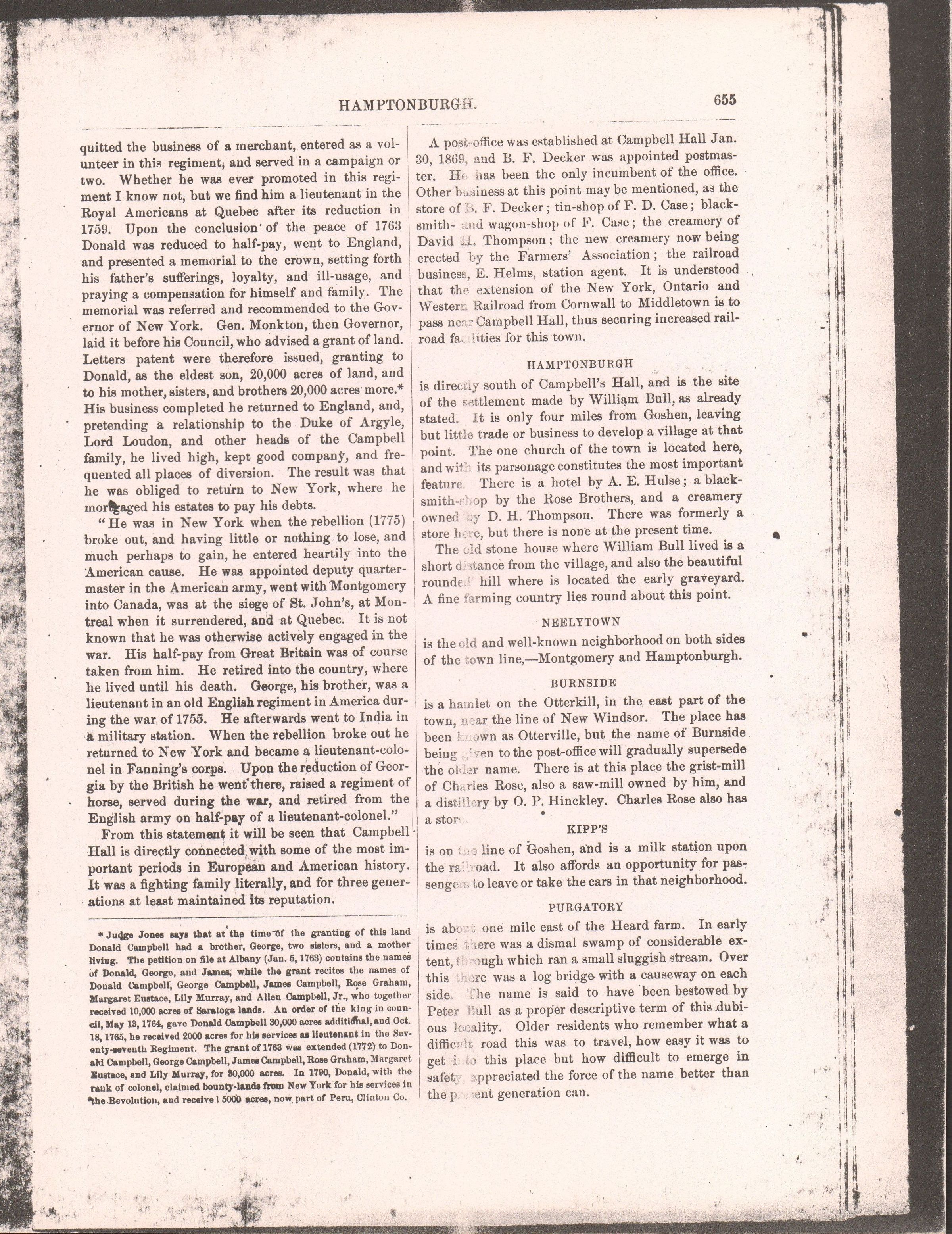
HAMPTONBURGH.
Quitted the business of a merchant, entered as a volunteer in this regiment, and served in a campaign or two. Whether he was ever promoted in this regiment I know not, but we find him a lieutenant in the Royal Americans at Quebec after its reduction in 1759. Upon the conclusion of the peace of 1763 Donald was reduced to half-pay, went to England, and presented a memorial to the crown, setting forth his father’s sufferings, loyalty, and ill-usage, and praying a compensation for himself and family. The memorial was referred and recommended to the Governor of New York. Gen. Monckton, then Governor, laid it before his Council, who advised a grant of land. Letters patent were therefore issued, granting to Donald, as the eldest son, 20,000 acres of land, and to his mother, sisters, and brothers, 20,000 acres more.*
His business compelled he returned to England, and, pending a relationship to the Duke of Argyle, Lord Loudon, and others, who recommended his family, he lived high, kept good company, and frequented all places of resort in New York. When he was obliged to return to New York, there was no place in which he could reside.
“He was in New York when the rebellion (1775) broke out, and having little or nothing to lose, and much to gain, he at once joined the newly created American parties. He was appointed deputy quartermaster-general, and was actively sent with supplies into Canada, was at the siege of St. John’s, at Montreal when it surrendered, and at Quebec. It is not known that he was otherwise actively engaged in the war. His half-pay from Great Britain was of course taken from him. He retired into the country, where he lived until his death. George, his brother, was a lieutenant in an old English regiment in America during the war of 1755. He afterwards went to India in a military station. When the rebellion broke out he returned to New York and became a lieutenant-colonel in Fanning’s corps. Upon the reduction of Georgia by the British he went there, raised a regiment of horse, served during the war, and retired from the English army on half-pay of a lieutenant-colonel.”†
From this statement it will be seen that Campbell Hall is directly connected with some of the most important periods in European and American history. It was a fighting family literally, and for three generations at least maintained its reputation.
*Judge Jones says that at the time of the granting of this land Donald Campbell had six brothers. George, two sisters and a widowed mother. Campbell was at the siege of St. John’s, Montreal, and Quebec, in 1775. He died in 1796. Letters patent were issued in 1767 to Donald, George, and James Campbell, the grant embracing Donald Campbell, George Campbell, Allan Campbell, Eliza Campbell, Margaret Campbell, Mary Campbell, and Allison Campbell, and the grant included 10,000 acres for Saratoga lands. An order of survey was made May 17, 1766, and covered lands in Orange county, and the patent was issued in 1767. The grant was confirmed by the council, and the patent issued by the Governor. The grant of 1767 included Donald, Margaret, Eliza, Mary, and Allison Campbell. The patent of 1767 was issued to Donald Campbell and others. The family had lands in New York, New Jersey, and Canada. They received 10,000 acres from New York for services in the Revolution, and received 1,000 acres, now part of Perth, Chittico Co.
A post-office was established at Campbell Hall Jan. 30, 1868, and B. F. Decker was appointed postmaster. He has been the only incumbent of the office. Other business at this point may be mentioned, as the store of B. F. Decker; tin-shop of F. D. Case; blacksmith- and wagon-shop of F. D. Case; the creamery of David H. Thompson; the new creamery now being erected by the Farmers’ Association; the railroad business, E. Helms, station agent. It is understood that the extension of the New York, Ontario and Western Railroad from Cornwall to Middletown is to pass near Campbell Hall, thus securing increased railroad facilities for this town.
HAMPTONBURGH
is directly south of Campbell’s Hall, and is the site of the settlement made by William Bull, as already stated. It is only four miles from Goshen, leaving but little trade or business to develop a village at that point. The one church of the town is located here, and with its parsonage constitutes the most important feature. There is a hotel by A. E. Hulse; a blacksmith-shop by the Rose Brothers, and a creamery owned by D. H. Thompson. There was formerly a store here, but there is none at the present time.
The old stone house where William Bull lived is a short distance from the village, and also the beautiful rounded hill where is located the early graveyard. A fine farming country surrounds this point.
NEELYTOWN
is the old and well-known neighborhood on both sides of the town line,—Montgomery and Hamptonburgh.
BURNSIDE
is a hamlet on the Otterkill, in the east part of the town, near the line of New Windsor. The place has been known as Otterville, but the name of Burnside given to the post-office will gradually supersede the older name. There is at this place the grist-mill of Charles Rose, also a saw-mill owned by him, and a distillery by O. P. Hinckley. Charles Rose also has a store.
KIPPS
is on the line of Goshen, and is a milk station upon the railroad. It also affords an opportunity for passengers to leave or take the cars in that neighborhood.
PURGATORY
is about one mile east of the Heard farm. In early times there was a dismal swamp of considerable extent, through which ran a small sluggish stream. Over this stream was a log bridge with a causeway on each side. The name is said to have been bestowed by Peter Bull as a proper descriptive term of this dubious locality. Older residents who remember what a bitter road this was to travel, how easy it was to get off this place but how difficult to emerge in safety, appreciate the force of the name better than the present generation can.Relationships
Related Person or Organization
Person or Organization
Orange County History