Name/Title
Hat PinsEntry/Object ID
100172Scope and Content
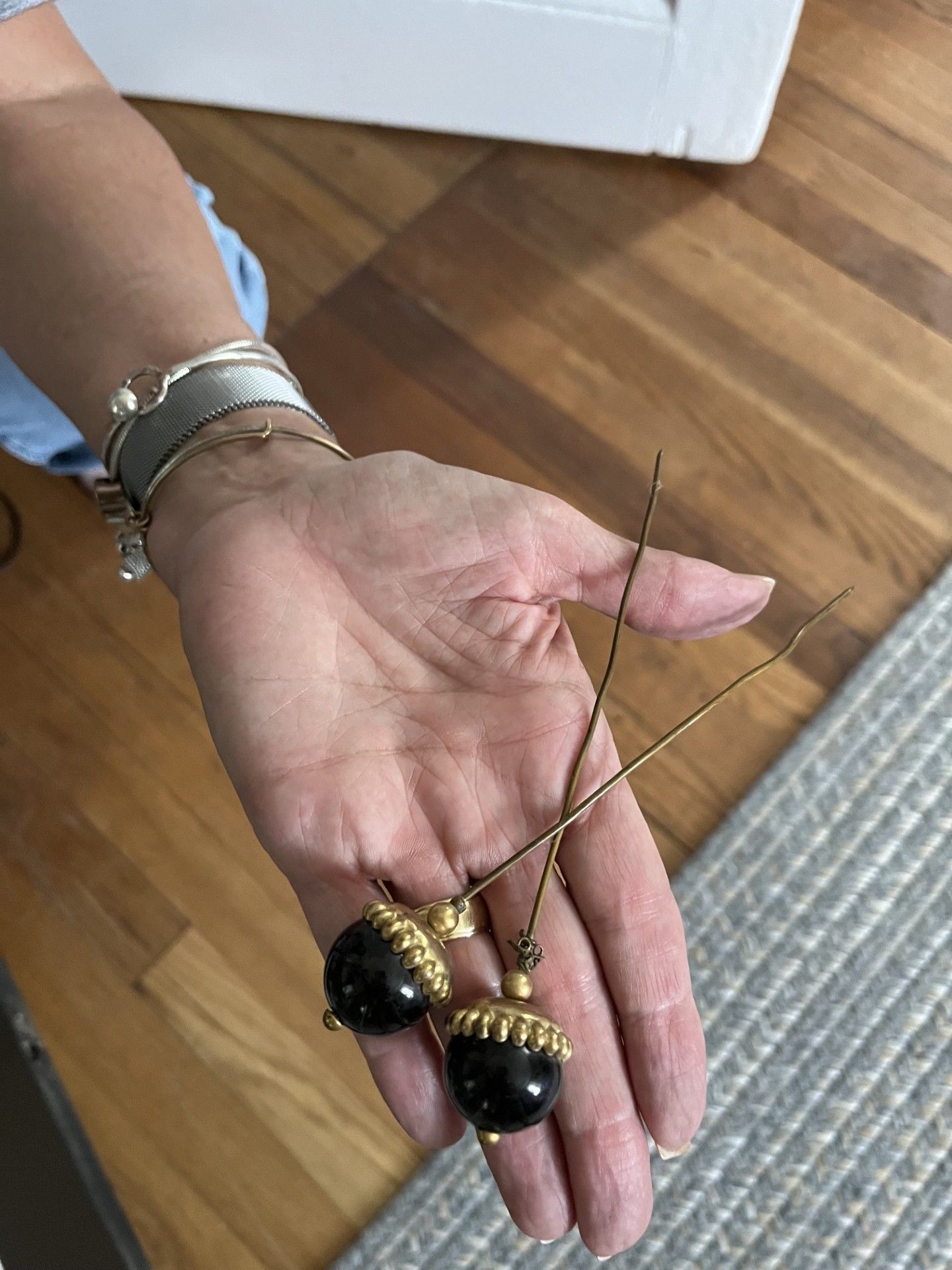
(AI) a pair of antique hatpins, likely dating from the late Victorian to the Edwardian era (circa 1890s–1910s).
1. Their Purpose
During the late 19th and early 20th centuries, women’s hats grew massive, heavy, and highly decorated (think of the iconic "Gibson Girl" style). To keep these enormous hats from blowing away in the wind, women would pile their hair high into voluminous updos and plunge these long pins straight through the hat, through their hair, and out the other side of the hat to lock it into place.
2. Design & Materials
The Style: The decorative heads are styled to look like elegant acorns or capped ornaments.
The Materials: The black spherical bases are likely made of jet (a fossilized wood popular in mourning jewelry), onyx, black glass (often called "French jet"), or an early synthetic material like vulcanite.
The Caps: The black beads are nestled into scalloped, beaded brass or gold-toned metal caps.
The Shafts: The long metal pins have a slight wave or crimp near the middle/end—this was a deliberate design feature to help the pin "grip" the hair and prevent it from sliding out.
3. A Fun Historical Footnote
Because Edwardian hatpins were so long and sharp, they actually became a point of major social controversy. In the early 1900s, as women started entering public transit and crowded city streets more independently, people began fearing them as accidental—or very intentional—weapons. Several cities actually passed laws limiting the length of hatpins or requiring women to wear tiny guards (called hatpin protectors) over the sharp tips! in glass case value ?