Name/Title
Historical & Genealogical article from Independent Republican, Nov 28, 1922Entry/Object ID
000114Tags
GenealogySubject
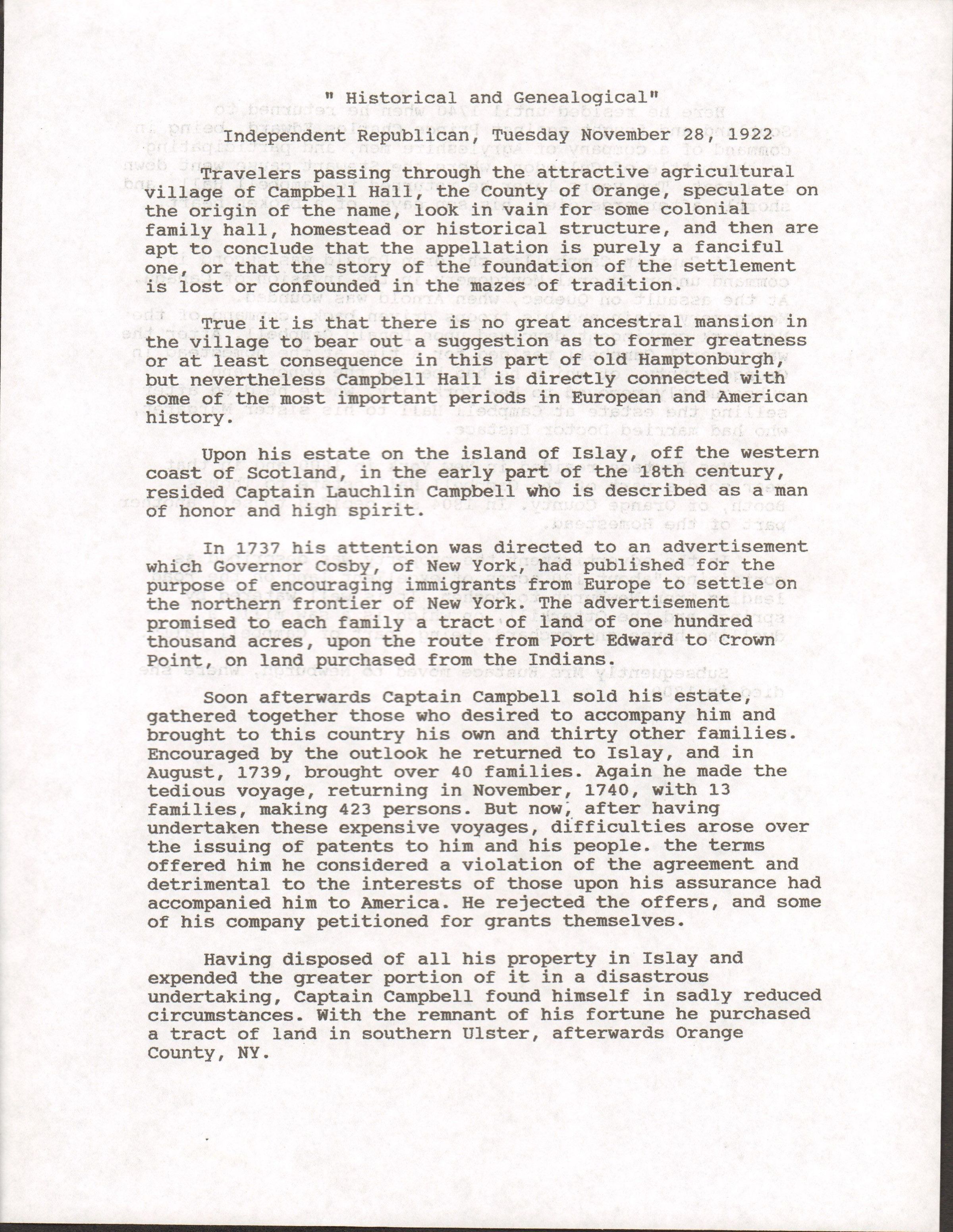
Independent Republican, Tuesday November 28, 1922
Travelers passing through the attractive agricultural village of Campbell Hall, the County of Orange, speculate on the origin of the name, look in vain for some colonial family hall, homestead or historical structure, and then are apt to conclude that the appellation is purely a fanciful one, or that the story of the foundation of the settlement is lost or confounded in the mazes of tradition.
True it is that there is no great ancestral mansion in the village to bear out a suggestion as to former greatness or at least consequence in this part of old Hamptonburgh, but nevertheless Campbell Hall is directly connected with some of the most important periods in European and American history.
Upon his estate on the island of Islay, off the western coast of Scotland, in the early part of the 18th century, resided Captain Lauchlin Campbell who is described as a man of honor and high spirit.
In 1737 his attention was directed to an advertisement which Governor Cosby, of New York, had published for the purpose of encouraging immigrants from Europe to settle on the northern frontier of New York. The advertisement promised to each family a tract of land of one hundred thousand acres, upon the route from Port Edward to Crown Point, on land purchased from the Indians.
Soon afterwards Captain Campbell sold his estate, gathered together those who desired to accompany him and brought to this country his own and thirty other families. Encouraged by the outlook he returned to Islay, and in August, 1739, brought over 40 families. Again he made the tedious voyage, returning in November, 1740, with 13 families, making 423 persons. But now, after having undertaken these expensive voyages, difficulties arose over the issuing of patents to him and his people. The terms offered him he considered a violation of the agreement and detrimental to the interests of those upon his assurance had accompanied him to America. He rejected the offers, and some of his company petitioned for grants themselves.
Having disposed of all his property in Islay and expended the greater portion of it in a disastrous undertaking, Captain Campbell found himself in sadly reduced circumstances. With the remnant of his fortune he purchased a tract of land in southern Ulster, afterwards Orange County, NY.
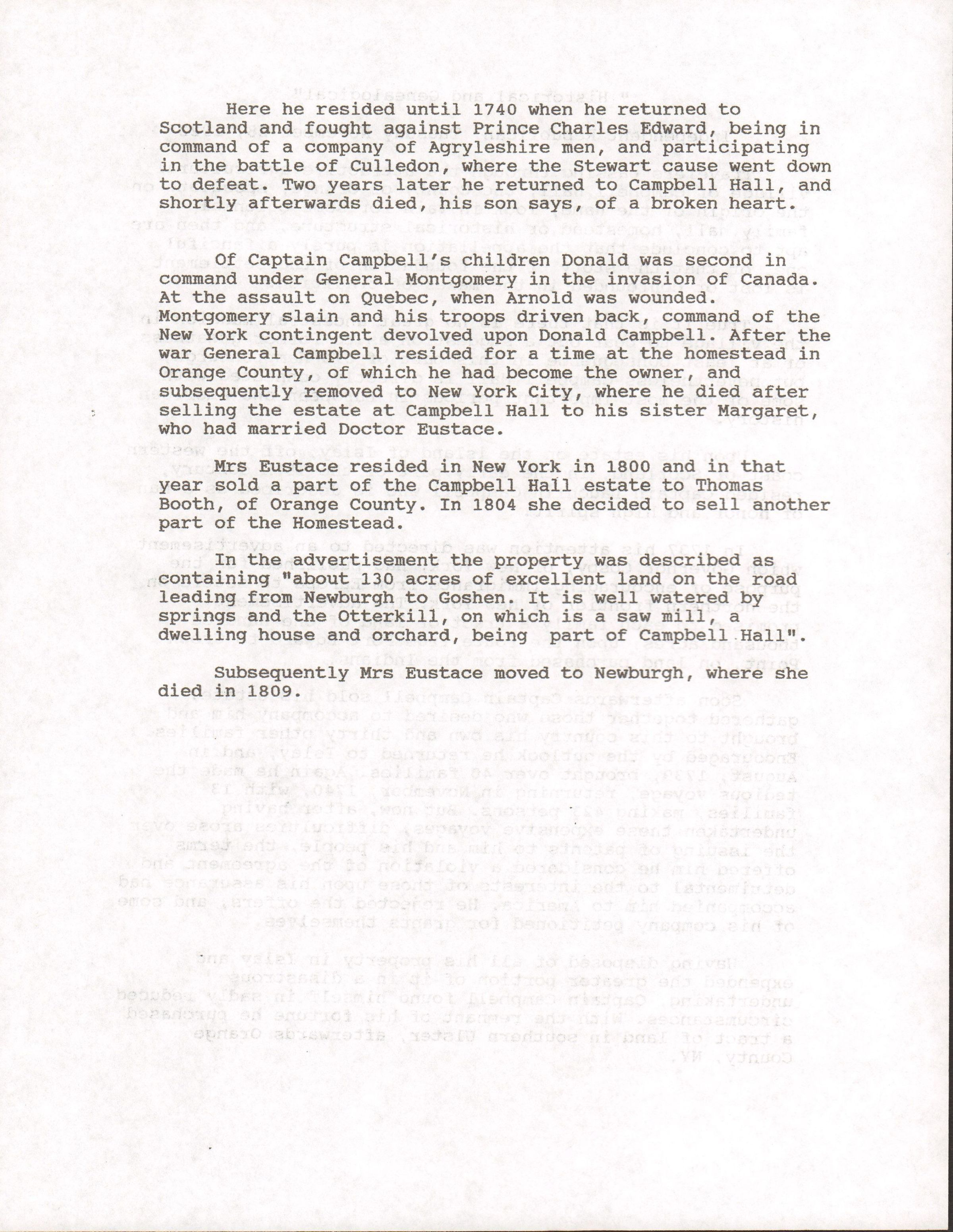
Here he resided until 1740 when he returned to Scotland and fought against Prince Charles Edward, being in command of a company of Agryleshire men, and participating in the battle of Culledon, where the Stewart cause went down to defeat. Two years later he returned to Campbell Hall, and shortly afterwards died, his son says, of a broken heart.
Of Captain Campbell’s children Donald was second in command under General Montgomery in the invasion of Canada. At the assault on Quebec, when Arnold was wounded. Montgomery slain and his troops driven back, command of the New York contingent devolved upon Donald Campbell. After the war General Campbell resided for a time at the homestead in Orange County, of which he had become the owner, and subsequently removed to New York City, where he died after selling the estate at Campbell Hall to his sister Margaret, who had married Doctor Eustace.
Mrs Eustace resided in New York in 1800 and in that year sold a part of the Campbell Hall estate to Thomas Booth, of Orange County. In 1804 she decided to sell another part of the Homestead.
In the advertisement the property was described as containing "about 130 acres of excellent land on the road leading from Newburgh to Goshen. It is well watered by springs and the Otterkill, on which is a saw mill, a dwelling house and orchard, being part of Campbell Hall".
Subsequently Mrs Eustace moved to Newburgh, where she died in 1809.Relationships
Related Person or Organization
Person or Organization
Genealogy