Name/Title
Jesse Booth historic home newspaper article Jan 30, 1926Entry/Object ID
000236Tags
Jesse BoothScope and Content
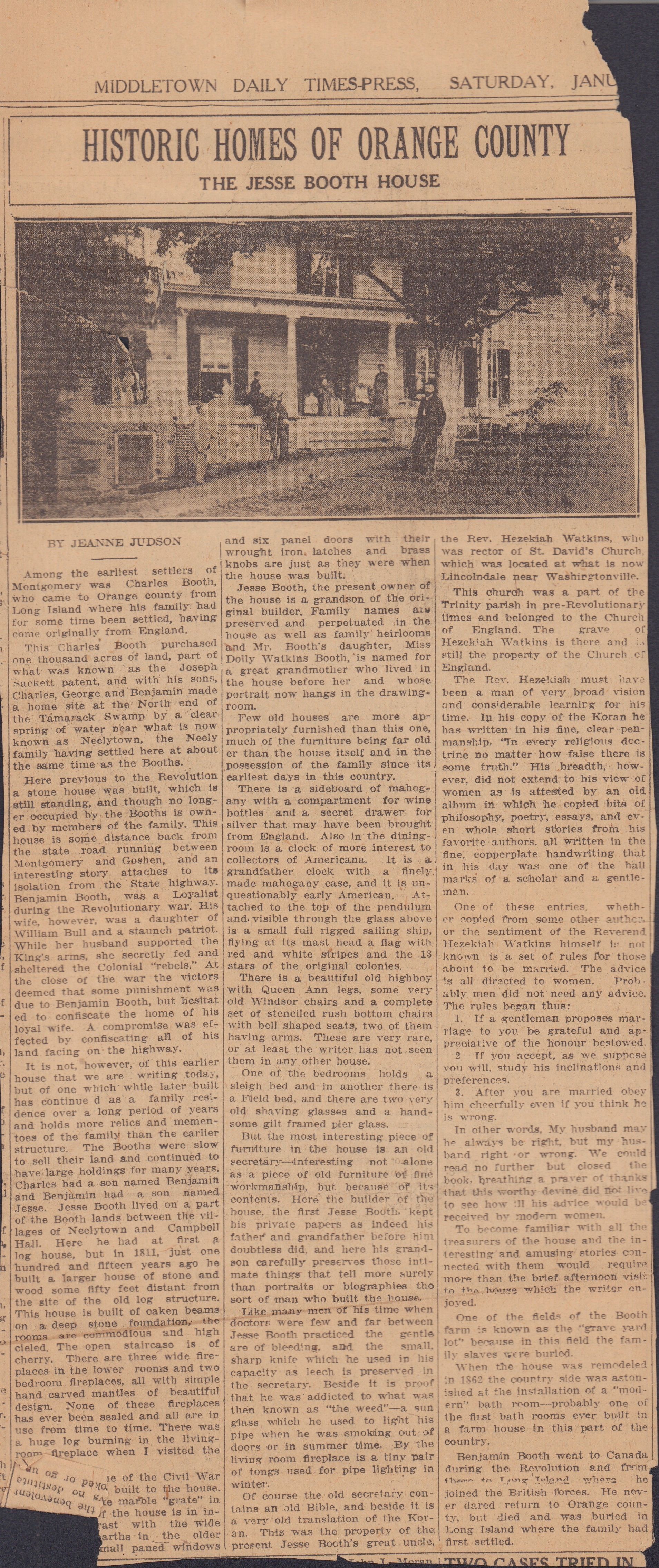
MIDDLETOWN DAILY TIMES-PRESS, SATURDAY, JANUARY ? HISTORIC HOMES OF ORANGE COUNTY THE JESSE BOOTH HOUSE
BY JEANNE JUDSON
Among the earliest settlers of Montgomery was Charles Booth, who came to Orange county from Long Island where his family had for some time been settled, having come originally from England.
This Charles Booth purchased one thousand acres of land, part of what was known as the Joseph Sackett patent, and with his sons, Charles, George and Benjamin made a home site at the North end of the Tamarack Swamp by a clear spring of water near what is now known as Neelytown, the Neely family having settled here at about the same time as the Booths.
Here previous to the Revolution a stone house was built, which is still standing, and though no long- er occupied by the Booths is owned by members of the family. This house is some distance back from the state road running between Montgomery and Goshen, and an interesting story attaches to its isolation from the State highway. Benjamin Booth, was a Loyalist during the Revolutionary war. His wife, however, was a daughter of William Bull and a staunch patriot. While her husband supported the King's arms, she secretly fed and sheltered the Colonial "rebels." At the close of the war the victors deemed that some punishment was due to Benjamin Booth, but hesitated to confiscate the home of his loyal wife. A compromise was effected by confiscating all of his land facing on the highway.
It is not, however, of this earlier house that we are writing today, but of one which while later built has continue d as a family residence over a long period of years and holds more relics and mementoes of the family than the earlier structure. The Booths were slow to sell their land and continued to have large holdings for many years. Charles had a son named Benjamin and Benjamin had a son named Jesse. Jesse Booth lived on a part of the Booth lands between the villages of Neelytown and Campbell Hall. Here he had at first a log house, but in 1811, just one hundred and fifteen years ago he built a larger house of stone and wood some fifty feet distant from the site of the old log structure. This house is built of oaken beams on a deep stone foundation, the rooms are commodious and high ceiled. The open staircase is of cherry. There are three wide fire- places in the lower rooms and two bedroom fireplaces, all with simple hand carved mantles of beautiful design. None of these fireplaces has ever been sealed and all are in use from time to time. There was a huge log burning in the living- room fireplace when I visited the [cut off/inverted text at bottom left]
house ... ie of the Civil War ... built to the house. marble "grate" in ... the house is in in contrast with the wide hearths in the older walled paned windows and six panel doors with their wrought iron latches and brass
knobs are just as they were when the house was built.
Jesse Booth, the present owner of the house is a grandson of the original builder. Family names are preserved and perpetuated in the house as well as family heirlooms and Mr. Booth's daughter, Miss Dolly Watkins Booth, is named for a great grandmother who lived in the house before her and whose
portrait now hangs in the drawing-room. Few old houses are more appropriately furnished than this one, much of the furniture being far old-
er than the house itself and in the possession of the family since its
earliest days in this country. There is a sideboard of mahogany with a compartment for wine bottles and a secret drawer for silver that may have been brought from England. Also in the dining-room is a clock of more interest to collectors of Americana. It is a grandfather clock with a finely
made mahogany case, and it is unquestionably early American. Attached to the top of the pendulum and visible through the glass above is a small full rigged sailing ship, flying at its mast head a flag with red and white stripes and the 13 stars of the original colonies.
There is a beautiful old highboy with Queen Ann legs, some very Old Windsor chairs and a complete set of stenciled rush bottom chairs with bell shaped seats, two of them having arms. These are very rare, or at least the writer has not seen them in any other house.
One of the bedrooms holds a sleigh bed and in another there is a Field bed, and there are two very old shaving glasses and a handsome gilt framed pier glass.
But the most interesting piece of furniture in the house is an old
secretary-interesting not alone as a piece of old furniture of fine
workmanship, but because of its contents. Here the builder of the
house, the first Jesse Booth, kept his private papers as indeed his
father and grandfather before him doubtless did, and here his grandson carefully preserves those intimate things that tell more surely
than portraits or biographies the sort of man who built the house.
Like many men of his time when doctors were few and far between
Jesse Booth practiced the gentle are of bleeding, and the small,
sharp knife which he used in his capacity as leech is preserved in
the secretary. Beside it is proof that he was addicted to what was
then known as "the weed"-a sun glass which he used to light his
pipe when he was smoking out of doors or in summer time. By the
living room fireplace is a tiny pair of tongs used for pipe lighting in
winter.
Of course the old secretary contains an old Bible, and beside it is
a very old translation of the Koran. This was the property of the
present Jesse Booth's great uncle,
the Rev. Hezekiah Watkins, who was rector of St. David's Church,
which was located at what is now Lincolndale near Washingtonville.
This church was a part of the Trinity parish in pre-Revolutionary
times and belonged to the Church of England. The grave of
Hezekiah Watkins is there and is still the property of the Church of
England.
The Rev. Hezekiah must have been a man of very broad vision
and considerable learning for his time. In his copy of the Koran he
has written in his fine, clear penmanship, "In every religious doc-
trine no matter how false there is some truth." His breadth, how-
ever, did not extend to his view of women as is attested by an old
album in which he copied bits of philosophy, poetry, essays, and even whole short stories from his favorite authors, all written in the fine, copperplate handwriting that in his day was one of the hall marks of a scholar and a gentleman.
One of these entries, whether copied from some other author
or the sentiment of the Reverend Hezekiah Watkins himself is not
known is a set of rules for those about to be married. The advice
is all directed to women. Probably men did not need any advice.
The rules began thus:
If a gentleman proposes marriage to you be grateful and appreciative of the honour bestowed.
If you accept, as we suppose you will, study his inclinations and
preferences.
After you are married obey him cheerfully even if you think he
is wrong.
In other words, My husband may he always be right, but my husband right or wrong. We could read no further but closed the book, breathing a prayer of thanks that this worthy divine did not live to see how ill his advice would be
received by modern women.
To become familiar with all the treasurers of the house and the interesting and amusing stories connected with them would require
more than the brief afternoon visit to the house which the writer enjoyed.
One of the fields of the Booth farm is known as the "grave yard
lot" because in this field the family slaves were buried.
When the house was remodeled in 1862 the country side was astonished at the installation of a "modern" bath room-probably one of the first bath rooms ever built in a farm house in this part of the country.
Benjamin Booth went to Canada during the Revolution and from
there to Long Island where he joined the British forces. He never dared return to Orange county, but died and was buried in Long Island where the family had first settled.Relationships
Related Person or Organization
Person or Organization
Jesse Booth