Name/Title
Letter from Mrs. Odell Mapes I think about history of areaEntry/Object ID
000166Tags
Odell MapesSubject
Page 1
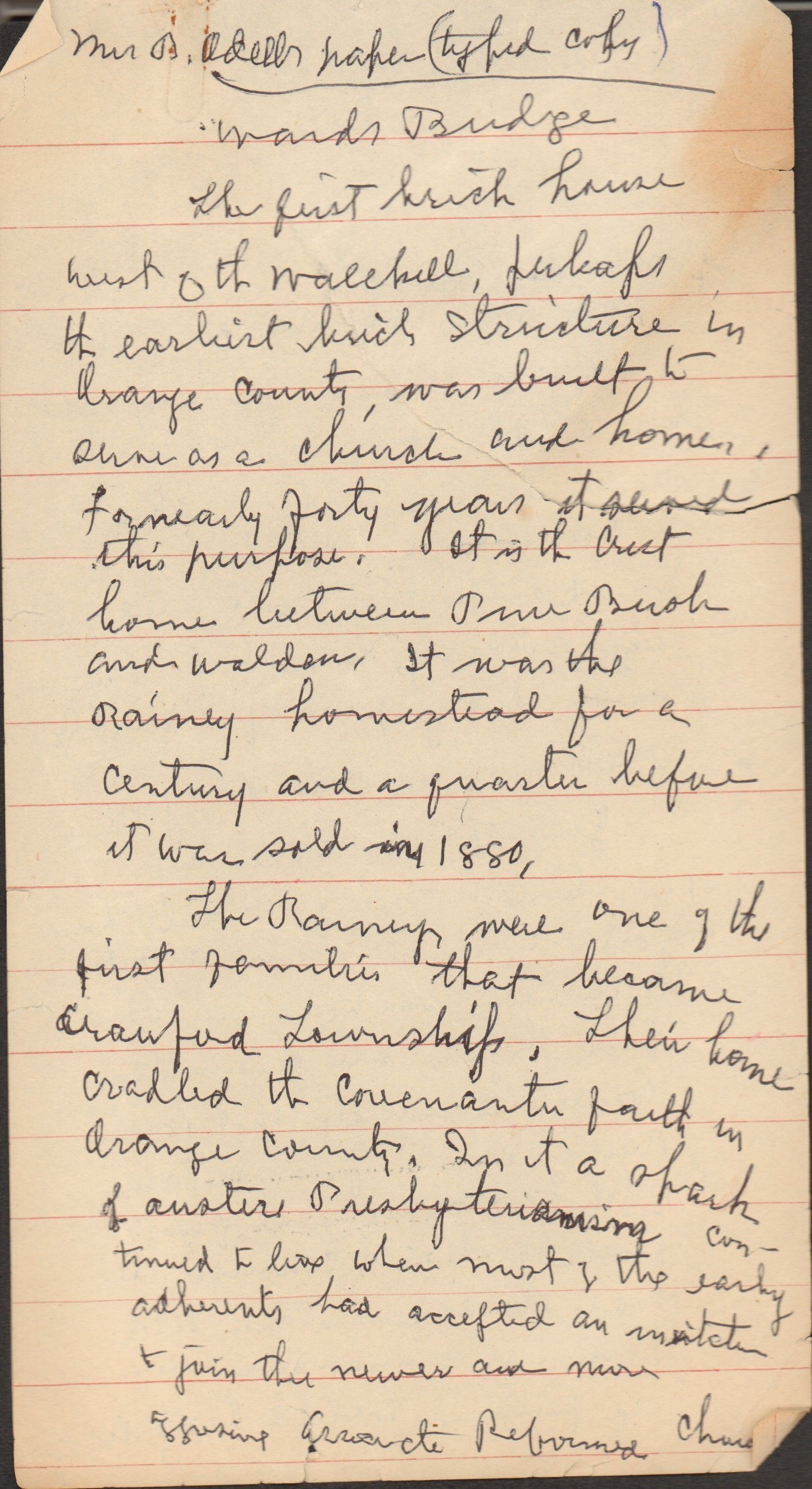
Mrs B. Odell’s paper (typed copy)
Wards Bridge
The first brick house west of the Wallkill, perhaps the earliest brick structure in Orange County, was built to serve as a church and home. For nearly forty years it served this purpose. It is the erect home between Pine Bush and Walden. It was the Rainey homestead for a century and a quarter before it was sold in 1880.
The Raineys were one of the first families that became Crawford Township. Their home cradled the Covenanter faith in Orange County. In it a spark of austere Presbyterianism continued to live when most of the early adherents had accepted an invitation to join the newer and more aggressive Associate Reformed Church.
Page 2
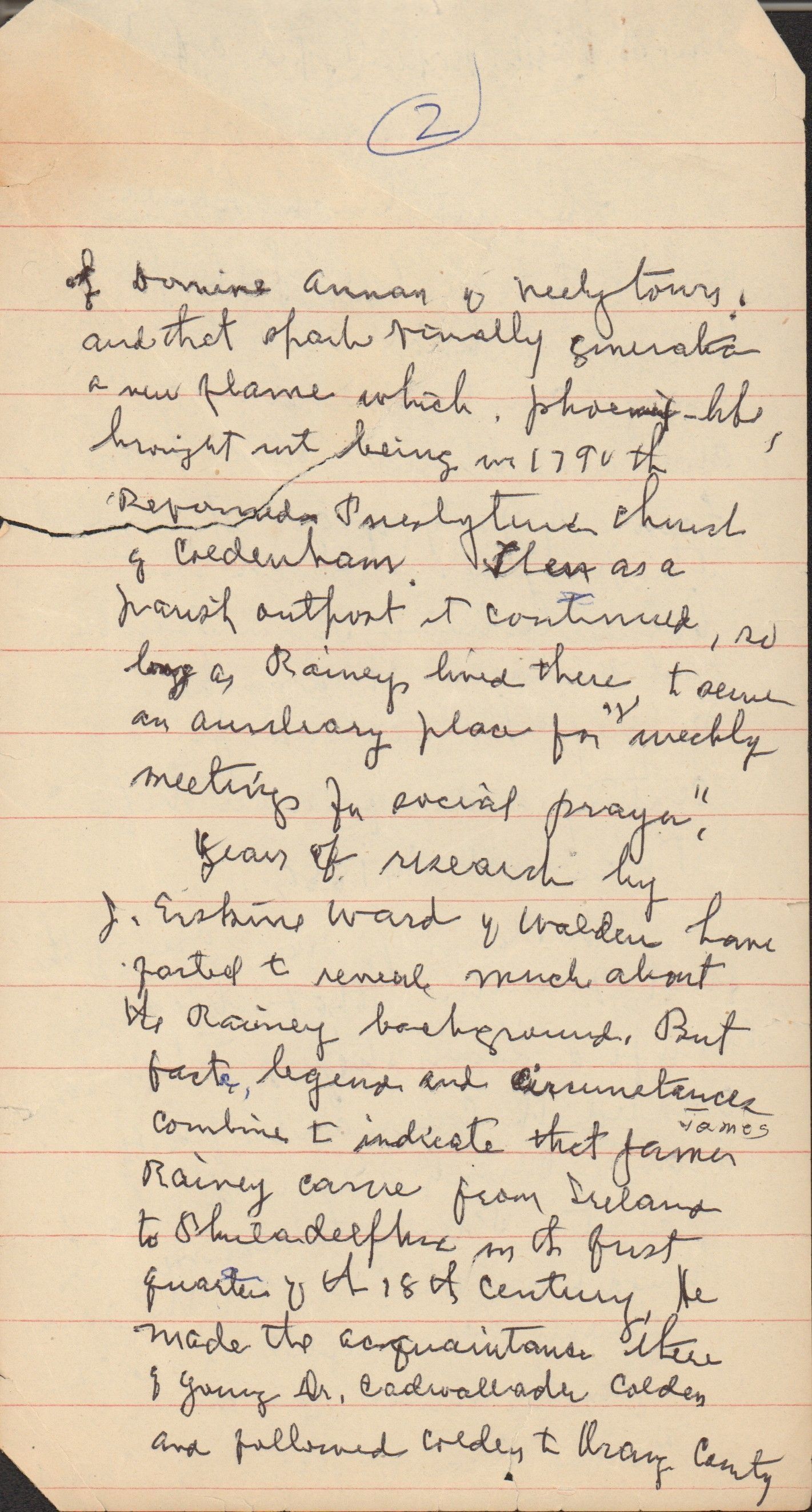
of Domine Annan & Neelytown, and that spark visually generated a new flame which, phoenix-like, brought into being in 1790 the Reformed Presbyterian Church of Coldenham. Then as a parish outpost it continued, so long as Rainey lived there, to serve an auxiliary place for "weekly meetings for social prayer."
Years of research by J. Erskine Ward of Walden have failed to reveal much about the Rainey background. But facts, legends and circumstances combine to indicate that James
Rainey came from Ireland to Philadelphia in the first quarter of the 18th Century. He made the acquaintance there of young Dr. Cadwallader Colden and followed Colden to Orange County
Page 3
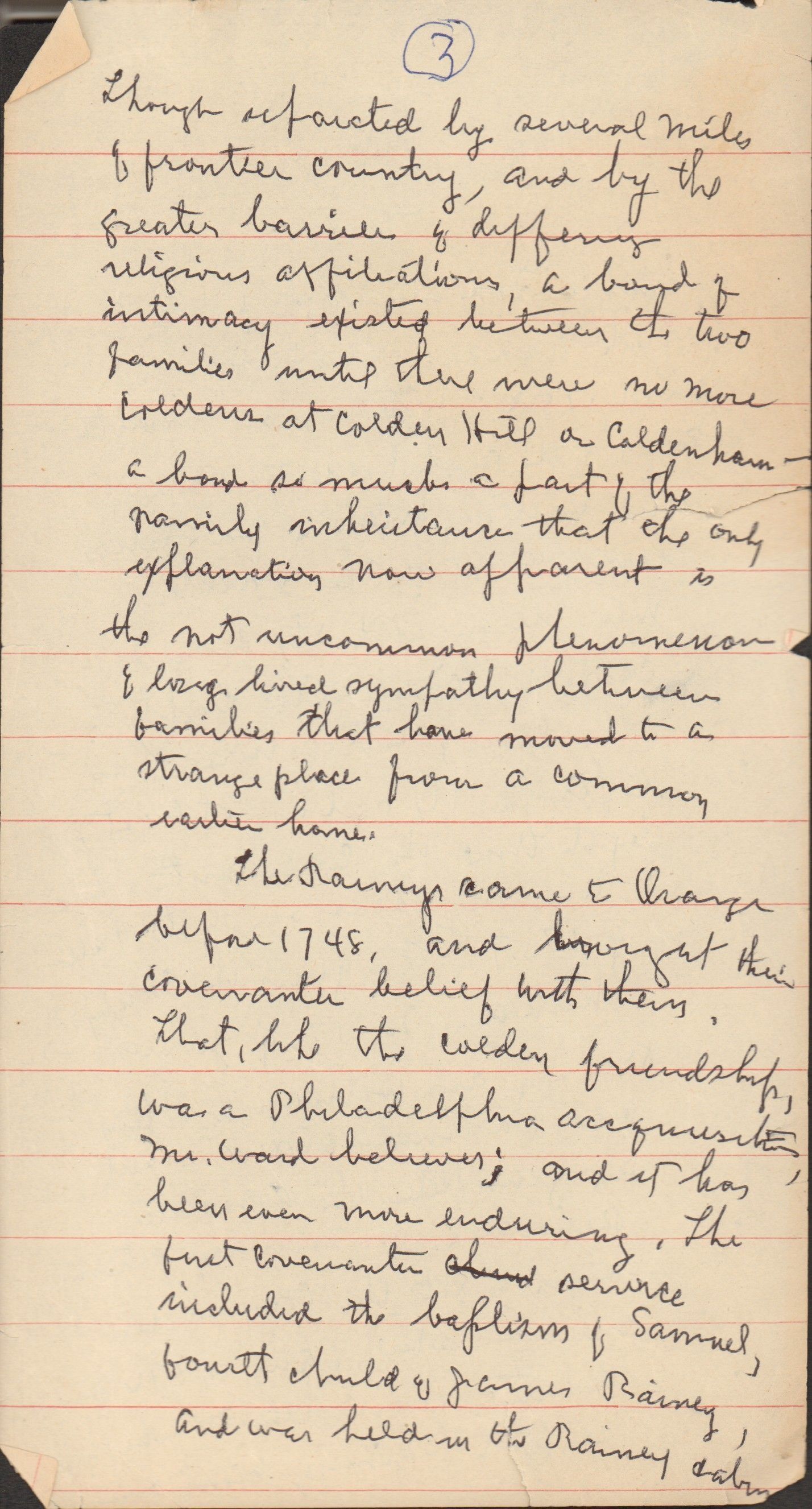
Though separated by several miles of frontier country, and by the greater barrier of differing religious affiliations, a bond of intimacy existed between the two families until there were no more Coldens at Colden Hill or Coldenham—a bond so much a fact of the family inheritance that the only explanation now apparent is the not uncommon phenomenon of long-lived sympathy between families that have moved to a strange place from a common earlier home.
The Raineys came to Orange before 1748, and brought their Covenanter belief with them. That, like the Colden friendship, was a Philadelphia acquisition, Mr. Ward believes; and it has been even more enduring. The first Covenanter church service included the baptism of Samuel, fourth child of James Rainey, and was held in the Rainey cabin.
Page 4
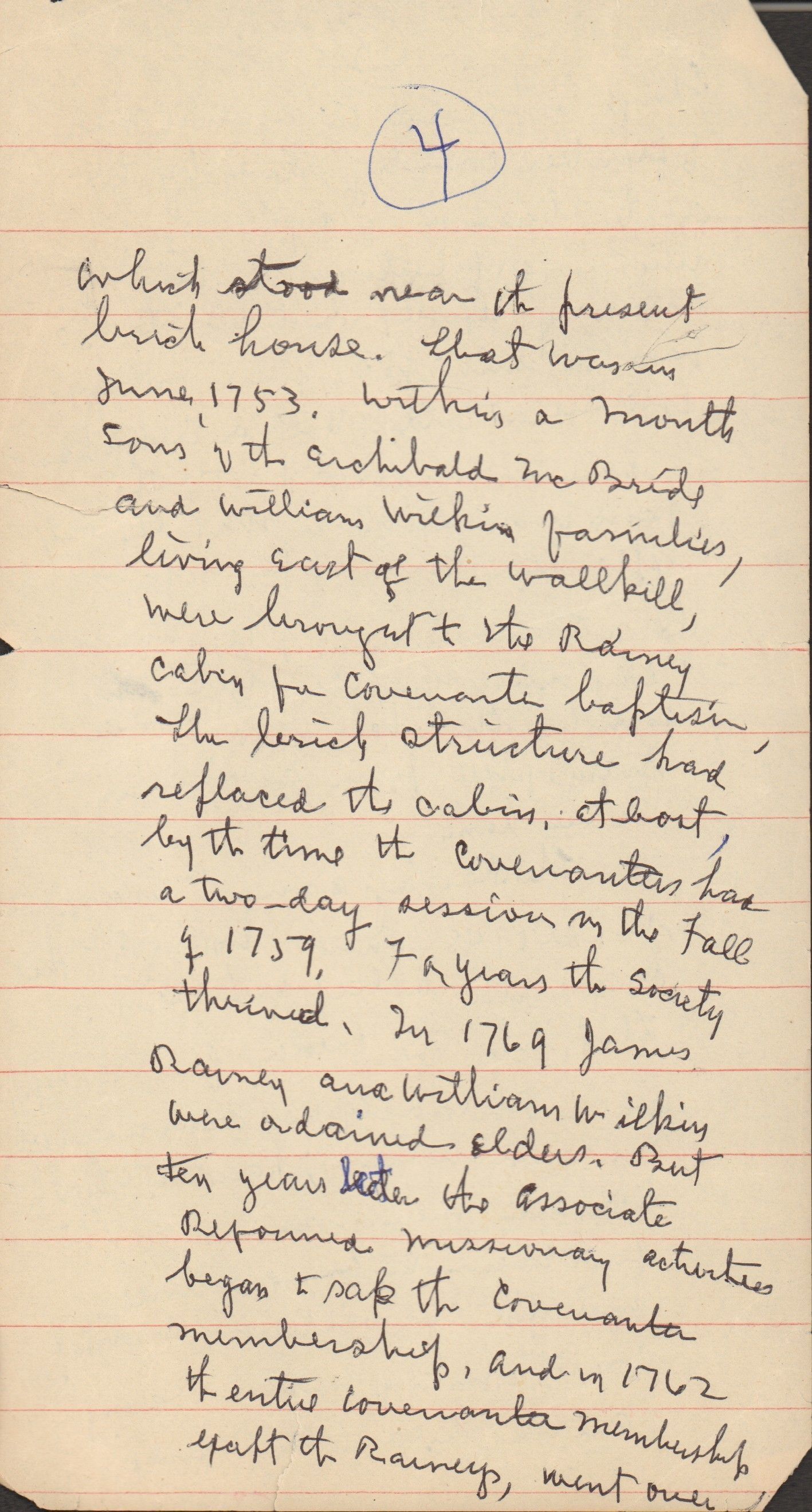
which stood near the present brick house. That was in June, 1753. Within a month sons of the Archibald McBride and William Wilkin families, living east of the Wallkill, were brought to the Rainey cabin for Covenanter baptism. The brick structure had replaced the cabin, at least, by the time the Covenanters had a two-day session in the fall
of 1759. For years the society thrived. In 1769 James Rainey and William Wilkin were ordained elders. But ten years later the Associate Reformed missionary activities
began to sap the Covenanter membership, and in 1782 the entire Covenanter membership except the Raineys, went over
Page 5
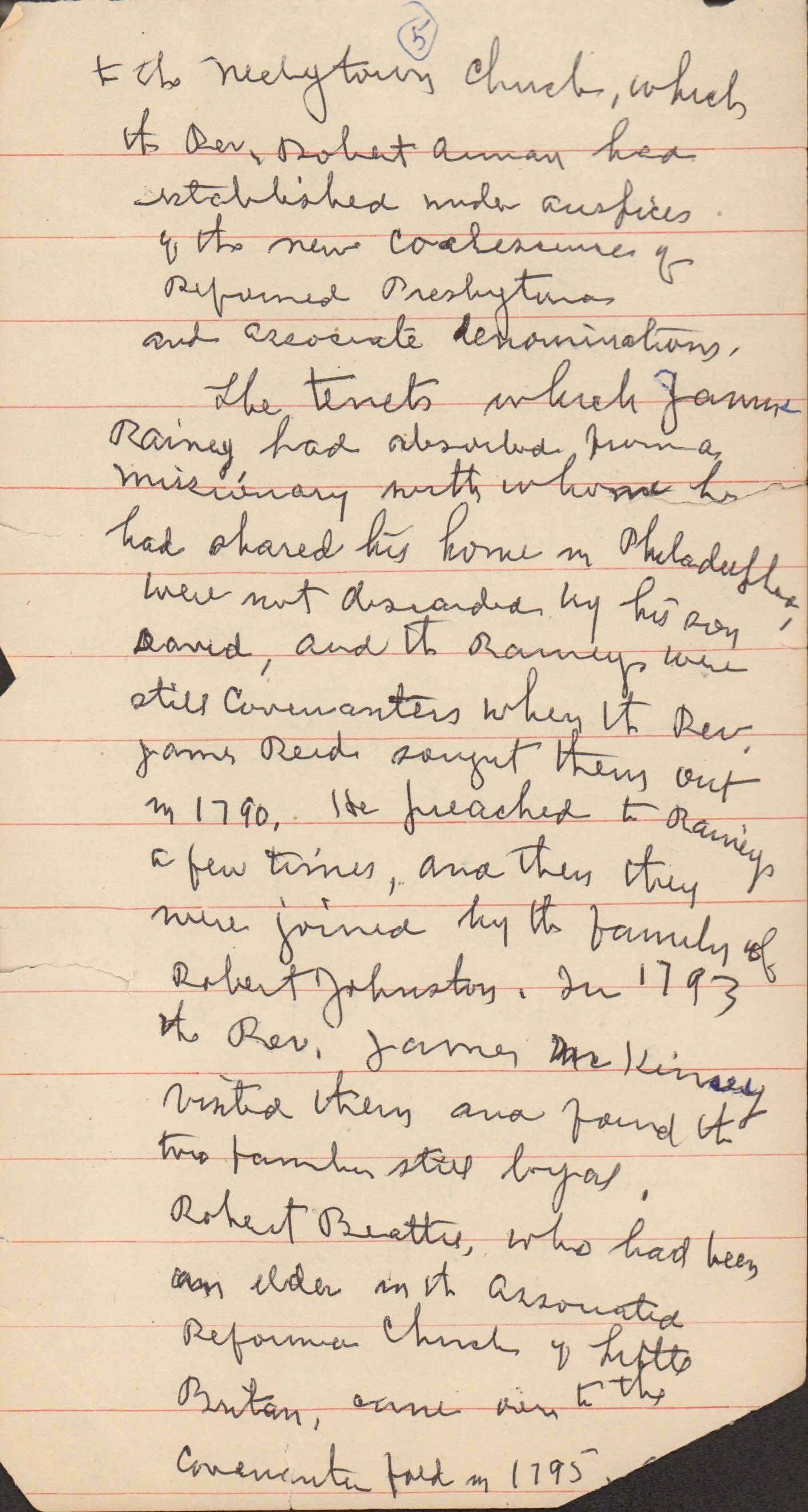
to the Neelytown Church, which the Rev. Robert Annan had established under auspices of the new conference of Reformed Presbyterians and associate denominations.
The tenets which James Rainey had absorbed from a missionary with whom he had shared his home in Philadelphia were not discarded by his son David, and the Raineys were
still Covenanters when the Rev. James Reid sought them out in 1790. He preached to Raineys a few times, and then they were joined by the family of Robert Johnston. In 1793
the Rev. James McKinney visited them and found the two families still loyal.
Robert Beattie, who had been an elder in the Associated Reformed Church of Little Britain, came over to the Covenanter fold in 1795.
Page 6
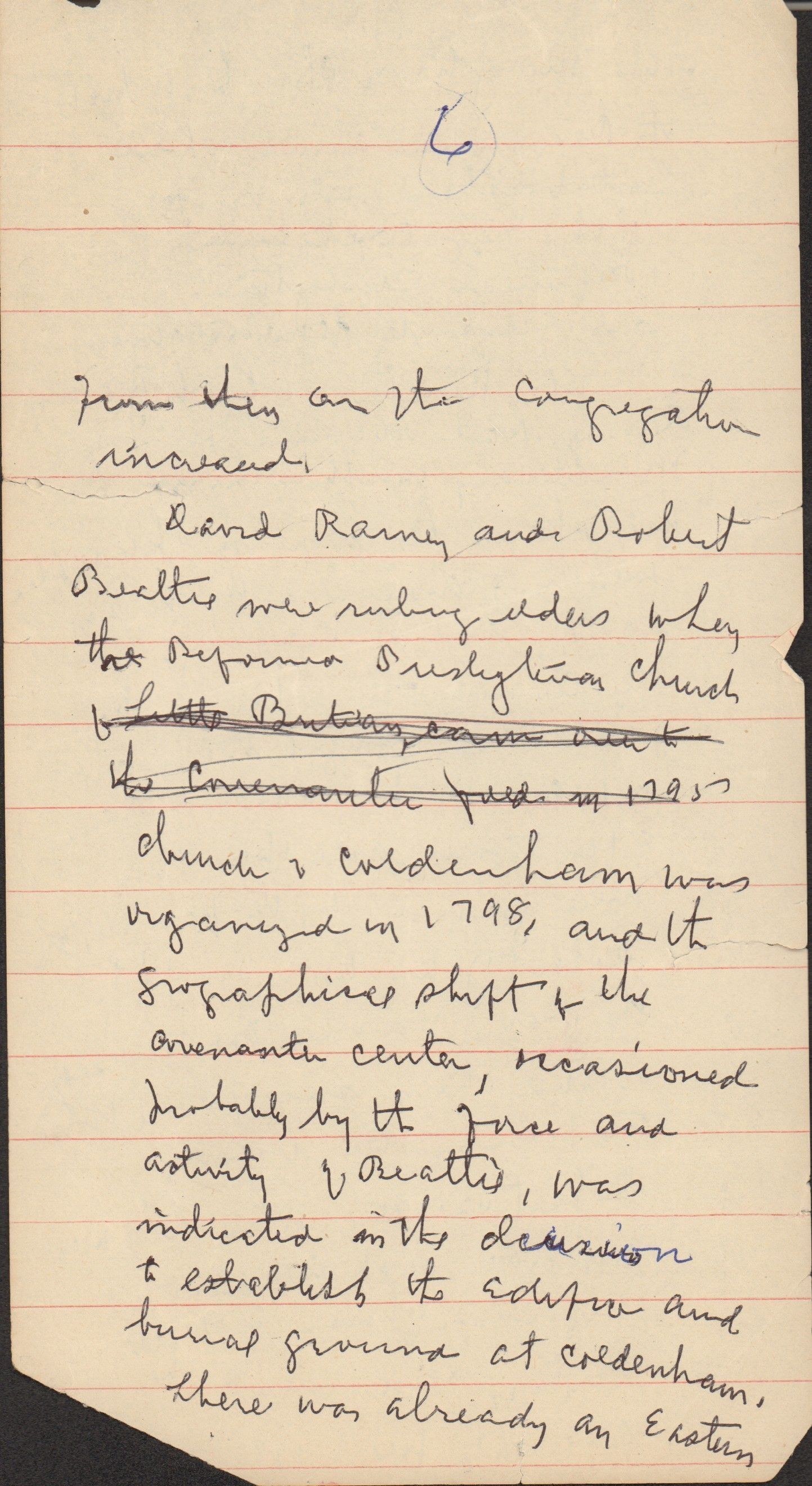
from then on the congregation increased. David Rainey and Robert Beattie were ruling elders when the Reformed Presbyterian church ~~of Little Britain came into~~ the Covenanter fold in 1795.
Church of Coldenham was organized in 1798, and the geographical shift of the Covenanter center, occasioned probably by the force and activity of Beattie, was indicated in the decision to establish the edifice and burial ground at Coldenham.
There was already an Eastern
Page 7
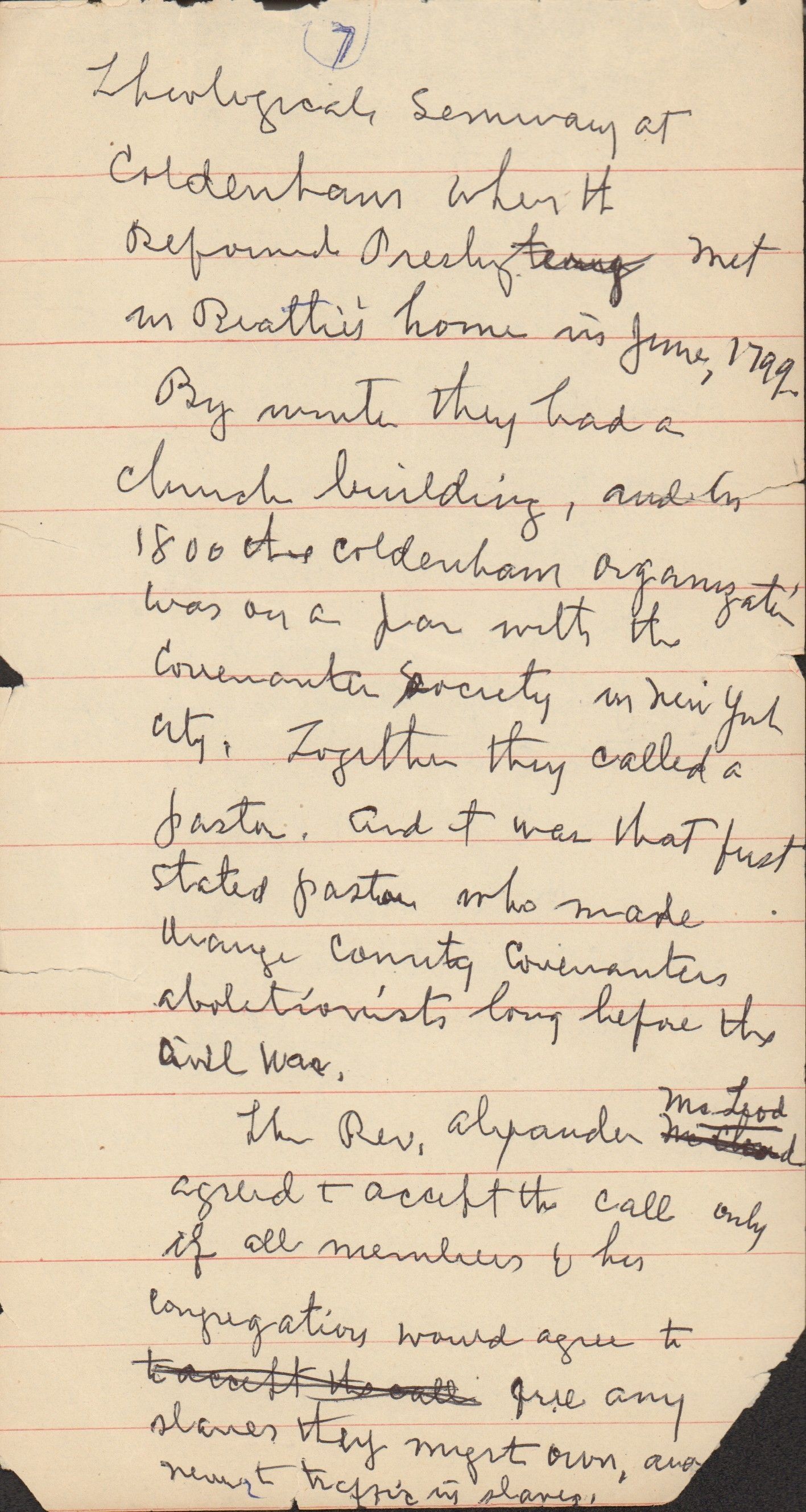
Theological Seminary at Coldenham when the Reformed Presbyterians met in Beattie’s home in June, 1798.
By winter they had a church building, and by 1800 the Coldenham organization was on a par with the Covenanter Society in New York City. Together they called a pastor. And it was that first stated pastor who made Orange County Covenanters abolitionists long before the Civil War.
The Rev. Alexander McLeod [name corrected from McLeod] agreed to accept the call only if all members of his congregation would agree to ~~accept the call~~ free any
slaves they might own, and never traffic in slaves.
Page 8
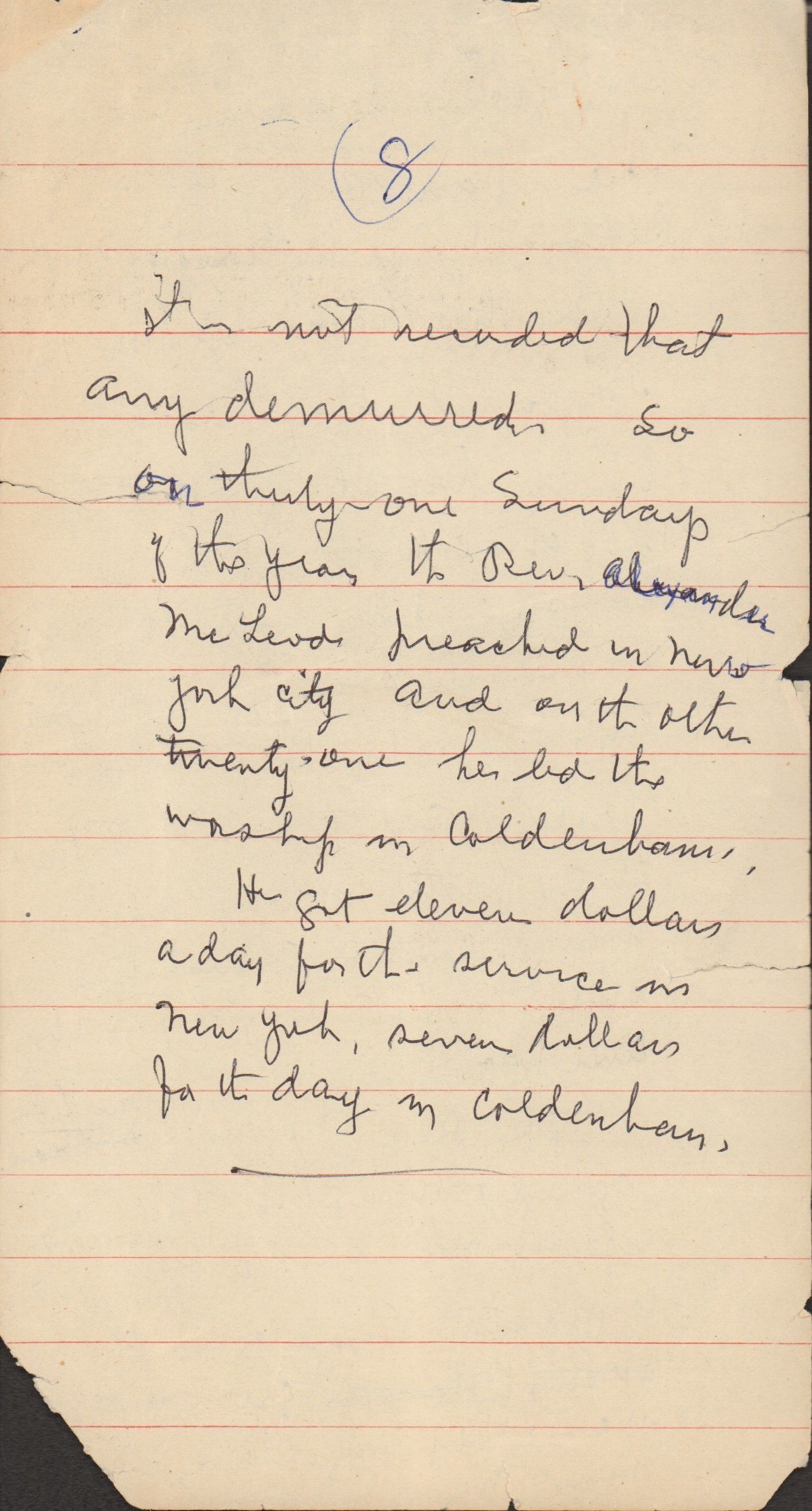
It is not recorded that any demurred, so on thirty-one Sundays of the year the Rev. Alexander McLeod preached in New York City and on the other twenty-one he led the worship in Coldenham.
He got eleven dollars a day for the service in New York, seven dollars for the day in Coldenham.
Page 9
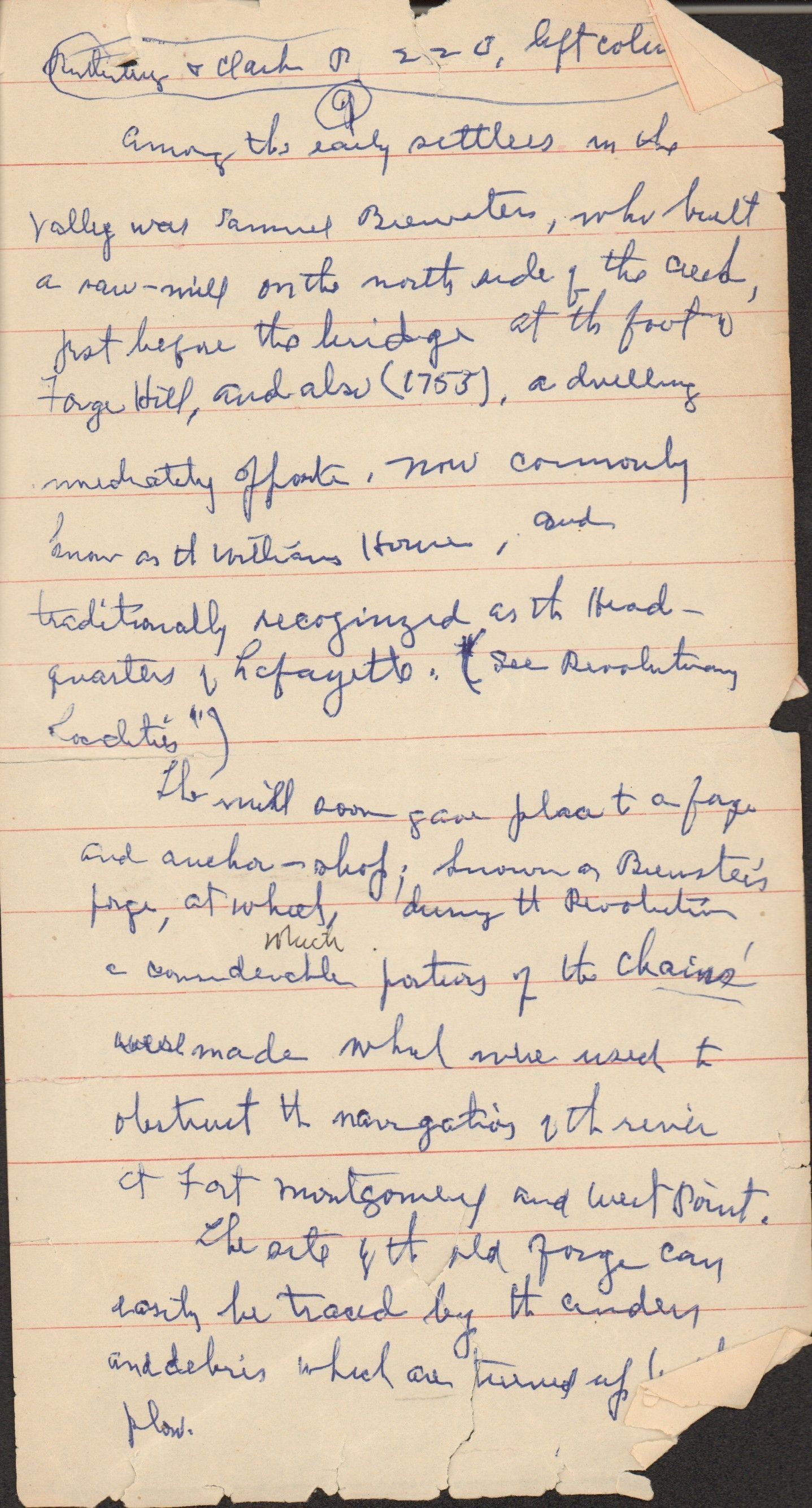
Ruttenber & Clark p. 228, left colm.
[¶ symbol] Among the early settlers in the valley was Samuel Brewster, who built a saw-mill on the north side of the creek, just before the bridge at the foot of Forge Hill, and also (1755), a dwelling immediately opposite, now commonly known as the Williams House, and traditionally recognized as the Headquarters of Lafayette. (“See Revolutionary Localities”)
The mill soon gave place to a forge and anchor-shop; known as Brewster’s forge, at what, during the Revolution a considerable much portion of the chains were made which were used to obstruct the navigation of the river at Fort Montgomery and West Point.
The site of the old forge can easily be traced by the cinders and debris which are turned up [by the] plow.
Page 10
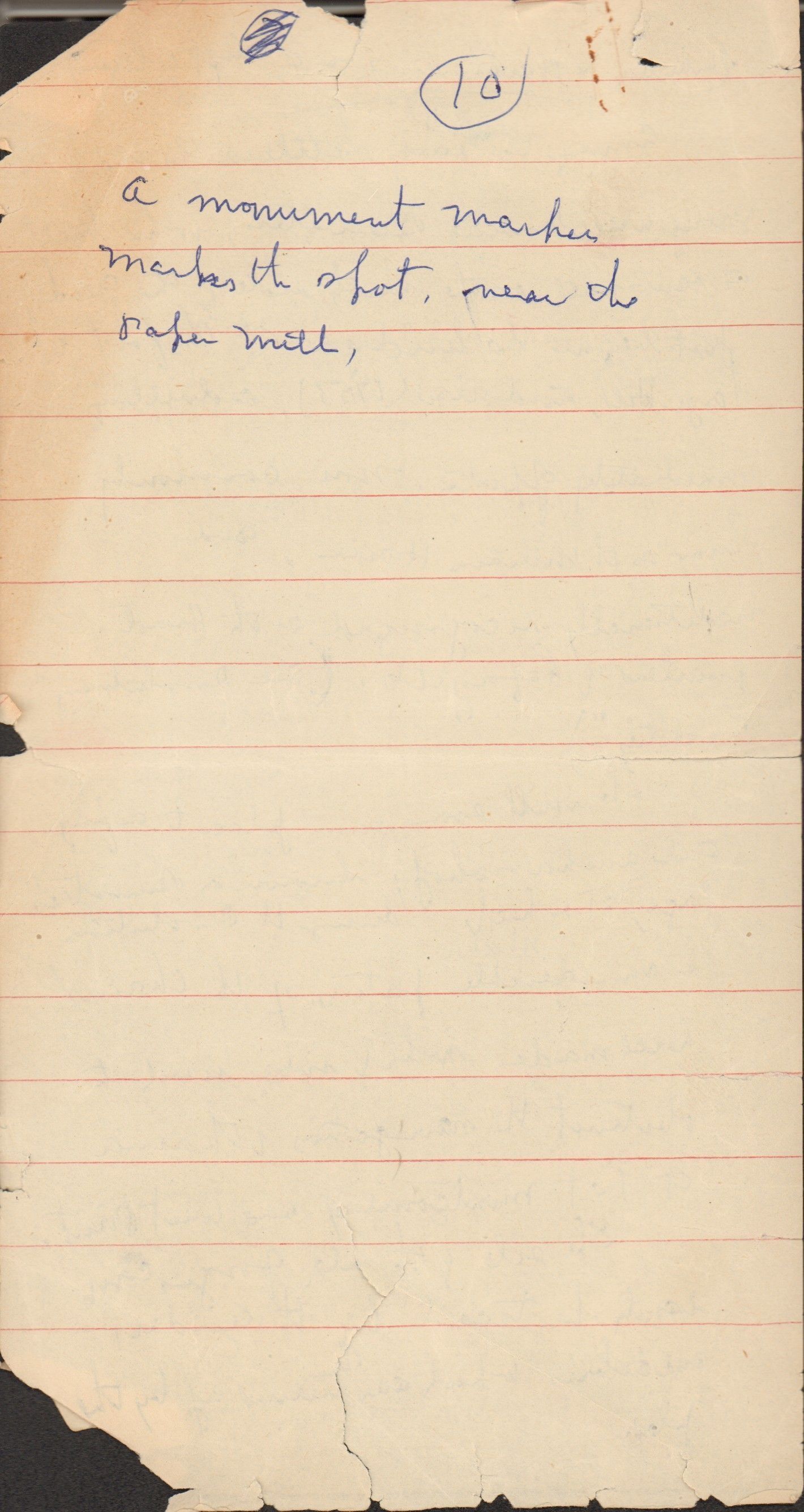
A monument marker marks the spot, near the paper mill,Relationships
Related Person or Organization
Person or Organization
Odell Mapes