Name/Title
Newspaper 1950 The Gleaner by Mildred Parker SeeseEntry/Object ID
002751Tags
Daniel CrommelinScope and Content
Correction of Local History
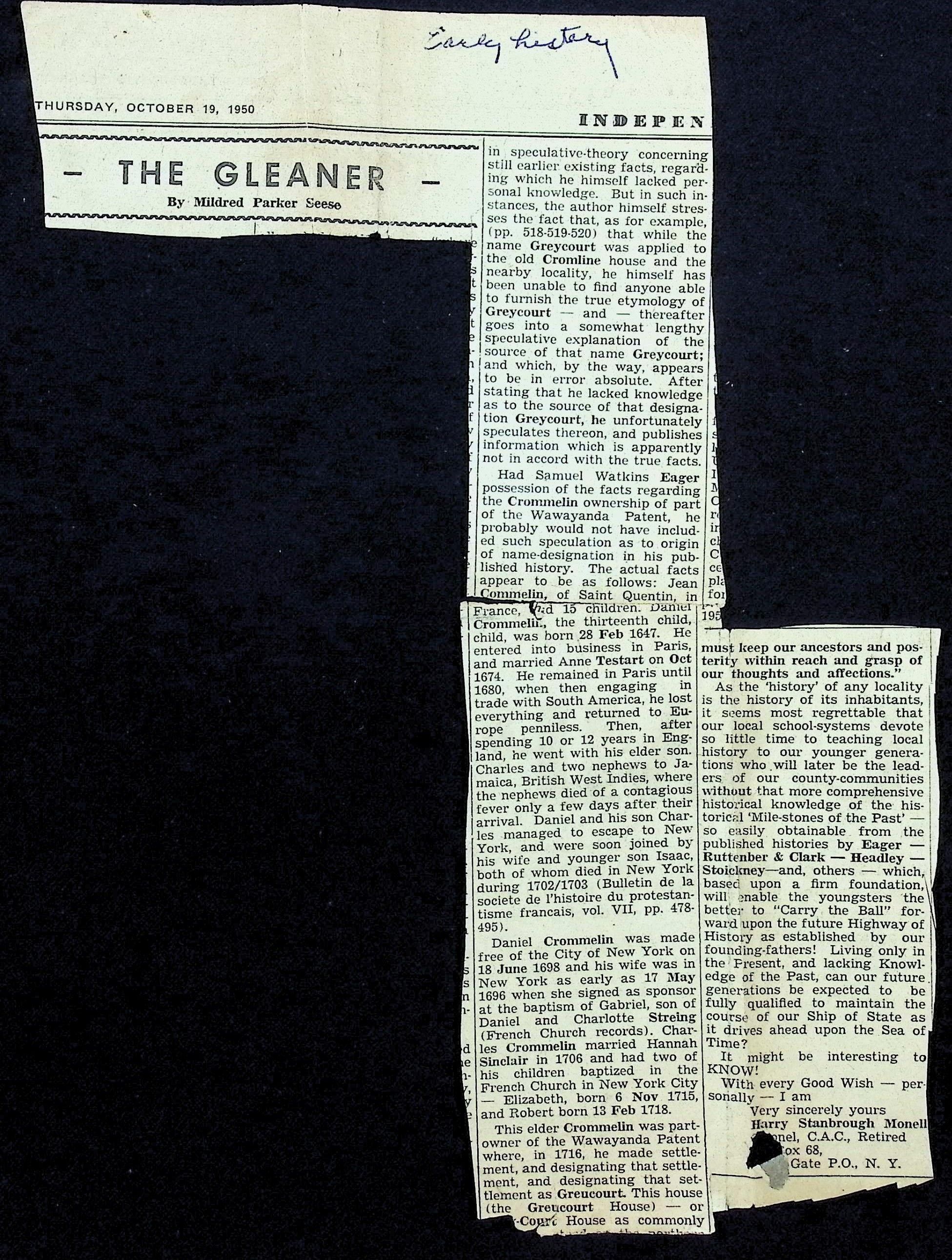
The article features a letter by Harry Stanbrough Monell aimed at correcting historical inaccuracies regarding the origin of the name Greycourt (or Greucourt) and the ownership of the Wawayanda Patent. Monell argues that a previously published history by Samuel Watkins Eager contains errors based on pure speculation rather than fact.
The Crommelin Family History
Monell provides the actual genealogical and historical facts regarding the Crommelin family, who were the true historical figures tied to the land:
Origins: Jean Crommelin of Saint Quentin, France, had 15 children. His thirteenth child, Daniel Crommelin, was born on February 28, 1647.
Hardships: Daniel went into business in Paris and married Anne Testart in 1674. After losing everything in trade with South America around 1680, he fled to Europe penniless. He spent 10 to 12 years in England before traveling to Jamaica with his son Charles and two nephews. The nephews quickly died of a contagious fever upon arrival.
Arrival in New York: Daniel and Charles escaped to New York, where they were later joined by Daniel's wife and younger son, Isaac. Both Daniel and Isaac died in New York between 1702 and 1703.
The Next Generation: Daniel's son, Charles Crommelin, married Hannah Sinclair in 1706. They had two children, Elizabeth (born 1715) and Robert (born 1718), both baptized in the French Church in New York City.
Establishment of Greycourt
The elder Daniel Crommelin was a part-owner of the Wawayanda Patent. In 1716, a settlement was made on this land, which he designated as Greucourt (later known as the Greycourt House or Court House).
Value of Local History
Monell concludes his letter with a plea for local school systems to devote more time to teaching local history to younger generations. He argues that a strong foundational knowledge of local history—derived from reliable historians like Eager, Ruttenber, Clark, Headley, and Stickney—is essential for preparing future leaders.